Gil-Perez Angela, Montalban-Bravo Guillermo
University Hospital of Guadalajara, Guadalajara, Spain.
Department of Leukemia, University of Texas, MD Anderson Cancer Center, 1515 Holcombe Blvd, Houston, TX 77015, USA.
Ther Adv Hematol. 2019 May 9;10:2040620719847059. doi: 10.1177/2040620719847059. eCollection 2019.
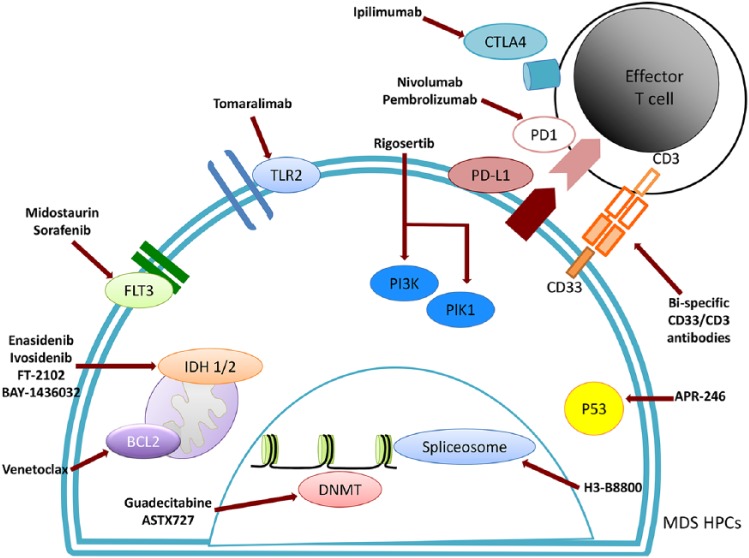
Hypomethylating agents (HMAs) are the standard of care for patients with myelodysplastic syndrome (MDS). However, only around 50% of patients respond to these agents, and responses tend to be transient, with loss of response frequently happening within 2 years and being associated with very poor prognosis and limited therapeutic options. Identification of patients who will respond to HMAs is challenging. Mechanisms underlying resistance to HMAs are not clear yet. Recently, absence of response has been associated with increased cell-cycle quiescence among the hematopoietic progenitor cells. There are no standard-of-care options for patients after HMA failure. However, the increasing knowledge of MDS pathogenesis has led to the development of new potential therapies, including HMAs with longer half-life and exposure, inhibition of the antiapoptotic BCL2 protein with venetoclax or inhibition of immune-checkpoint regulatory proteins such as PD-1 or CTLA-4, innate immunity and targeting of CD33/CD3 with multiple monoclonal antibodies. In addition, multiple targeted agents are opening opportunities to treat subgroups of patients whose disease harbors mutations in , and genes involved in splicing machinery. Newer formulations of intensive chemotherapy and its different combinations may be considered a valid option in selected patients after HMA failure. Finally, decision making at the time of failure of response to HMAs should be personalized, taking into account that allogenic stem-cell transplantation remains the only therapeutic approach with curative potential in these patients. In the current review, we will focus on all the above aspects.
去甲基化药物(HMAs)是骨髓增生异常综合征(MDS)患者的标准治疗药物。然而,只有约50%的患者对这些药物有反应,而且反应往往是短暂的,常在2年内失去反应,这与非常差的预后和有限的治疗选择相关。识别对HMAs有反应的患者具有挑战性。对HMAs耐药的潜在机制尚不清楚。最近,无反应与造血祖细胞中细胞周期静止增加有关。对于HMA治疗失败后的患者,没有标准的治疗选择。然而,对MDS发病机制的认识不断增加,已促使开发新的潜在治疗方法,包括半衰期和暴露时间更长的HMAs、用维奈克拉抑制抗凋亡BCL2蛋白或抑制免疫检查点调节蛋白如PD-1或CTLA-4、固有免疫以及用多种单克隆抗体靶向CD33/CD3。此外,多种靶向药物为治疗疾病携带特定基因和参与剪接机制的基因发生突变的患者亚组带来了机会。强化化疗的新配方及其不同组合在HMA治疗失败后的特定患者中可能被视为一种有效的选择。最后,在对HMAs治疗无反应时的决策应个体化,同时考虑到异基因干细胞移植仍然是这些患者中唯一具有治愈潜力的治疗方法。在本综述中,我们将聚焦于上述所有方面。