Bochner Aaron F, Tippett Barr Beth A, Makunike Batsirai, Gonese Gloria, Wazara Blessing, Mashapa Richard, Meacham Elizabeth, Nyika Ponesai, Ncube Gertrude, Balachandra Shirish, Levine Ruth, Petracca Frances, Apollo Tsitsi, Downer Ann, Wiktor Stefan Z
International Training and Education Center for Health (I-TECH), Department of Global Health, University of Washington, Seattle, WA, USA.
Department of Epidemiology, University of Washington, 325 9th Ave, Box 359932, Seattle, WA, 98104, USA.
BMC Health Serv Res. 2019 Jun 3;19(1):351. doi: 10.1186/s12913-019-4169-z.
Expansion of provider-initiated testing and counselling (PITC) is one strategy to increase accessibility of HIV testing services. Insufficient human resources was identified as a primary barrier to increasing PITC coverage in Zimbabwe. We evaluated if deployment of supplemental PITC providers at public facilities in Zimbabwe was associated with increased numbers of individuals tested and diagnosed with HIV.
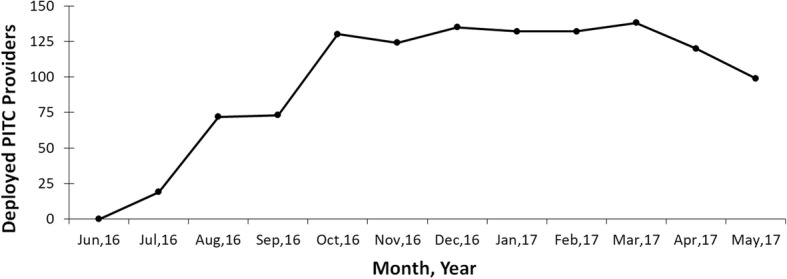
From July 2016 to May 2017, International Training and Education Center for Health (I-TECH) deployed 138 PITC providers to supplement existing ministry healthcare workers offering PITC at 249 facilities. These supplemental providers were assigned to facilities on a weekly basis. Each week, I-TECH providers reported the number of HIV tests and positive diagnoses they performed. Using routine reporting systems, we obtained from each facility the number of clients tested and diagnosed with HIV per month. Including data both before and during the intervention period, and utilizing the weekly variability in placement locations of the supplemental PITC providers, we employed generalized estimating equations to assess if the placement of supplemental PITC providers at a facility was associated with a change in facility outputs.
Supplemental PITC providers performed an average of 62 (SD = 52) HIV tests per week and diagnosed 4.4 (SD = 4.9) individuals with HIV per week. However, using facility reports from the same period, we found that each person-week of PITC provider deployment at a facility was associated with an additional 16.7 (95% CI, 12.2-21.1) individuals tested and an additional 0.9 (95% CI, 0.5-1.2) individuals diagnosed with HIV. We also found that staff placement at clinics was associated with a larger increase in HIV testing than staff placement at polyclinics or hospitals (24.0 vs. 9.8; p < 0.001).
This program resulted in increased numbers of individuals tested and diagnosed with HIV. The discrepancy between the average weekly HIV tests conducted by supplemental PITC providers (62) and the increase in facility-level HIV tests associated with one week of PITC provider deployment (16.7) suggests that supplemental PITC providers displaced existing staff who may have been reassigned to fulfil other duties at the facility.
扩大由医护人员主动提供的检测与咨询服务(PITC)是提高艾滋病毒检测服务可及性的一项策略。人力资源不足被认为是津巴布韦扩大PITC覆盖范围的主要障碍。我们评估了在津巴布韦的公共机构部署补充性PITC服务人员是否与接受检测及被诊断出感染艾滋病毒的人数增加有关。
2016年7月至2017年5月期间,国际卫生培训与教育中心(I-TECH)部署了138名PITC服务人员,以补充在249个机构提供PITC服务的现有卫生部医护人员。这些补充性服务人员每周被分配到各个机构。每周,I-TECH的服务人员报告他们进行的艾滋病毒检测数量和阳性诊断数量。利用常规报告系统,我们从每个机构获取每月接受检测及被诊断出感染艾滋病毒的客户数量。纳入干预期之前及期间的数据,并利用补充性PITC服务人员安置地点的每周变化情况,我们采用广义估计方程来评估在一个机构部署补充性PITC服务人员是否与机构产出的变化有关。
补充性PITC服务人员平均每周进行62次(标准差=52)艾滋病毒检测,每周诊断出4.4例(标准差=4.9)艾滋病毒感染者。然而,根据同一时期各机构的报告,我们发现,在一个机构每部署一个人周的PITC服务人员,会额外增加16.7例(95%置信区间,12.2 - 21.1)接受检测的人员以及0.9例(95%置信区间,0.5 - 1.2)被诊断出感染艾滋病毒的人员。我们还发现,在诊所安置工作人员相比在综合诊所或医院安置工作人员,艾滋病毒检测增加幅度更大(24.0对9.8;p < 0.001)。
该项目使得接受检测及被诊断出感染艾滋病毒的人数增加。补充性PITC服务人员平均每周进行的艾滋病毒检测数量(62次)与部署一周PITC服务人员后机构层面艾滋病毒检测增加数量(16.7例)之间的差异表明,补充性PITC服务人员取代了现有工作人员,而这些现有工作人员可能被重新分配去履行机构的其他职责。