Department of Respiratory Medicine, The Second Affiliated Hospital of Chongqing Medical University, 76 Linjiang Road, Yuzhong District, Chongqing, 400010 China.
Cell Mol Biol Lett. 2019 May 28;24:35. doi: 10.1186/s11658-019-0154-0. eCollection 2019.
Pulmonary edema is one of the pathological characteristics of acute respiratory distress syndrome (ARDS). The epithelial sodium channel (ENaC) is thought to be the rate-limiting factor for alveolar fluid clearance (AFC) during pulmonary edema. The peroxisome proliferator-activated receptor γ (PPARγ) agonist rosiglitazone was shown to stimulate ENaC-mediated salt absorption in the kidney. However, its role in the lung remains unclear. Here, we investigated the role of the PPARγ agonist in the lung to find out whether it can regulate AFC during acute lung injury (ALI). We also attempted to elucidate the mechanism for this.
Our ALI model was established through intratracheal instillation of lipopolysaccharide (LPS) in C57BL/6 J mice. The mice were randomly divided into 4 groups of 10. The control group underwent a sham operation and received an equal quantity of saline. The three experimental groups underwent intratracheal instillation of 5 mg/kg LPS, followed by intraperitoneal injection of 4 mg/kg rosiglitazone, 4 mg/kg rosiglitazone plus 1 mg/kg GW9662, or only equal quantity of saline. The histological morphology of the lung, the levels of TNF-α and IL-1β in the bronchoalveolar lavage fluid (BALF), the level of AFC, and the expressions of αENaC and serum and glucocorticoid-induced kinase-1 (SGK1) were determined. Type 2 alveolar (AT II) cells were incubated with rosiglitazone (15 μM) with or without GW9662 (10 μM). The expressions of αENaC and SGK1 were determined 24 h later.
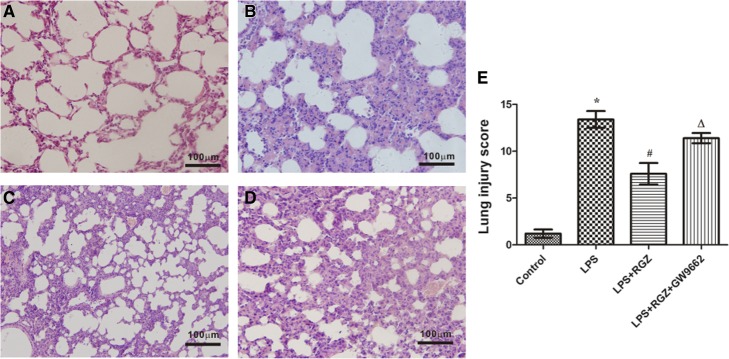
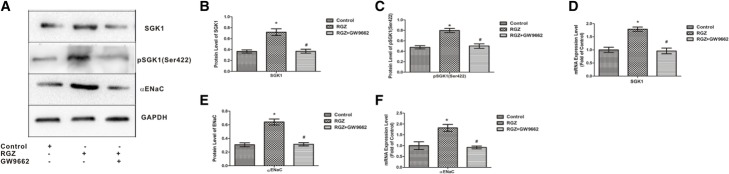
A mouse model of ALI was successfully established. Rosiglitazone significantly ameliorated the lung injury, decreasing the TNF-α and IL-1β levels in the BALF, enhancing AFC, and promoting the expressions of αENaC and SGK1 in ALI mice, which were abolished by the specific PPARγ blocker GW9662. In vitro, rosiglitazone increased the expressions of αENaC and SGK1. This increase was prevented by GW9662.
Rosiglitazone ameliorated the lung injury and promoted ENaC-mediated AFC via a PPARγ/SGK1-dependent signaling pathway, alleviating pulmonary edema in a mouse model of ALI.
肺水肿是急性呼吸窘迫综合征(ARDS)的病理特征之一。上皮钠通道(ENaC)被认为是肺水肿期间肺泡液清除(AFC)的限速因素。过氧化物酶体增殖物激活受体 γ(PPARγ)激动剂罗格列酮被证明可刺激肾脏中 ENaC 介导的盐吸收。然而,其在肺部的作用尚不清楚。在这里,我们研究了 PPARγ 激动剂在肺部的作用,以了解它是否可以调节急性肺损伤(ALI)期间的 AFC。我们还试图阐明其机制。
我们通过气管内滴注脂多糖(LPS)在 C57BL/6J 小鼠中建立 ALI 模型。将小鼠随机分为 4 组,每组 10 只。对照组接受假手术并接受等量生理盐水。三个实验组气管内滴注 5mg/kg LPS,然后腹腔内注射 4mg/kg 罗格列酮、4mg/kg 罗格列酮加 1mg/kg GW9662 或仅等量生理盐水。观察肺组织形态学、支气管肺泡灌洗液(BALF)中 TNF-α和 IL-1β 水平、AFC 水平以及 αENaC 和血清和糖皮质激素诱导激酶-1(SGK1)的表达。将 2 型肺泡(AT II)细胞与罗格列酮(15μM)孵育,或与 GW9662(10μM)孵育。24 小时后测定 αENaC 和 SGK1 的表达。
成功建立了 ALI 小鼠模型。罗格列酮显著改善了肺损伤,降低了 BALF 中的 TNF-α和 IL-1β 水平,增强了 AFC,并促进了 ALI 小鼠中 αENaC 和 SGK1 的表达,这些作用被特异性的 PPARγ 阻滞剂 GW9662 所阻断。在体外,罗格列酮增加了 αENaC 和 SGK1 的表达。这种增加被 GW9662 所阻止。
罗格列酮通过 PPARγ/SGK1 依赖的信号通路改善了肺损伤并促进了 ENaC 介导的 AFC,减轻了急性肺损伤小鼠的肺水肿。