Kenna Daniel, Cooley Hazel, Pretelli Ilaria, Ramos Rodrigues Ana, Gill Steve D, Gill Richard J
Department of Life Sciences Imperial College London Silwood Park Ascot Berkshire UK.
Dipartimento di Biologia Università di Padova Padova Italy.
Ecol Evol. 2019 Apr 29;9(10):5637-5650. doi: 10.1002/ece3.5143. eCollection 2019 May.
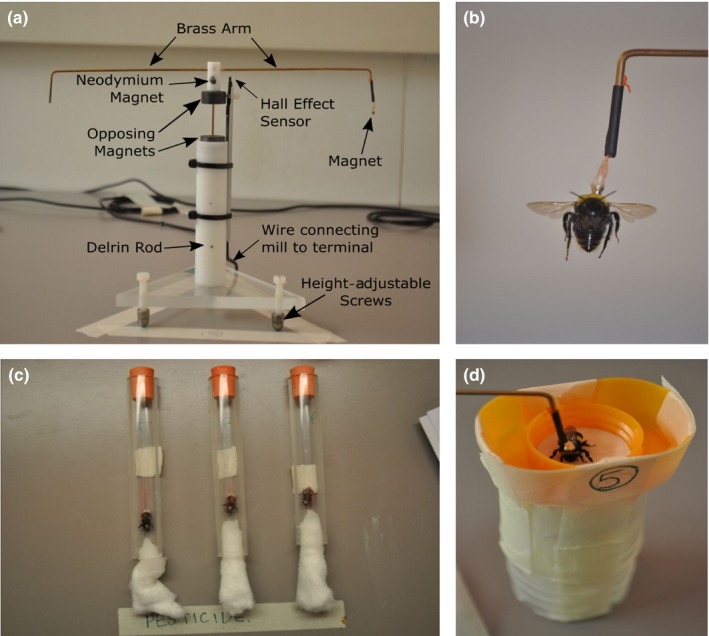
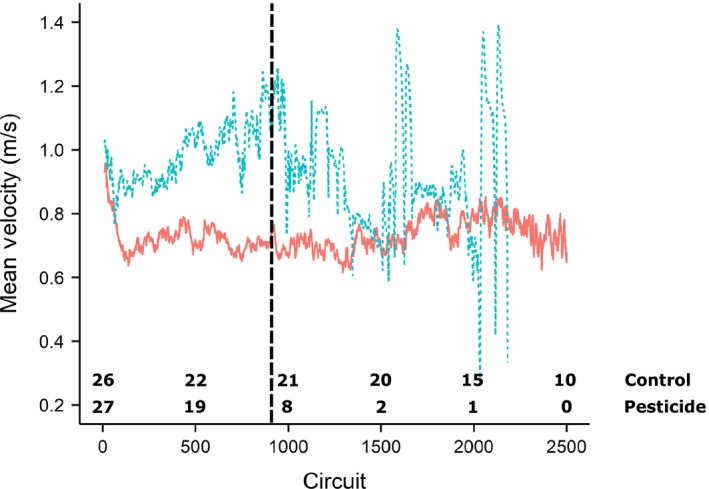
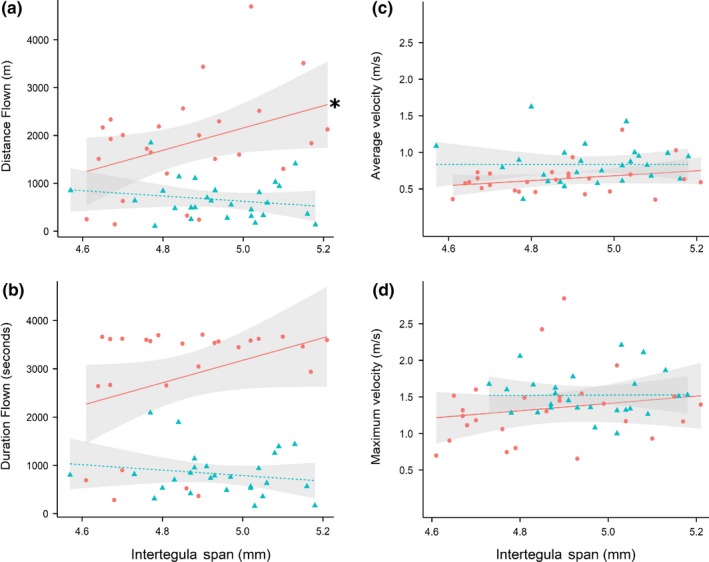
The emergence of agricultural land use change creates a number of challenges that insect pollinators, such as eusocial bees, must overcome. Resultant fragmentation and loss of suitable foraging habitats, combined with pesticide exposure, may increase demands on foraging, specifically the ability to collect or reach sufficient resources under such stress. Understanding effects that pesticides have on flight performance is therefore vital if we are to assess colony success in these changing landscapes. Neonicotinoids are one of the most widely used classes of pesticide across the globe, and exposure to bees has been associated with reduced foraging efficiency and homing ability. One explanation for these effects could be that elements of flight are being affected, but apart from a couple of studies on the honeybee (), this has scarcely been tested. Here, we used flight mills to investigate how exposure to a field realistic (10 ppb) acute dose of imidacloprid affected flight performance of a wild insect pollinator-the bumblebee, . Intriguingly, observations showed exposed workers flew at a significantly higher velocity over the first ¾ km of flight. This apparent hyperactivity, however, may have a cost because exposed workers showed reduced flight distance and duration to around a third of what control workers were capable of achieving. Given that bumblebees are central place foragers, impairment to flight endurance could translate to a decline in potential forage area, decreasing the abundance, diversity, and nutritional quality of available food, while potentially diminishing pollination service capabilities.
农业土地利用变化的出现带来了一些挑战,诸如群居性蜜蜂等昆虫传粉者必须克服这些挑战。由此导致的适宜觅食栖息地的破碎化和丧失,再加上农药暴露,可能会增加觅食需求,特别是在这种压力下收集或获取足够资源的能力。因此,如果我们要评估在这些不断变化的景观中蜂群的生存情况,了解农药对飞行性能的影响至关重要。新烟碱类农药是全球使用最广泛的一类农药,蜜蜂接触此类农药与觅食效率和归巢能力降低有关。对这些影响的一种解释可能是飞行的某些方面受到了影响,但除了几项针对蜜蜂的研究外,这几乎没有得到验证。在这里,我们使用飞行磨来研究接触田间实际浓度(10 ppb)的急性剂量吡虫啉如何影响野生昆虫传粉者——大黄蜂的飞行性能。有趣的是,观察结果显示,接触农药的工蜂在飞行的前三分之四公里中飞行速度明显更高。然而,这种明显的多动可能会有代价,因为接触农药的工蜂飞行距离和持续时间减少到对照工蜂能够达到的水平的三分之一左右。鉴于大黄蜂是中心地觅食者,飞行耐力受损可能会转化为潜在觅食区域的减少,降低可用食物的丰度、多样性和营养质量,同时可能削弱授粉服务能力。