School of Nursing, College of Nursing, Taipei Medical University, Taipei, Taiwan.
Graduate Institute of Information Management, National Taipei University, New Taipei City, Taiwan.
PLoS One. 2019 Jun 4;14(6):e0217622. doi: 10.1371/journal.pone.0217622. eCollection 2019.
The nursing process system (NPS) is used to establish the nursing process involving assessment, diagnosis, planning, intervention, and evaluation in solving the health problems of patients.
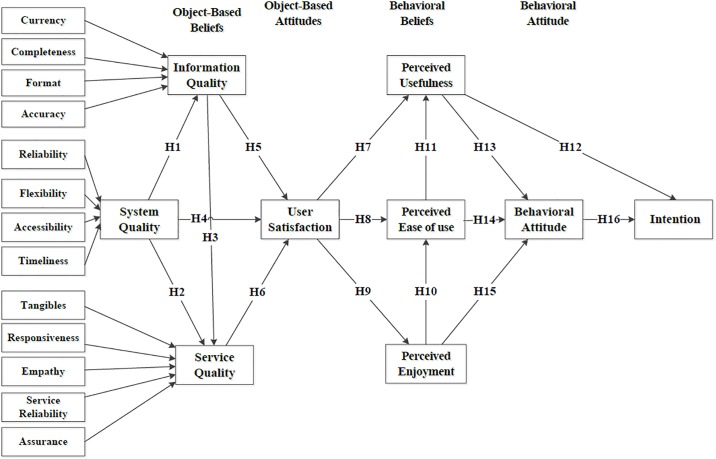
The factors influencing the use of the NPS by nurses were analyzed based on user satisfaction and technology acceptance within the 3Q (service quality, information quality, and system quality) model.
In this cross-sectional quantitative study, the valid responses of 222 nurses to a questionnaire were obtained; these nurses worked at eight hospitals affiliated with public organizations in Taiwan. Structural equation modeling was used to analyze information quality, system quality, service quality, user satisfaction, perceived usefulness, perceived ease of use, perceived enjoyment, behavioral attitude, and intention after the nurses had used the NPS system for more than 1 month.
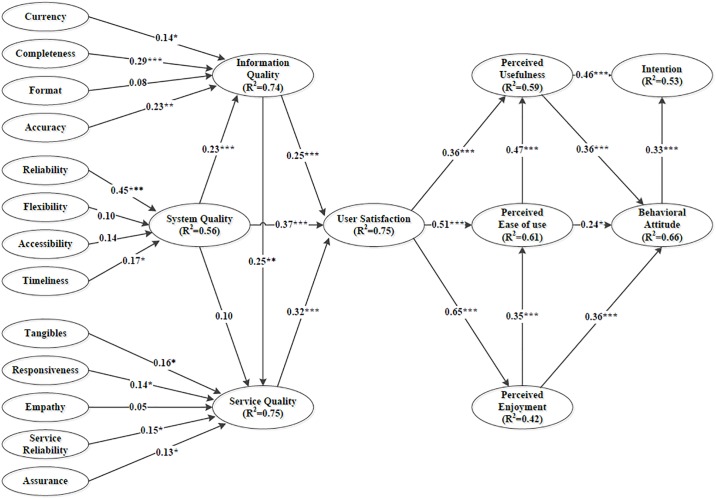
Information quality, service quality, and system quality influenced user satisfaction. User satisfaction affected perceived usefulness, perceived ease of use, and perceived enjoyment and had the highest explanatory power (R2 = 0.75). Furthermore, perceived usefulness, perceived ease of use, and perceived enjoyment influenced behavioral attitude and intention to use the system. The proposed model explained 53% of the variance in the intention to use the NPS.
The relationships between the variables of the 3Q model were successfully used to examine the intention of nurses toward using the NPS. Using the findings of this study, designers and programmers can comprehensively understand the perceptions of nurses and further improve the performance of the NPS.
护理程序系统(NPS)用于建立护理过程,包括评估、诊断、计划、干预和评估,以解决患者的健康问题。
基于 3Q(服务质量、信息质量和系统质量)模型中的用户满意度和技术接受度,分析影响护士使用 NPS 的因素。
在这项横断面定量研究中,共获得了 222 名护士对问卷的有效回复,这些护士在台湾 8 家公立机构附属医院工作。采用结构方程模型分析了信息质量、系统质量、服务质量、用户满意度、感知有用性、感知易用性、感知趣味性、行为态度和使用意向,这些护士在使用 NPS 系统超过 1 个月后进行了评估。
信息质量、服务质量和系统质量影响用户满意度。用户满意度影响感知有用性、感知易用性和感知趣味性,具有最高的解释力(R2 = 0.75)。此外,感知有用性、感知易用性和感知趣味性影响行为态度和系统使用意向。所提出的模型解释了使用 NPS 的意向的 53%的方差。
成功地使用了 3Q 模型的变量关系来检验护士使用 NPS 的意向。利用本研究的结果,设计者和程序员可以全面了解护士的看法,并进一步提高 NPS 的性能。