Department of Hospital and Health Care Administration, Chia-Nan University of Pharmacy and Science, Tainan, Taiwan, Republic of China.
BMC Med Inform Decis Mak. 2013 Jan 29;13:16. doi: 10.1186/1472-6947-13-16.
Pain management is a critical but complex issue for the relief of acute pain, particularly for postoperative pain and severe pain in cancer patients. It also plays important roles in promoting quality of care. The introduction of pain management decision support systems (PM-DSS) is considered a potential solution for addressing the complex problems encountered in pain management. This study aims to investigate factors affecting acceptance of PM-DSS from a nurse anesthetist perspective.
A questionnaire survey was conducted to collect data from nurse anesthetists in a case hospital. A total of 113 questionnaires were distributed, and 101 complete copies were returned, indicating a valid response rate of 89.3%. Collected data were analyzed by structure equation modeling using the partial least square tool.
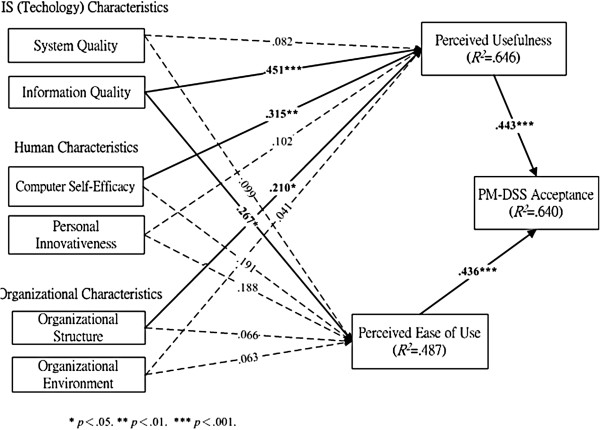
The results show that perceived information quality (γ=.451, p<.001), computer self-efficacy (γ=.315, p<.01), and organizational structure (γ=.210, p<.05), both significantly impact nurse anesthetists' perceived usefulness of PM-DSS. Information quality (γ=.267, p<.05) significantly impacts nurse anesthetists' perceptions of PM-DSS ease of use. Furthermore, both perceived ease of use (β=.436, p<.001, R(2)=.487) and perceived usefulness (β=.443, p<.001, R(2)=.646) significantly affected nurse anesthetists' PM-DSS acceptance (R2=.640). Thus, the critical role of information quality in the development of clinical decision support system is demonstrated.
The findings of this study enable hospital managers to understand the important considerations for nurse anesthetists in accepting PM-DSS, particularly for the issues related to the improvement of information quality, perceived usefulness and perceived ease of use of the system. In addition, the results also provide useful suggestions for designers and implementers of PM-DSS in improving system development.
疼痛管理是缓解急性疼痛的关键且复杂的问题,特别是术后疼痛和癌症患者的严重疼痛。它在提高护理质量方面也起着重要作用。引入疼痛管理决策支持系统(PM-DSS)被认为是解决疼痛管理中遇到的复杂问题的潜在解决方案。本研究旨在从护士麻醉师的角度调查影响 PM-DSS 接受度的因素。
通过案例医院的护士麻醉师进行问卷调查,共发放问卷 113 份,收回有效问卷 101 份,有效回收率为 89.3%。使用偏最小二乘工具的结构方程模型对收集的数据进行分析。
结果表明,感知信息质量(γ=.451,p<.001)、计算机自我效能(γ=.315,p<.01)和组织结构(γ=.210,p<.05)均显著影响护士麻醉师对 PM-DSS 的感知有用性。信息质量(γ=.267,p<.05)显著影响护士麻醉师对 PM-DSS 的易用性感知。此外,感知易用性(β=.436,p<.001,R(2)=.487)和感知有用性(β=.443,p<.001,R(2)=.646)均显著影响护士麻醉师对 PM-DSS 的接受度(R2=.640)。因此,本研究证明了信息质量在开发临床决策支持系统中的关键作用。
本研究的结果使医院管理者能够了解护士麻醉师接受 PM-DSS 的重要考虑因素,特别是与系统信息质量、感知有用性和感知易用性的改进相关的问题。此外,结果还为 PM-DSS 的设计者和实施者在改进系统开发方面提供了有用的建议。