Institute of Biomedicine and Biotechnology, Shenzhen Institutes of Advanced Technology, Chinese Academy of Sciences, Nanshan, Shenzhen, China
School of Biological Sciences, Nanyang Technological University, Singapore, Singapore.
mBio. 2019 Jun 4;10(3):e02469-18. doi: 10.1128/mBio.02469-18.
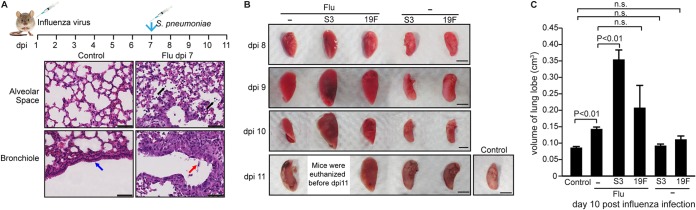
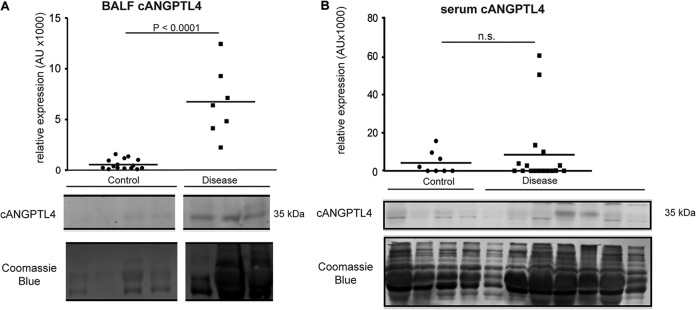
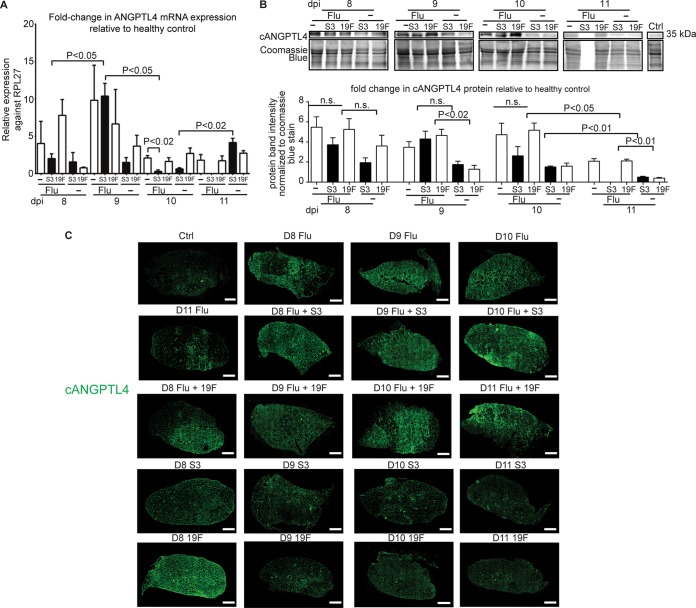
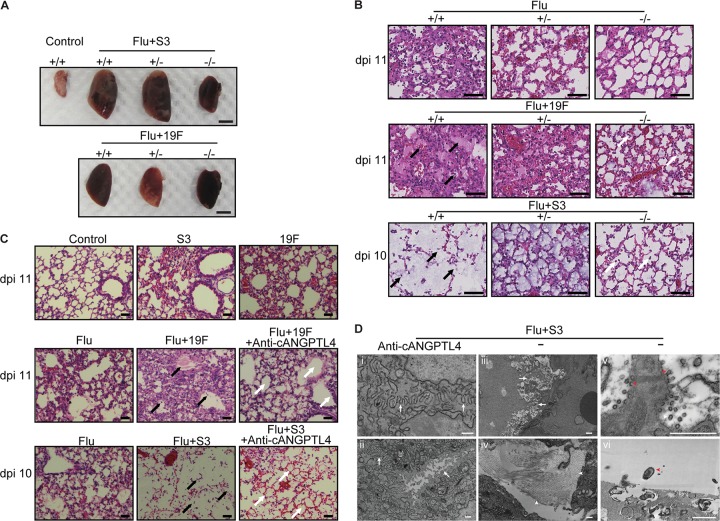
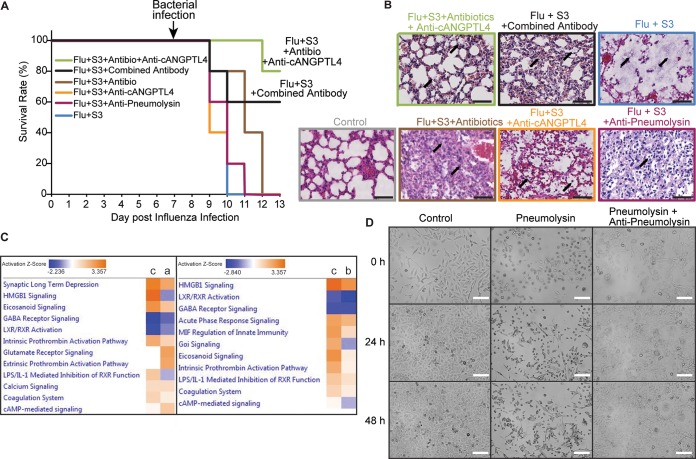
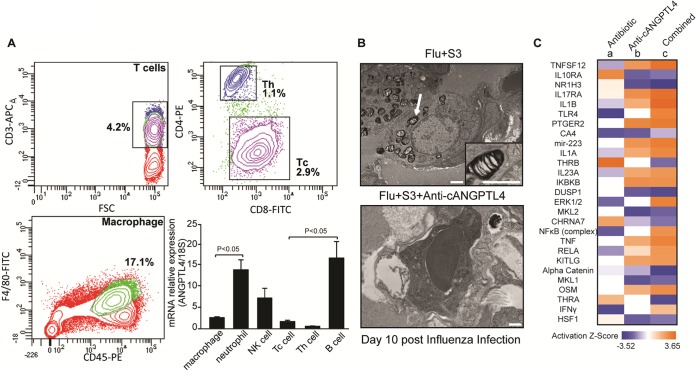
Secondary bacterial lung infection by () poses a serious health concern, especially in developing countries. We posit that the emergence of multiantibiotic-resistant strains will jeopardize current treatments in these regions. Deaths arising from secondary infections are more often associated with acute lung injury, a common consequence of hypercytokinemia, than with the infection Given that secondary bacterial pneumonia often has a poor prognosis, newer approaches to improve treatment outcomes are urgently needed to reduce the high levels of morbidity and mortality. Using a sequential dual-infection mouse model of secondary bacterial lung infection, we show that host-directed therapy via immunoneutralization of the angiopoietin-like 4 c-isoform (cANGPTL4) reduced pulmonary edema and damage in infected mice. RNA sequencing analysis revealed that anti-cANGPTL4 treatment improved immune and coagulation functions and reduced internal bleeding and edema. Importantly, anti-cANGPTL4 antibody, when used concurrently with either conventional antibiotics or antipneumolysin antibody, prolonged the median survival of mice compared to monotherapy. Anti-cANGPTL4 treatment enhanced immune cell phagocytosis of bacteria while restricting excessive inflammation. This modification of immune responses improved the disease outcomes of secondary pneumococcal pneumonia. Taken together, our study emphasizes that host-directed therapeutic strategies are viable adjuncts to standard antimicrobial treatments. Despite extensive global efforts, secondary bacterial pneumonia still represents a major cause of death in developing countries and is an important cause of long-term functional disability arising from lung tissue damage. Newer approaches to improving treatment outcomes are needed to reduce the significant morbidity and mortality caused by infectious diseases. Our study, using an experimental mouse model of secondary infection, shows that a multimodal treatment that concurrently targets host and pathogen factors improved lung tissue integrity and extended the median survival time of infected mice. The immunoneutralization of host protein cANGPTL4 reduced the severity of pulmonary edema and damage. We show that host-directed therapeutic strategies as well as neutralizing antibodies against pathogen virulence factors are viable adjuncts to standard antimicrobial treatments such as antibiotics. In view of their different modes of action compared to antibiotics, concurrent immunotherapies using antibodies are potentially efficacious against secondary pneumococcal pneumonia caused by antibiotic-resistant pathogens.
由 ()引起的继发性细菌性肺部感染对健康构成严重威胁,特别是在发展中国家。我们认为,多抗生素耐药菌株的出现将危及这些地区的现有治疗方法。继发感染引起的死亡更多地与急性肺损伤有关,这是细胞因子血症的常见后果,而不是与感染本身有关。鉴于继发性细菌性肺炎的预后往往较差,迫切需要采用新的方法来改善治疗效果,以降低发病率和死亡率。我们使用继发性细菌性肺部感染的序贯双重感染小鼠模型表明,通过免疫中和血管生成素样 4 c-异构体(cANGPTL4)进行宿主定向治疗可减少感染小鼠的肺水肿和损伤。RNA 测序分析显示,抗 cANGPTL4 治疗可改善免疫和凝血功能,并减少内出血和水肿。重要的是,与单药治疗相比,抗 cANGPTL4 抗体与常规抗生素或抗肺炎球菌溶血素抗体同时使用可延长小鼠的中位生存期。抗 cANGPTL4 治疗增强了免疫细胞对细菌的吞噬作用,同时限制了过度炎症。这种免疫反应的改变改善了继发性肺炎球菌肺炎的疾病结局。总之,我们的研究强调了宿主定向治疗策略是标准抗菌治疗的可行辅助手段。尽管全球范围内进行了广泛的努力,但继发性细菌性肺炎仍然是发展中国家死亡的主要原因,也是由肺部组织损伤引起的长期功能障碍的重要原因。需要采用新的方法来改善治疗效果,以降低由传染病引起的高发病率和死亡率。我们的研究使用继发性感染的实验小鼠模型表明,同时针对宿主和病原体因素的多模式治疗可改善肺组织完整性并延长感染小鼠的中位生存期。宿主蛋白 cANGPTL4 的免疫中和减轻了肺水肿和损伤的严重程度。我们表明,宿主定向治疗策略以及针对病原体毒力因子的中和抗体是标准抗菌治疗(如抗生素)的可行辅助手段。鉴于它们与抗生素的作用模式不同,使用抗体的同时免疫疗法对由抗生素耐药病原体引起的继发性肺炎球菌肺炎可能具有疗效。