Department of Immunology and Microbiology, University of Colorado School of Medicine, Aurora, CO, United States.
Front Immunol. 2020 Feb 11;11:105. doi: 10.3389/fimmu.2020.00105. eCollection 2020.
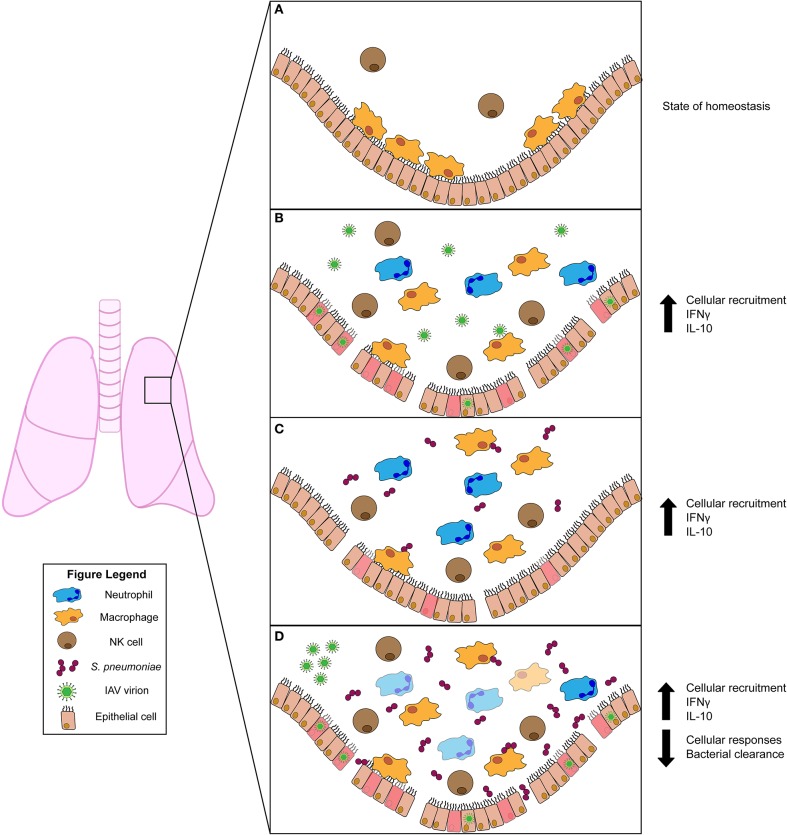
Bacterial and viral pathogens are predominant causes of pulmonary infections and complications. Morbidity and mortality from these infections is increased in populations that include the elderly, infants, and individuals with genetic disorders such as Down syndrome. Immune senescence, concurrent infections, and other immune alterations occur in these susceptible populations, but the underlying mechanisms that dictate increased susceptibility to lung infections are not fully defined. Here, we review unique features of the lung as a mucosal epithelial tissue and aspects of inflammatory and immune responses in model pulmonary infections and co-infections by influenza virus and . In these models, lung inflammatory responses are a double-edged sword: recruitment of immune effectors is essential to eliminate bacteria and virus-infected cells, but inflammatory cytokines drive changes in the lung conducive to increased pathogen replication. Excessive accumulation of inflammatory cells also hinders lung function, possibly causing death of the host. Some animal studies have found that targeting host modulators of lung inflammatory responses has therapeutic or prophylactic effects in these infection and co-infection models. However, conflicting results from other studies suggest microbiota, sequence of colonization, or other unappreciated aspects of lung biology also play important roles in the outcome of infections. Regardless, a predisposition to excessive or aberrant inflammatory responses occurs in susceptible human populations. Hence, in appropriate contexts, modulation of inflammatory responses may prove effective for reducing the frequency or severity of pulmonary infections. However, there remain limitations in our understanding of how this might best be achieved-particularly in diverse human populations.
细菌和病毒病原体是肺部感染和并发症的主要原因。在包括老年人、婴儿和唐氏综合征等遗传疾病患者在内的人群中,这些感染的发病率和死亡率会增加。在这些易感人群中,会出现免疫衰老、合并感染和其他免疫改变,但决定肺部感染易感性增加的潜在机制尚未完全确定。在这里,我们回顾了肺部作为黏膜上皮组织的独特特征,以及流感病毒和 感染模型中肺部炎症和免疫反应的各个方面。在这些模型中,肺部炎症反应是一把双刃剑:招募免疫效应细胞对于消除细菌和病毒感染细胞至关重要,但炎症细胞因子会导致肺部发生变化,有利于病原体的复制。炎症细胞的过度积累也会阻碍肺功能,可能导致宿主死亡。一些动物研究发现,针对宿主肺部炎症反应的调节剂在这些感染和合并感染模型中具有治疗或预防作用。然而,其他研究的结果相互矛盾,表明微生物组、定植的顺序或其他未被认识到的肺部生物学方面也在感染结局中发挥重要作用。无论如何,易感人群中存在易发生过度或异常炎症反应的倾向。因此,在适当的情况下,调节炎症反应可能有助于降低肺部感染的频率或严重程度。然而,我们对如何最好地实现这一目标的理解仍然存在局限性,特别是在不同的人群中。