State Key Laboratory of Veterinary Etiological Biology, National Foot and Mouth Diseases Reference Laboratory, Key Laboratory of Animal Virology of Ministry of Agriculture, Lanzhou Veterinary Research Institute, Chinese Academy of Agricultural Sciences, Lanzhou, China.
College of Veterinary Medicine, Northwest A&F University, Yangling, Shaanxi, China.
J Virol. 2019 Jul 30;93(16). doi: 10.1128/JVI.00362-19. Print 2019 Aug 15.
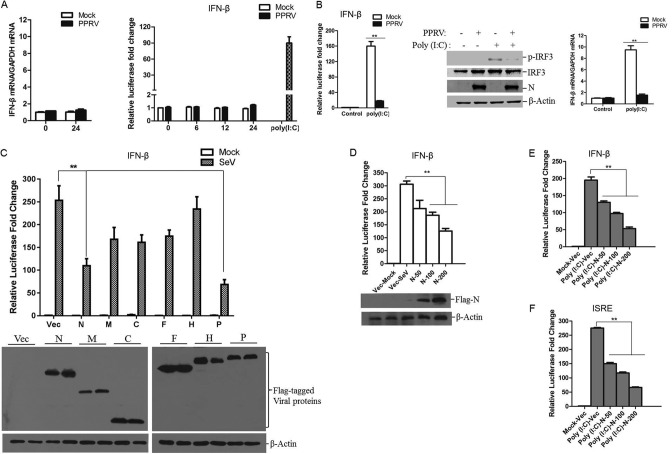
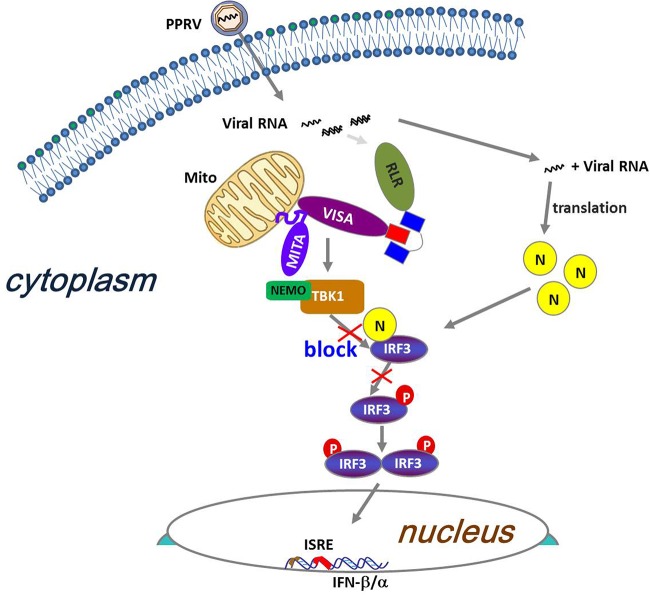
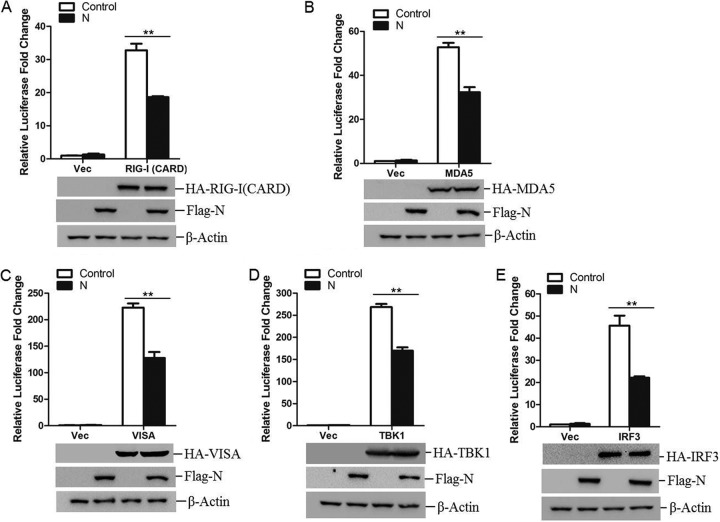
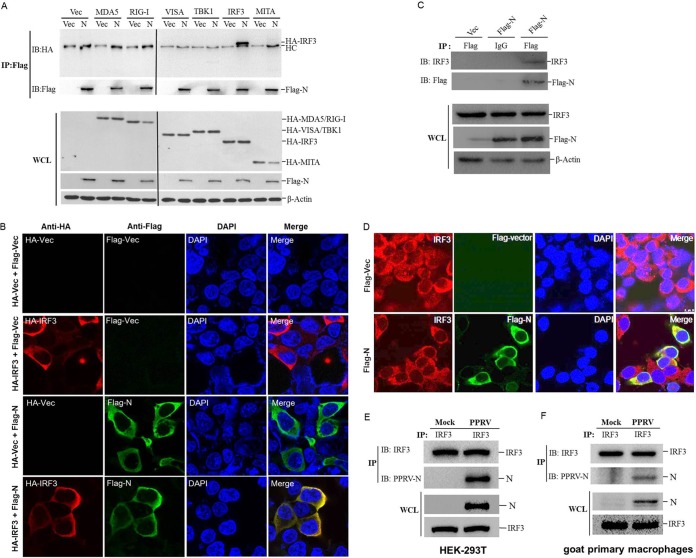
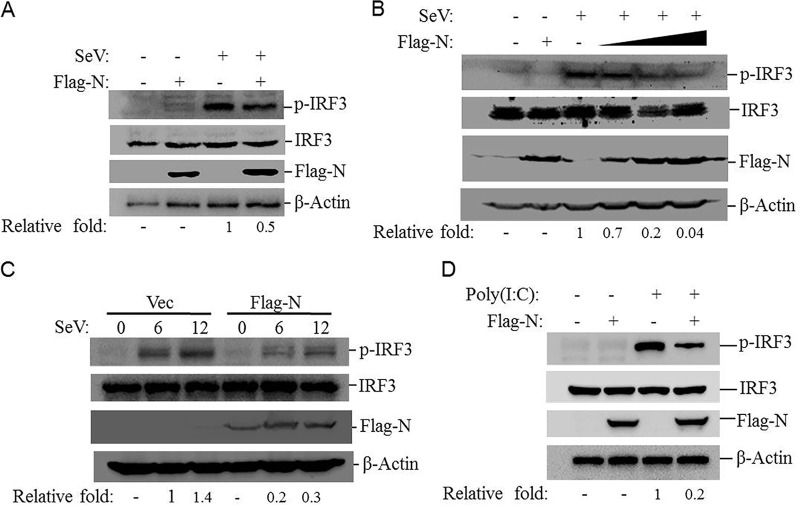
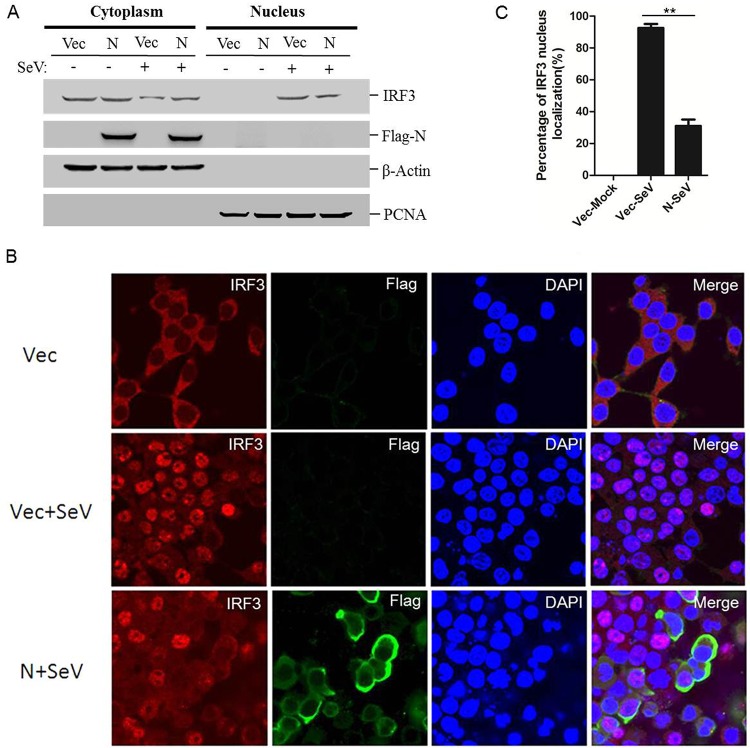
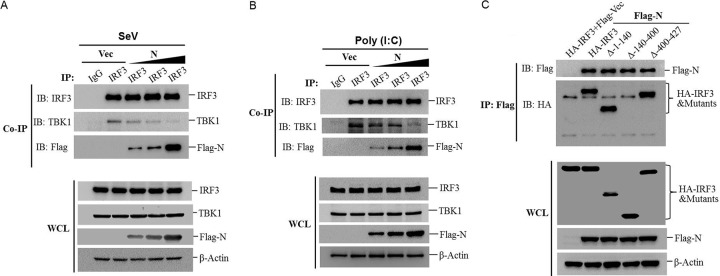
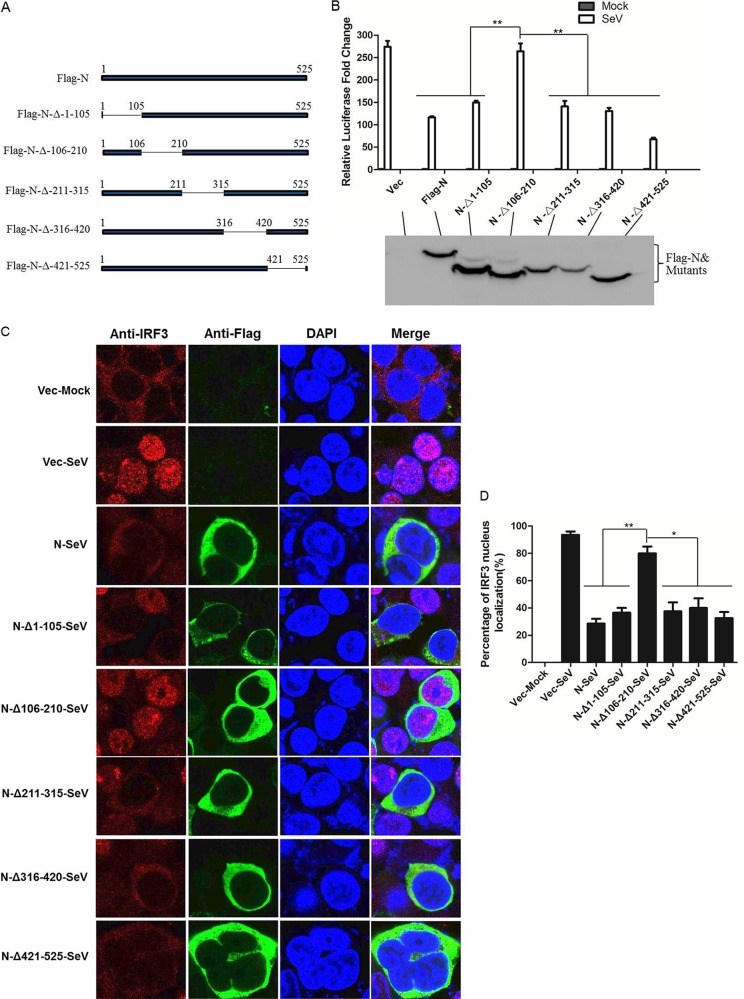
Peste des petits ruminants virus (PPRV) is the etiological agent of peste des petits ruminants, causing acute immunosuppression in its natural hosts. However, the molecular mechanisms by which PPRV antagonizes the host immune responses have not been fully characterized. In particular, how PPRV suppresses the activation of the host RIG-I-like receptor (RLR) pathway has yet to be clarified. In this study, we demonstrated that PPRV infection significantly suppresses RLR pathway activation and type I interferon (IFN) production and identified PPRV N protein as an extremely important antagonistic viral factor that suppresses beta interferon (IFN-β) and IFN-stimulated gene (ISG) expression. A detailed analysis showed that PPRV N protein inhibited type I IFN production by targeting interferon regulatory factor 3 (IRF3), a key molecule in the RLR pathway required for type I IFN induction. PPRV N protein interacted with IRF3 (but not with other components of the RLR pathway, including MDA5, RIG-I, VISA, TBK1, and MITA) and abrogated the phosphorylation of IRF3. As expected, PPRV N protein also considerably impaired the nuclear translocation of IRF3. The TBK1-IRF3 interaction was involved significantly in IRF3 phosphorylation, and we showed that PPRV N protein inhibits the association between TBK1 and IRF3, which in turn inhibits IRF3 phosphorylation. The amino acid region 106 to 210 of PPRV N protein was determined to be essential for suppressing the nuclear translocation of IRF3 and IFN-β production, and the 140 to 400 region of IRF3 was identified as the crucial region for the N-IRF3 interaction. Together, our findings demonstrate a new mechanism evolved by PPRV to inhibit type I IFN production and provide structural insights into the immunosuppression caused by PPRV. Peste des petits ruminants is a highly contagious animal disease affecting small ruminants, which threatens both small livestock and endangered susceptible wildlife populations in many countries. The causative agent, peste des petits ruminants virus (PPRV), often causes acute immunosuppression in its natural hosts during infection. Here, for the first time, we demonstrate that N protein, the most abundant protein of PPRV, plays an extremely important role in suppression of interferon regulatory factor 3 (IRF3) function and type I interferon (IFN) production by interfering with the formation of the TBK1-IRF3 complex. This study explored a novel antagonistic mechanism of PPRV.
小反刍兽疫病毒(PPRV)是小反刍兽疫的病原体,在其自然宿主中引起急性免疫抑制。然而,PPRV 拮抗宿主免疫反应的分子机制尚未完全阐明。特别是,PPRV 如何抑制宿主 RIG-I 样受体(RLR)途径的激活仍不清楚。在这项研究中,我们证明了 PPRV 感染显著抑制了 RLR 途径的激活和 I 型干扰素(IFN)的产生,并确定了 PPRV N 蛋白是一种极其重要的拮抗病毒因子,它抑制β干扰素(IFN-β)和 IFN 刺激基因(ISG)的表达。详细分析表明,PPRV N 蛋白通过靶向干扰素调节因子 3(IRF3)抑制 I 型 IFN 的产生,IRF3 是 RLR 途径中诱导 I 型 IFN 所必需的关键分子。PPRV N 蛋白与 IRF3 相互作用(但不与 RLR 途径的其他成分相互作用,包括 MDA5、RIG-I、VISA、TBK1 和 MITA)并使 IRF3 磷酸化失活。正如预期的那样,PPRV N 蛋白也极大地损害了 IRF3 的核转位。TBK1-IRF3 相互作用显著参与了 IRF3 的磷酸化,我们表明 PPRV N 蛋白抑制了 TBK1 和 IRF3 之间的结合,从而抑制了 IRF3 的磷酸化。PPRV N 蛋白的氨基酸区域 106 至 210 被确定对于抑制 IRF3 的核转位和 IFN-β 的产生是必需的,IRF3 的 140 至 400 区域被确定为 N-IRF3 相互作用的关键区域。总之,我们的研究结果表明 PPRV 进化出了一种新的抑制 I 型 IFN 产生的机制,并为 PPRV 引起的免疫抑制提供了结构上的见解。小反刍兽疫是一种高度传染性的动物疾病,影响小反刍动物,在许多国家威胁着小牲畜和濒危的易感野生动物种群。其病原体小反刍兽疫病毒(PPRV)在其自然宿主感染过程中经常导致急性免疫抑制。在这里,我们首次证明,PPRV 中最丰富的蛋白 N 蛋白通过干扰 TBK1-IRF3 复合物的形成,在抑制干扰素调节因子 3(IRF3)功能和 I 型干扰素(IFN)产生方面发挥了极其重要的作用。这项研究探索了 PPRV 的一种新的拮抗机制。