Department of Statistics and Probability, Michigan State University, East Lansing, MI.
College of Integrative Sciences and Arts, Arizona State University, Mesa, AZ.
Med Sci Sports Exerc. 2019 Nov;51(11):2302-2308. doi: 10.1249/MSS.0000000000002037.
The rate of decline in physical performance for women is thought to be faster than that for men at any age in the Masters age classes in weightlifting and other sports. We quantified the age-associated decline in Olympic weightlifting separately for women and men and investigated possible impact of perimenopausal years on the performance decline.
Results from Masters Weightlifting competitions from 1993 to 2018 were compiled from original score sheets and meet results made available by International Weightlifting Federation. Quantile curves were estimated for the age-related performance decline, and confidence intervals (CI) for the fractional performance with reference age 35 yr were calculated. Age-related decline curves were estimated for different periods to examine changes in performance levels.
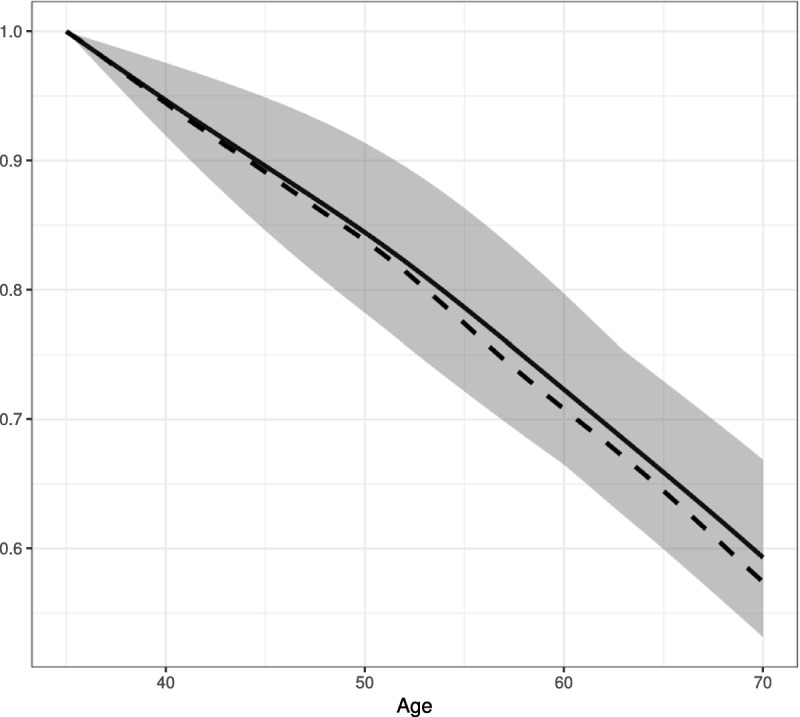
A total of 10,225 performance results for male and female weightlifters age 35 to 90 yr from 71 countries were included in the analysis. At age 40 yr compared with age 35 yr, the fractional performance is 0.947 (95% CI, 0.926-0.975), for men and 0.952 (95% CI. 0.898-0.986) for women while this is reduced to 0.723 (95% CI: 0.651-0.800) at age 60 yr for men and 0.604 (95% CI. 0.543-0.706) for women. Female performance levels before 2000 were worse; however, they have stabilized since 2013.
The performances of women weightlifters have improved over the last 25 yr. Thus, previous publications do not reflect current physical capabilities of women. The age-associated performance decline for female weightlifters mirrors the decline for men except for an accelerated decline during a 10-yr period across the age range from late 40s to late 50s thus coinciding with a transition into menopause.
在举重和其他运动的大师年龄组中,女性的身体机能下降速度被认为比男性任何年龄段都要快。我们分别量化了女性和男性的与年龄相关的奥林匹克举重成绩下降,并研究了围绝经期对成绩下降的可能影响。
从 1993 年到 2018 年的大师举重比赛的结果是从国际举重联合会提供的原始记分表和比赛结果中汇编的。为年龄相关的表现下降估计了分位数曲线,并计算了参考年龄 35 岁时的分数与年龄的置信区间(CI)。为了检查不同时期的表现水平变化,估计了与年龄相关的下降曲线。
从 71 个国家的 35 至 90 岁的男女举重运动员中,共纳入了 10225 项举重成绩进行分析。与 35 岁相比,男性在 40 岁时的分数为 0.947(95%CI,0.926-0.975),女性为 0.952(95%CI,0.898-0.986),而到 60 岁时,男性的分数降至 0.723(95%CI:0.651-0.800),女性为 0.604(95%CI,0.543-0.706)。2000 年前女性的表现水平更差;然而,自 2013 年以来,她们的表现已经稳定下来。
在过去的 25 年里,女性举重运动员的表现有所提高。因此,之前的出版物并不能反映女性当前的身体能力。女性举重运动员的与年龄相关的表现下降与男性相似,除了在 40 多岁到 50 多岁的年龄段内,有一个 10 年的加速下降期,正好与更年期过渡相吻合。