Emmanuel Faran, Persaud Navindra, Weir Sharon S, Bhattacharjee Parinita, Isac Shajy
Centre for Global Public Health, Winnipeg, MB, Canada.
Family Health International 360, Washington DC, WA, United States.
JMIR Public Health Surveill. 2019 Jun 6;5(2):e12636. doi: 10.2196/12636.
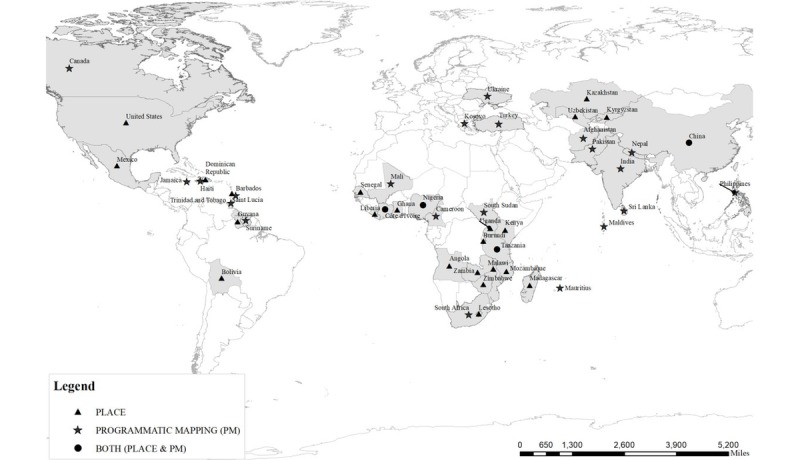
Programmatic mapping (PM) is a rapid and efficient mechanism to develop size estimates of key populations including female sex workers (FSWs) and geolocate them at physical locations in a systematic and scientific manner. At the macro level, this information forms the basis for allocating program resources, setting performance targets, and assess coverage. At a micro level, PM data provide specific information on hot spots, estimates of FSWs at those spots, and hot spot typology and days and times of operation, all of which provides targeted service delivery strategies. This information can provide a reliable platform to plan HIV prevention and treatment services to considerable scale and intensity. Above all, the entire PM process requires deep involvement of FSWs, which increases community ownership of the data and can lead to an increased uptake of services. Despite a few limitations, the approach is versatile and can be used in varied country contexts to generate important information about sex work and its dynamics. In this paper, we describe experiences and lessons learned from using evidence generated from PM of FSWs in multiple countries to develop HIV prevention programs at scale.
规划性绘图(PM)是一种快速且高效的机制,用于对包括女性性工作者(FSW)在内的关键人群进行规模估计,并以系统科学的方式在实际地点对其进行地理定位。在宏观层面,这些信息构成了分配项目资源、设定绩效目标和评估覆盖范围的基础。在微观层面,PM数据提供了有关热点地区的具体信息、这些地区FSW的估计数量、热点地区类型以及运营的日期和时间,所有这些都为有针对性的服务提供策略提供了依据。这些信息可以为大规模、高强度地规划艾滋病毒预防和治疗服务提供一个可靠的平台。最重要的是,整个PM过程需要FSW的深度参与,这增加了社区对数据的所有权,并可能导致服务利用率的提高。尽管存在一些局限性,但该方法具有通用性,可在不同国家背景下用于生成有关性工作及其动态的重要信息。在本文中,我们描述了在多个国家利用FSW的PM所产生的证据来大规模制定艾滋病毒预防计划的经验和教训。