From the Department of Psychology, University of Arizona, Tucson, Tucson, Arizona.
Psychosom Med. 2019 Oct;81(8):731-738. doi: 10.1097/PSY.0000000000000717.
Using an integrative view of psychology, neuroscience, immunology, and psychophysiology, the present review of literature curates the findings that have had an impact on the field of bereavement research and shaped its development.
Beginning with pivotal systematic descriptions of medical and psychological responses to the death of a loved one by Lindemann in the mid-1940s, this selective review integrates findings in bereavement research from studies that investigate medical outcomes after loss, their psychological predictors, and biopsychosocial mechanisms.
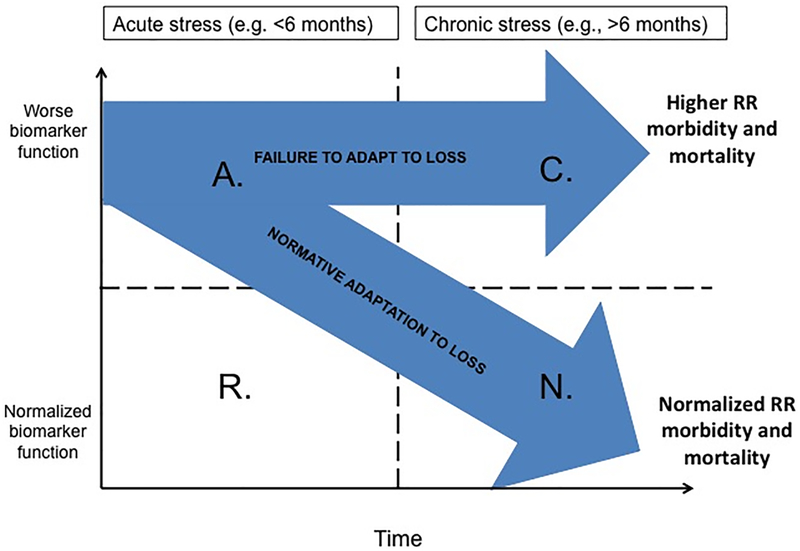
Morbidity and mortality after the death of a loved one have long been a topic of research. Early researchers characterized somatic and psychological symptoms and studied immune cell changes in bereaved samples. More recent research has repeatedly demonstrated increased rates of morbidity and mortality in bereaved samples, as compared with married controls, in large epidemiological studies. Recent developments also include the development of criteria for prolonged grief disorder (also termed complicated grief). Newer methods, including neuroimaging, have observed that the greatest impact of the death of a loved one is in those who have the most severe psychological grief reactions. Research addressing the mechanisms tying bereavement to medical outcomes is relatively scarce, but differences in rumination, in inflammation, and in cortisol dysregulation between those who adapt well and those who do not have been offered with some evidence.
Recommendations to propel the field forward include longitudinal studies to understand differences between acute reactions and later adaptation, comparing samples with grief disorders from those with more typical responses, and integrating responses in brain, mind, and body.
本文献综述从心理学、神经科学、免疫学和心理生理学的综合视角出发,梳理了对丧亲研究领域产生影响并塑造其发展的研究发现。
本综述从林德曼(Lindemann)在 20 世纪 40 年代中期对所爱之人去世的医学和心理反应的开创性系统描述开始,综合了丧亲研究中与丧失后医疗结果、其心理预测因素和生物心理社会机制相关的研究发现。
所爱之人去世后的发病率和死亡率一直是研究的主题。早期研究人员描述了丧亲者的躯体和心理症状,并研究了丧亲样本中的免疫细胞变化。最近的研究在大型流行病学研究中反复证明,与已婚对照组相比,丧亲组的发病率和死亡率更高。最近的进展还包括制定了延长悲伤障碍(也称为复杂悲伤)的标准。新方法,包括神经影像学,观察到所爱之人去世对心理悲痛反应最严重的人的影响最大。研究将丧亲与医疗结果联系起来的机制相对较少,但在那些适应良好的人与那些适应不良的人之间,在沉思、炎症和皮质醇失调方面的差异提供了一些证据。
推进该领域的建议包括进行纵向研究,以了解急性反应和后期适应之间的差异,将有悲伤障碍的样本与有更典型反应的样本进行比较,并整合大脑、心理和身体的反应。