Department of Plant Biology, Michigan State University, East Lansing, MI 48824;
Great Lakes Bioenergy Research Center, Michigan State University, East Lansing, MI 48824.
Proc Natl Acad Sci U S A. 2019 Jun 25;116(26):12933-12941. doi: 10.1073/pnas.1821543116. Epub 2019 Jun 10.
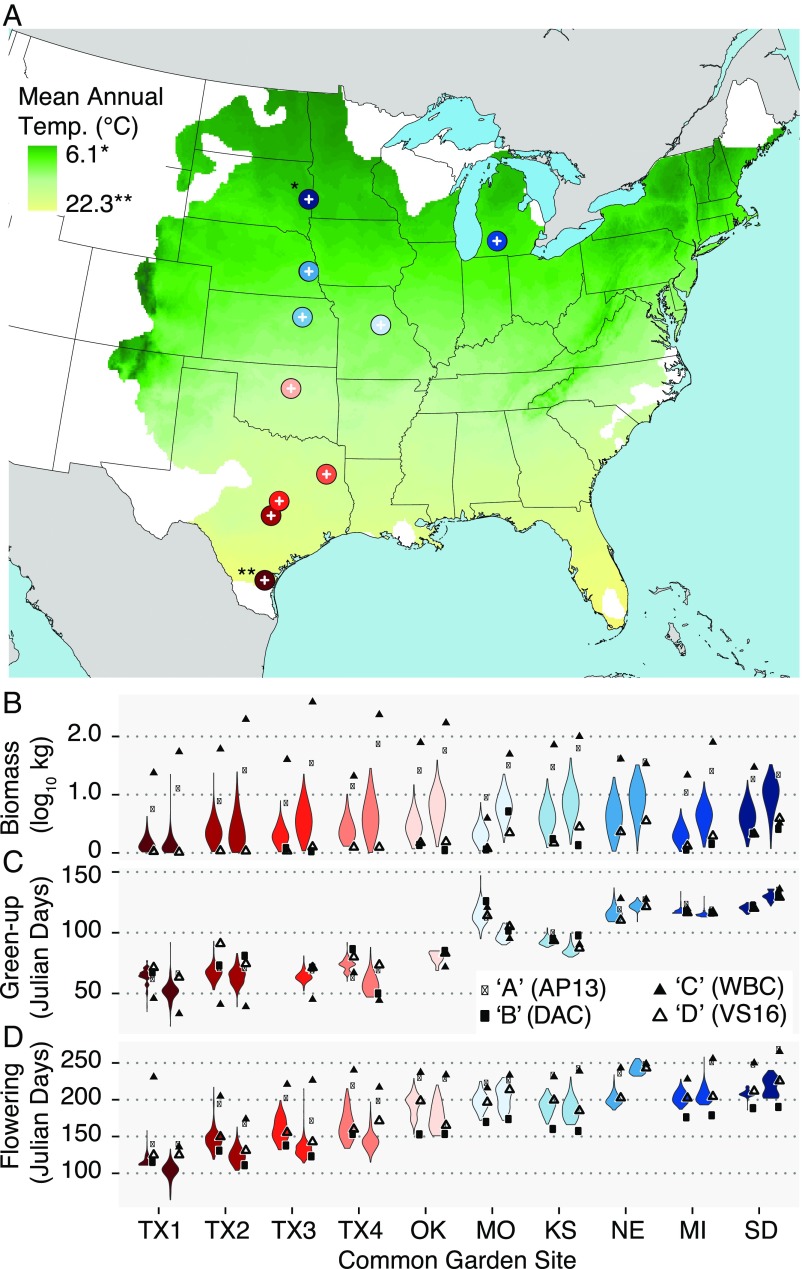
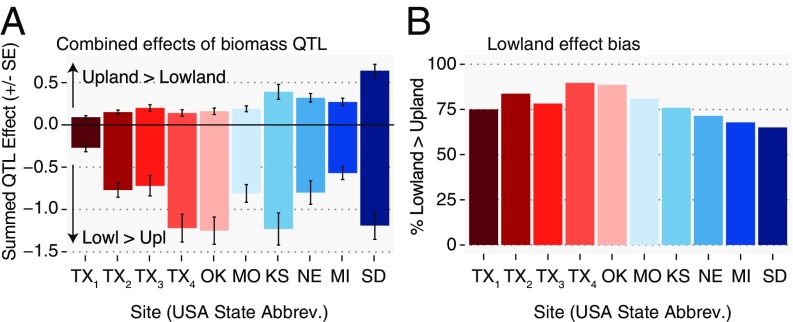
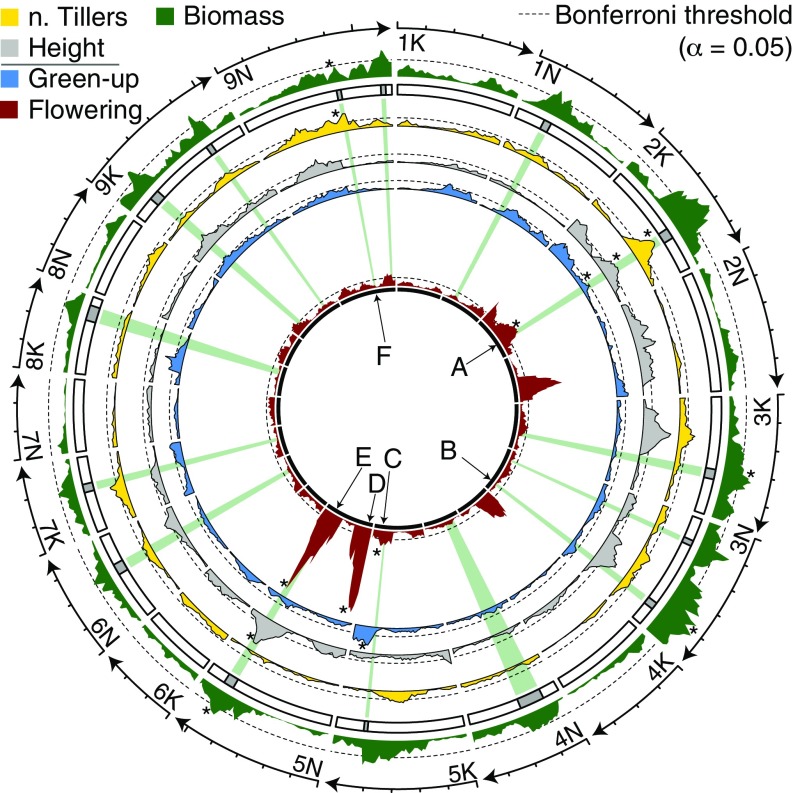
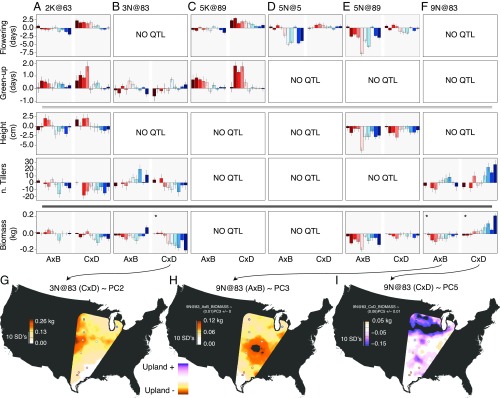
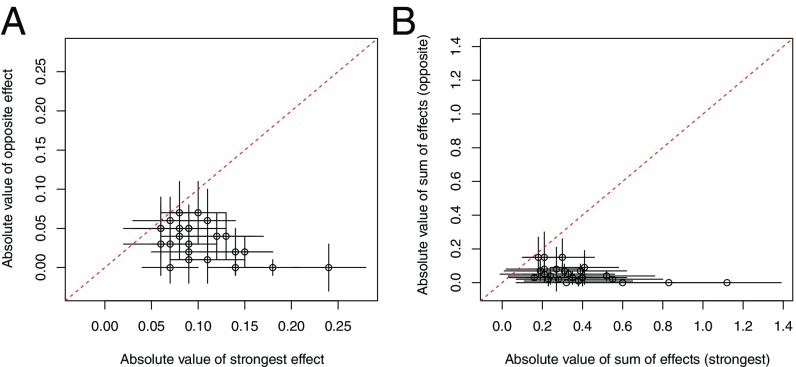
Local adaptation is the process by which natural selection drives adaptive phenotypic divergence across environmental gradients. Theory suggests that local adaptation results from genetic trade-offs at individual genetic loci, where adaptation to one set of environmental conditions results in a cost to fitness in alternative environments. However, the degree to which there are costs associated with local adaptation is poorly understood because most of these experiments rely on two-site reciprocal transplant experiments. Here, we quantify the benefits and costs of locally adaptive loci across 17° of latitude in a four-grandparent outbred mapping population in outcrossing switchgrass ( L.), an emerging biofuel crop and dominant tallgrass species. We conducted quantitative trait locus (QTL) mapping across 10 sites, ranging from Texas to South Dakota. This analysis revealed that beneficial biomass (fitness) QTL generally incur minimal costs when transplanted to other field sites distributed over a large climatic gradient over the 2 y of our study. Therefore, locally advantageous alleles could potentially be combined across multiple loci through breeding to create high-yielding regionally adapted cultivars.
本地化适应是自然选择在环境梯度上驱动适应性表型分歧的过程。理论认为,本地化适应是个体遗传基因座上遗传权衡的结果,即在一组环境条件下的适应会导致在替代环境中的适应性降低。然而,本地化适应相关成本的程度理解得很差,因为这些实验大多数依赖于两点互惠移植实验。在这里,我们在一个四亲本杂交作图群体中,在跨越 17 度的纬度范围内,量化了柳树(Panicum virgatum)中的本地适应性基因座的收益和成本,柳树是一种新兴的生物燃料作物和主要的高草物种。我们在 10 个地点进行了数量性状基因座(QTL)作图,范围从德克萨斯州到南达科他州。这项分析表明,在我们研究的 2 年内,有益生物量(适合度)QTL 通常在移植到分布在大气候梯度上的其他田间地点时,仅产生最小的成本。因此,通过育种可以将多个基因座上的有利等位基因结合起来,创造出高产、适应当地环境的品种。