AU MRI Research Center, Department of Electrical and Computer Engineering, Auburn University, 560 Devall Dr, Suite 266D, Auburn, AL, 36849, USA.
Department of Computer Science and Software Engineering, Auburn University, Auburn, AL, USA.
Neuroinformatics. 2020 Jan;18(1):87-107. doi: 10.1007/s12021-019-09422-1.
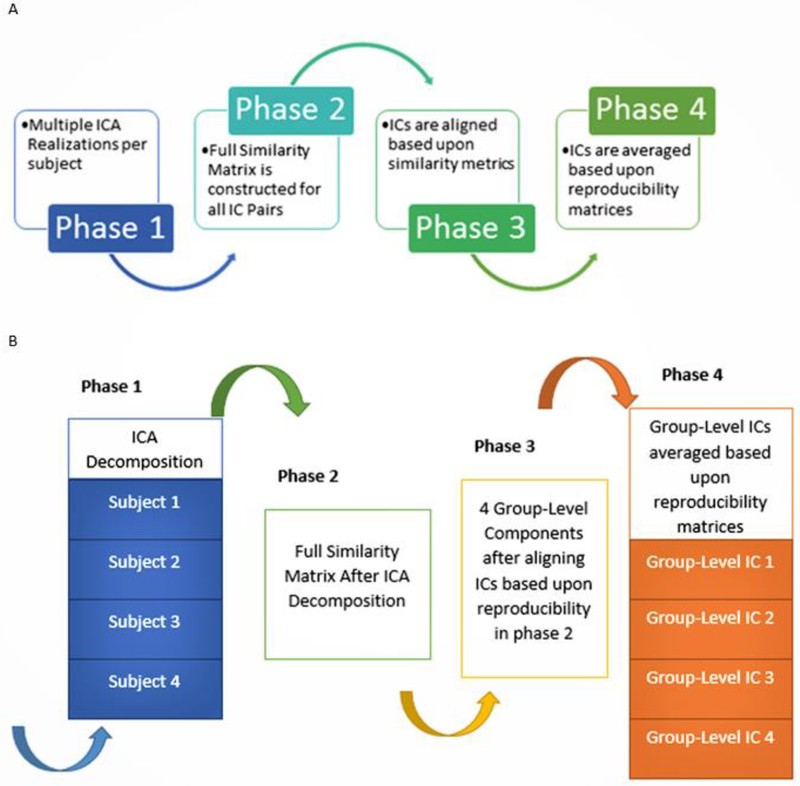
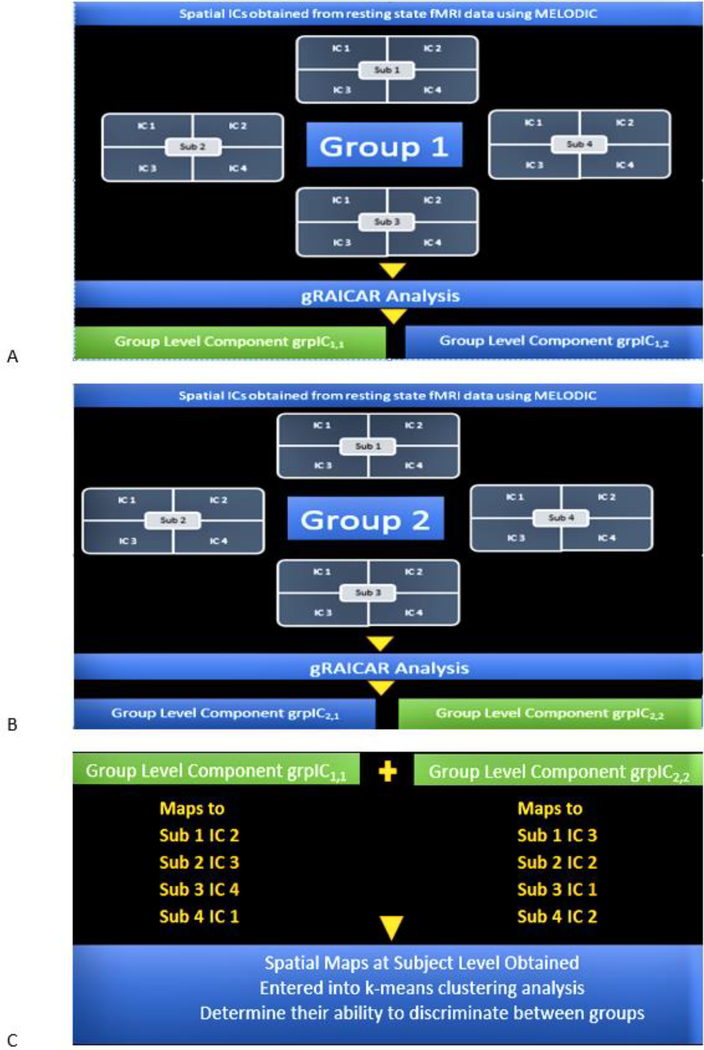
There is a lack of objective biomarkers to accurately identify the underlying etiology and related pathophysiology of disparate brain-based disorders that are less distinguishable clinically. Brain networks derived from resting-state functional magnetic resonance imaging (rs-fMRI) has been a popular tool for discovering candidate biomarkers. Specifically, independent component analysis (ICA) of rs-fMRI data is a powerful multivariate technique for investigating brain networks. However, ICA-derived brain networks that are not highly reproducible within heterogeneous clinical populations may exhibit mean statistical separation between groups, yet not be sufficiently discriminative at the individual-subject level. We hypothesize that functional brain networks that are most reproducible in subjects within clinical and control groups separately, but not when the two groups are merged, may possess the ability to discriminate effectively between the groups even at the individual-subject level. In this study, we present DisConICA or "Discover Confirm Independent Component Analysis", a software package that implements the methodology in support of our hypothesis. It relies on a "discover-confirm" approach based upon the assessment of reproducibility of independent components (representing brain networks) obtained from rs-fMRI (discover phase) using the gRAICAR (generalized Ranking and Averaging Independent Component Analysis by Reproducibility) algorithm, followed by unsupervised clustering analysis of these components to evaluate their ability to discriminate between groups (confirm phase). The unique feature of our software package is its ability to seamlessly interface with other software packages such as SPM and FSL, so that all related analyses utilizing features of other software can be performed within our package, thus providing a one-stop software solution starting with raw DICOM images to the final results. We showcase our software using rs-fMRI data acquired from US Army soldiers returning from the wars in Iraq and Afghanistan who were clinically grouped into the following groups: PTSD (posttraumatic stress disorder), comorbid PCS (post-concussion syndrome) + PTSD, and matched healthy combat controls. This software package along with test data sets is available for download at https://bitbucket.org/masauburn/disconica.
目前缺乏客观的生物标志物来准确识别临床上不太可区分的不同脑部疾病的潜在病因和相关病理生理学。基于静息态功能磁共振成像(rs-fMRI)的脑网络已成为发现候选生物标志物的流行工具。具体来说,rs-fMRI 数据的独立成分分析(ICA)是一种用于研究脑网络的强大多元技术。然而,在异质临床人群中,可重复性不高的 ICA 衍生脑网络可能在组间表现出平均统计学分离,但在个体水平上没有足够的辨别力。我们假设,在临床和对照组内的受试者中最具可重复性的功能脑网络,但当两组合并时则不具有可重复性,可能具有在个体水平上有效区分两组的能力。在这项研究中,我们提出了 DisConICA 或“发现确认独立成分分析”,这是一个实现我们假设的软件包。它依赖于一种“发现-确认”方法,该方法基于使用 gRAICAR(基于可重复性的广义排序和平均独立成分分析)算法评估从 rs-fMRI 获得的独立成分(代表脑网络)的可重复性(发现阶段),然后对这些成分进行无监督聚类分析,以评估它们区分组别的能力(确认阶段)。我们软件包的独特之处在于它能够与其他软件包(如 SPM 和 FSL)无缝集成,因此可以在我们的软件包中执行利用其他软件功能的所有相关分析,从而提供从原始 DICOM 图像到最终结果的一站式软件解决方案。我们使用从伊拉克和阿富汗战争归来的美国陆军士兵的 rs-fMRI 数据展示了我们的软件,这些士兵在临床上分为以下几组:创伤后应激障碍(PTSD)、并发脑震荡后综合征(PCS)+PTSD 以及匹配的健康战斗对照组。该软件包和测试数据集可在 https://bitbucket.org/masauburn/disconica 下载。