
肥胖作为阿尔茨海默病的一个风险因素:瘦素与谷氨酸的影响
Obesity as a Risk Factor for Alzheimer's Disease: Implication of Leptin and Glutamate.
作者信息
Lloret Ana, Monllor Paloma, Esteve Daniel, Cervera-Ferri Ana, Lloret Maria-Angeles
机构信息
Department of Physiology, Faculty of Medicine, University of Valencia, Health Research Institute INCLIVA, Valencia, Spain.
Department of Human Anatomy and Embryology, Faculty of Medicine, University of Valencia, Valencia, Spain.
出版信息
Front Neurosci. 2019 May 22;13:508. doi: 10.3389/fnins.2019.00508. eCollection 2019.
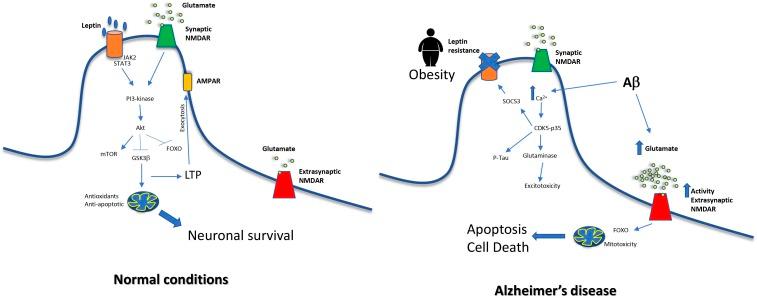
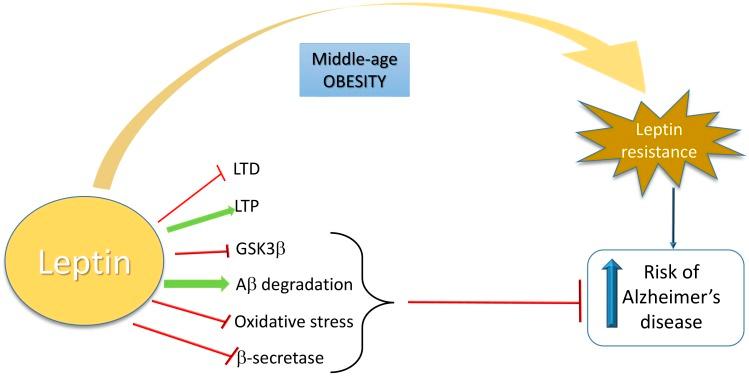
Obesity is known to induce leptin and insulin resistance. Leptin is a peptide hormone synthesized in adipose tissue that mainly regulates food intake. It has been shown that insulin stimulates the production of leptin when adipocytes are exposed to glucose to encourage satiety; while leptin, via a negative feedback, decreases the insulin release and enhances tissue sensitivity to it, leading to glucose uptake for energy utilization or storage. Therefore, resistance to insulin is closely related to leptin resistance. Obesity in middle age has also been related to Alzheimer's disease (AD). In recent years, the relation between impaired leptin signaling pathway and the onset of AD has been studied. In all this context the role of the blood brain barrier (BBB) is crucial. Slow excitotoxicity happens in AD due to an excess of the neurotransmitter glutamate. Since leptin has been shown to regulate -methyl-D-aspartate (NMDA) receptors, we want to review the link between these pathological pathways, and how they are affected by other AD triggering factors and its role in the onset of AD.
众所周知,肥胖会导致瘦素和胰岛素抵抗。瘦素是一种在脂肪组织中合成的肽类激素,主要调节食物摄入量。研究表明,当脂肪细胞暴露于葡萄糖时,胰岛素会刺激瘦素的产生以促进饱腹感;而瘦素通过负反馈减少胰岛素释放并增强组织对胰岛素的敏感性,从而促使葡萄糖摄取用于能量利用或储存。因此,胰岛素抵抗与瘦素抵抗密切相关。中年肥胖也与阿尔茨海默病(AD)有关。近年来,人们对瘦素信号通路受损与AD发病之间的关系进行了研究。在所有这些情况下,血脑屏障(BBB)的作用至关重要。由于神经递质谷氨酸过量,AD中会发生缓慢的兴奋性毒性。由于已证明瘦素可调节N-甲基-D-天冬氨酸(NMDA)受体,我们希望综述这些病理途径之间的联系,以及它们如何受到其他AD触发因素的影响及其在AD发病中的作用。
 Zotero 插件