Paelecke-Habermann Yvonne, Paelecke Marko, Mauth Juliane, Tschisgale Juliane, Lindenmeyer Johannes, Kübler Andrea
Institute of Psychology, Julius-Maximilians-University Würzburg, Würzburg, Germany.
Psychotherapeutical Practice, Child and Adolescent Behavioral Therapy, Köthen, Germany.
Addict Behav Rep. 2019 Mar 29;9:100178. doi: 10.1016/j.abrep.2019.100178. eCollection 2019 Jun.
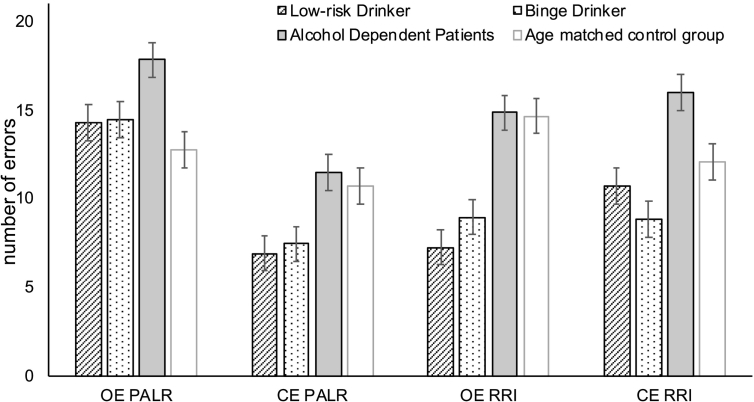
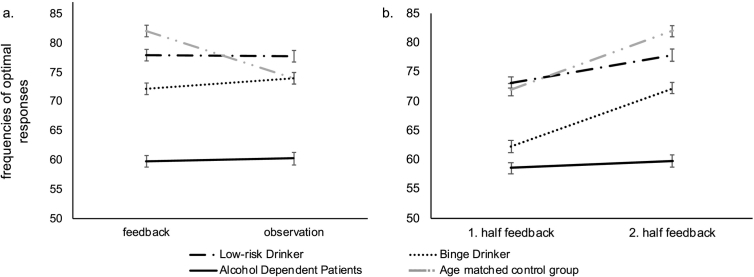
Chronic alcohol use leads to specific neurobiological alterations in the dopaminergic brain reward system, which probably are leading to a reward deficiency syndrome in alcohol dependence. The purpose of our study was to examine the effects of such hypothesized neurobiological alterations on the behavioral level, and more precisely on the implicit and explicit reward learning. Alcohol users were classified as dependent drinkers (using the DSM-IV criteria), binge drinkers (using criteria of the USA National Institute on Alcohol Abuse and Alcoholism) or low-risk drinkers (following recommendations of the Scientific board of trustees of the German Health Ministry). The final sample (n = 94) consisted of 36 low-risk alcohol users, 37 binge drinkers and 21 abstinent alcohol dependent patients. Participants were administered a probabilistic implicit reward learning task and an explicit reward- and punishment-based trial-and-error-learning task. Alcohol dependent patients showed a lower performance in implicit and explicit reward learning than low risk drinkers. Binge drinkers learned less than low-risk drinkers in the implicit learning task. The results support the assumption that binge drinking and alcohol dependence are related to a chronic reward deficit. Binge drinking accompanied by implicit reward learning deficits could increase the risk for the development of an alcohol dependence.
长期饮酒会导致多巴胺能脑奖赏系统发生特定的神经生物学改变,这可能会导致酒精依赖中的奖赏缺乏综合征。我们研究的目的是在行为层面,更确切地说是在隐性和显性奖赏学习方面,研究这种假设的神经生物学改变的影响。饮酒者被分为依赖饮酒者(使用DSM-IV标准)、暴饮者(使用美国国家酒精滥用与酒精中毒研究所的标准)或低风险饮酒者(遵循德国卫生部科学董事会的建议)。最终样本(n = 94)包括36名低风险饮酒者、37名暴饮者和21名戒酒的酒精依赖患者。参与者接受了概率性隐性奖赏学习任务和基于显性奖赏与惩罚的试错学习任务。酒精依赖患者在隐性和显性奖赏学习方面的表现低于低风险饮酒者。暴饮者在隐性学习任务中的学习能力低于低风险饮酒者。结果支持了暴饮和酒精依赖与慢性奖赏缺陷有关的假设。伴有隐性奖赏学习缺陷的暴饮可能会增加发展为酒精依赖的风险。