de Aquino Moura Karolinny Borinelli, Behrens Paula Marques Prates, Pirolli Rafaela, Sauer Aimee, Melamed Dayana, Veronese Francisco Veríssimo, da Silva André Luis Ferreira Azeredo
Division of Internal Medicine, Hospital de Clínicas de Porto Alegre, Porto Alegre, Rio Grande do Sul, Brazil.
Division of Nephrology, Hospital de Clínicas de Porto Alegre, Porto Alegre, Rio Grande do Sul, Brazil.
Clin Kidney J. 2019 Jan 4;12(3):400-407. doi: 10.1093/ckj/sfy133. eCollection 2019 Jun.
The aim of this study was to report the prevalence and mortality associated with anticoagulant-related nephropathy (ARN) through a systematic review of the literature.
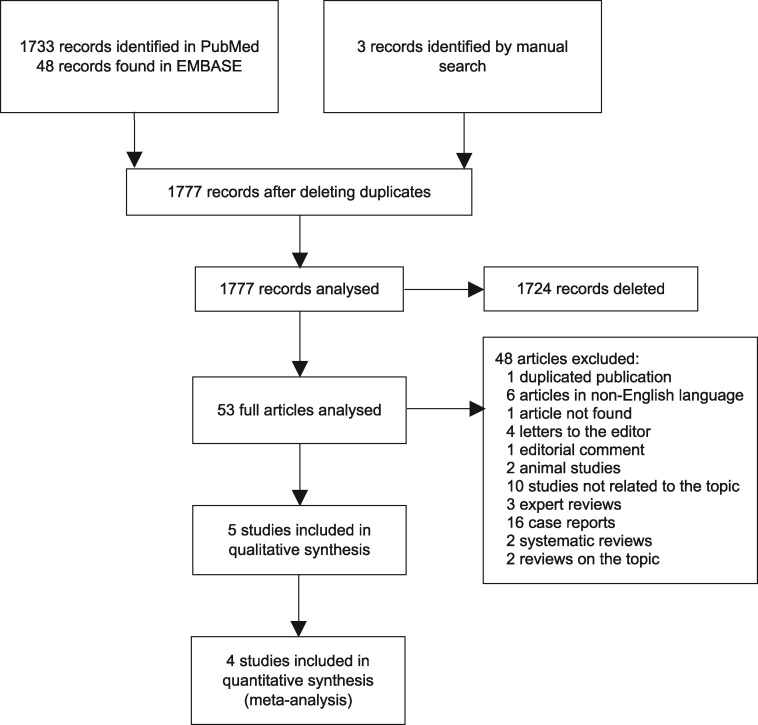
Electronic searches were conducted in the Medline and EMBASE databases, and manual searches were performed in the reference lists of the identified studies. The studies were selected by two independent researchers, first by evaluating the titles and abstracts and then by reading the complete texts of the identified studies. Case series, cross-sectional studies, cohort studies and case-control studies reporting the prevalence and factors associated with ARN were selected. The methodological quality was assessed using the Newcastle-Ottawa scale. Meta-analyses of the prevalence of ARN and 5-year mortality using the random effects model were performed when possible. Heterogeneity was assessed using the statistic.
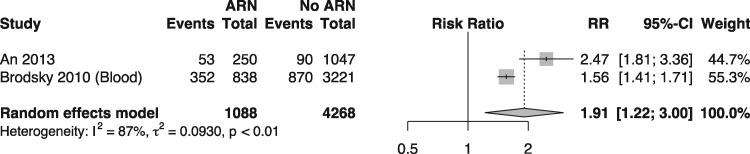
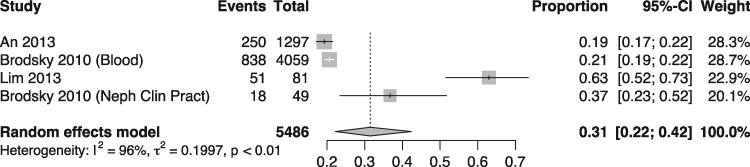
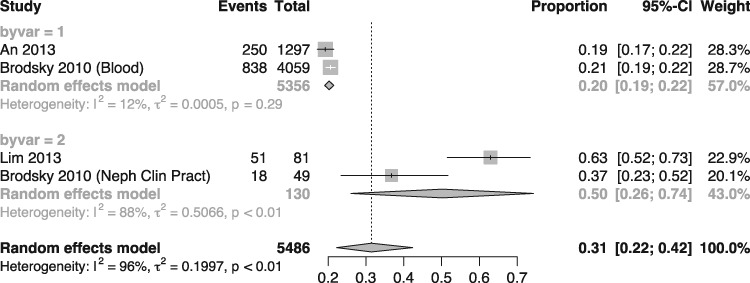
Five studies were included. Prevalence of ARN ranged from 19% to 63% among the four included cohort studies. Meta-analysis of these resulted in high heterogeneity [ 96%, summary effect 31%; 95% confidence interval (CI) 22-42%]. Subgroup meta-analysis yielded an ARN prevalence of 20% among studies that included patients with fewer comorbidities ( 12%; 95% CI 19-22%). In a direct comparison, meta-analysis of the 5-year mortality rate between anticoagulated patients who had experienced ARN and anticoagulated patients without ARN, patients with ARN were 91% more likely to die (risk ratio = 1.91; 95% CI 1.22-3; 87%). Risk factors for ARN that were reported in the literature included initial excessive anticoagulation, chronic kidney disease, age, diabetes, hypertension, cardiovascular disease and heart failure.
ARN studies are scarce and heterogeneous, and present significant methodological limitations. The high prevalence of ARN reported herein suggests that this entity is underdiagnosed in clinical practice. Mortality in patients with ARN seems to be high compared with patients without this condition in observational studies.
本研究旨在通过对文献的系统评价,报告抗凝相关肾病(ARN)的患病率及死亡率。
在Medline和EMBASE数据库中进行电子检索,并在已识别研究的参考文献列表中进行手动检索。由两名独立研究人员选择研究,首先评估标题和摘要,然后阅读已识别研究的全文。选择报告ARN患病率及相关因素的病例系列研究、横断面研究、队列研究和病例对照研究。使用纽卡斯尔-渥太华量表评估方法学质量。尽可能使用随机效应模型对ARN患病率和5年死亡率进行荟萃分析。使用 统计量评估异质性。
纳入五项研究。在四项纳入的队列研究中,ARN患病率在19%至63%之间。对这些研究进行荟萃分析导致高度异质性[ 96%,汇总效应31%;95%置信区间(CI)22 - 42%]。亚组荟萃分析显示,在合并症较少的患者( 12%;95% CI 19 - 22%)的研究中,ARN患病率为20%。在直接比较中,对经历过ARN的抗凝患者与未经历ARN的抗凝患者的5年死亡率进行荟萃分析,ARN患者死亡可能性高91%(风险比 = 1.91;95% CI 1.22 - 3; 87%)。文献中报道的ARN危险因素包括初始过度抗凝、慢性肾病、年龄、糖尿病、高血压、心血管疾病和心力衰竭。
ARN研究稀缺且异质性大,存在显著的方法学局限性。本文报道的ARN高患病率表明该疾病在临床实践中未得到充分诊断。在观察性研究中,与无此疾病的患者相比,ARN患者的死亡率似乎较高。