Silveira Fernanda P, Saul Melissa, Nowalk Mary Patricia, Saul Sean, Sax Theresa M, Eng Heather, Zimmerman Richard K, Balasubramani Goundappa K
Department of Medicine, School of Medicine, University of Pittsburgh, Pennsylvania.
Department of Family Medicine, School of Medicine, University of Pittsburgh, Pennsylvania.
Open Forum Infect Dis. 2019 Jun 10;6(6):ofz231. doi: 10.1093/ofid/ofz231. eCollection 2019 Jun.
A clinical informatics algorithm (CIA) was developed to systematically identify potential enrollees for a test-negative, case-control study to determine influenza vaccine effectiveness, to improve enrollment over manual records review. Further testing may enhance the CIA for increased efficiency.
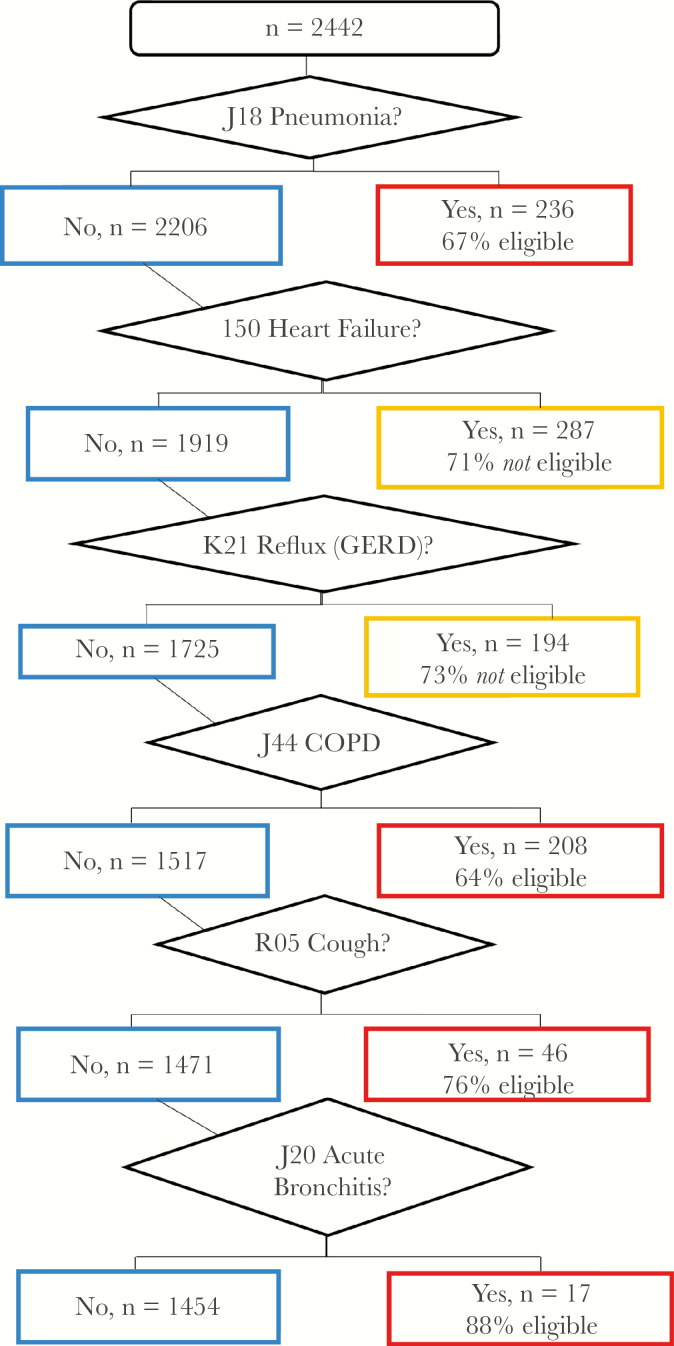
The CIA generated a daily screening list by querying all medical record databases for patients admitted in the last 3 days, using specified terms and diagnosis codes located in admission notes, emergency department notes, chief complaint upon registration, or presence of a respiratory viral panel charge or laboratory result (RVP). Classification and regression tree analysis (CART) and multivariable logistic regression were used to refine the algorithm.
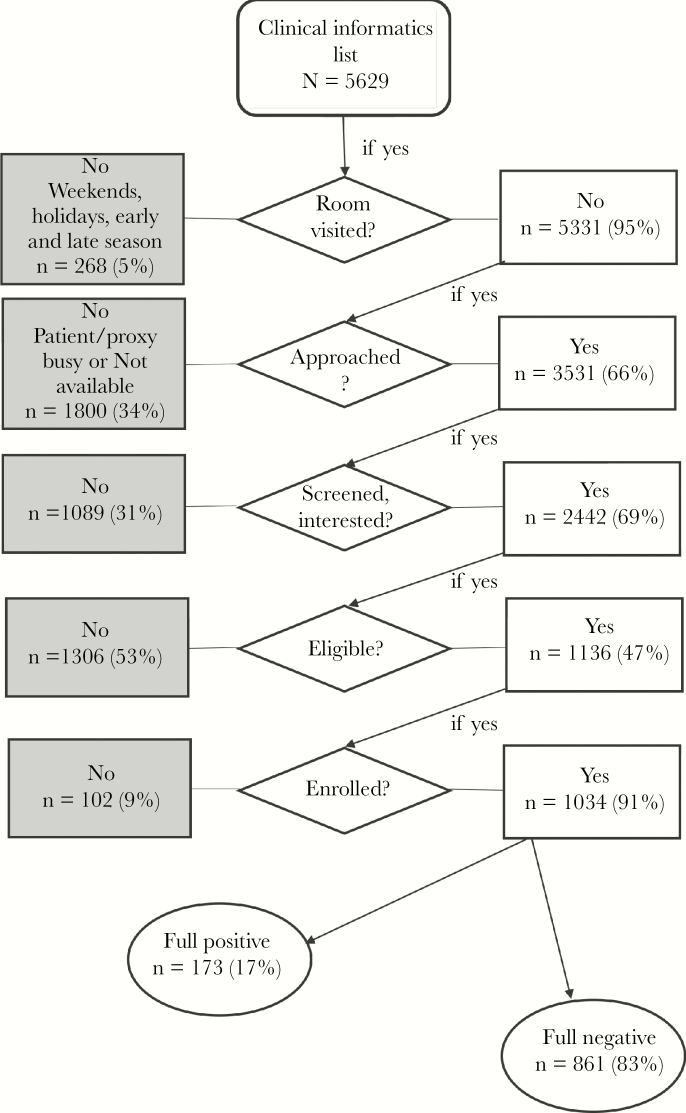
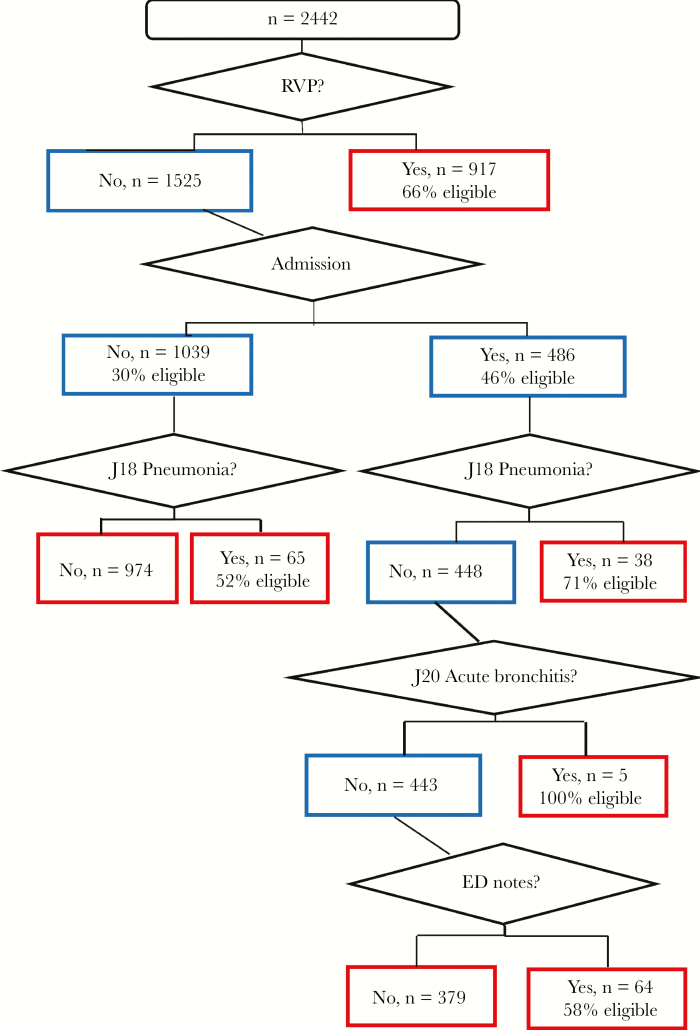
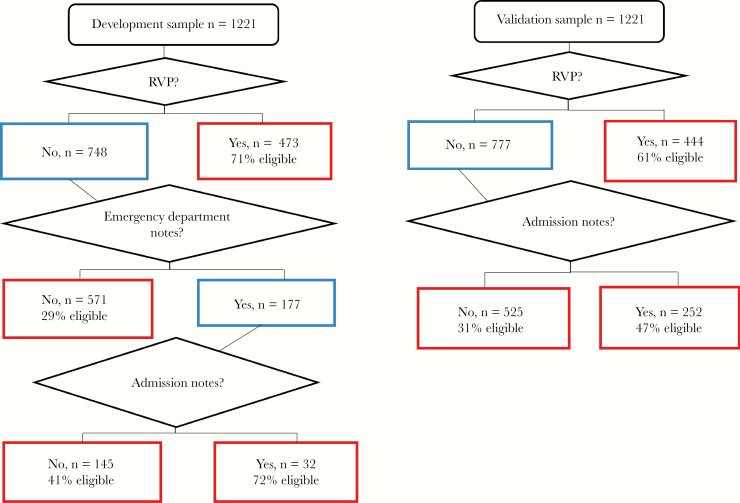
Using manual records review, 204 patients (<4/day) were approached and 144 were eligible in the 2014-2015 season compared with 3531 (12/day) patients who were approached and 1136 who were eligible in the 2016-2017 season using a CIA. CART analysis identified RVP as the most important indicator from the CIA list for determining eligibility, identifying 65%-69% of the samples and predicting 1587 eligible patients. RVP was confirmed as the most significant predictor in regression analysis, with an odds ratio (OR) of 4.9 (95% confidence interval [CI], 4.0-6.0). Other significant factors were indicators in admission notes (OR, 2.3 [95% CI, 1.9-2.8]) and emergency department notes (OR, 1.8 [95% CI, 1.4-2.3]).
This study supports the benefits of a CIA to facilitate recruitment of eligible participants in clinical research over manual records review. Logistic regression and CART identified potential eligibility screening criteria reductions to improve the CIA's efficiency.
开发了一种临床信息学算法(CIA),用于系统地识别检测呈阴性的病例对照研究的潜在参与者,以确定流感疫苗的有效性,从而提高与人工病历审查相比的招募效率。进一步测试可能会增强CIA以提高效率。
CIA通过查询过去3天内入院患者的所有病历数据库,使用入院记录、急诊科记录、登记时的主要诉求中指定的术语和诊断代码,或存在呼吸道病毒检测费用或实验室结果(RVP)来生成每日筛查清单。使用分类与回归树分析(CART)和多变量逻辑回归来优化该算法。
在2014 - 2015季节,通过人工病历审查,接触了204名患者(每天<4名),其中144名符合条件;而在2016 - 2017季节,使用CIA接触了3531名患者(每天12名),其中1136名符合条件。CART分析确定RVP是CIA清单中用于确定资格的最重要指标,识别出65% - 69%的样本并预测出1587名符合条件的患者。在回归分析中,RVP被确认为最显著的预测因子,优势比(OR)为4.9(95%置信区间[CI],4.0 - 6.0)。其他重要因素是入院记录中的指标(OR,2.3[95%CI,1.9 - 2.8])和急诊科记录中的指标(OR,1.8[95%CI,1.4 - 2.3])。
本研究支持CIA在促进临床研究中招募符合条件的参与者方面优于人工病历审查。逻辑回归和CART确定了潜在的资格筛选标准减少方案,以提高CIA的效率。