Institute of Genetics, Vetsuisse Faculty, University of Bern, 3001 Bern, Switzerland.
Ophthalmology Section, Vetsuisse Faculty, University of Zurich, 8057 Zurich, Switzerland.
Genes (Basel). 2019 Jun 14;10(6):454. doi: 10.3390/genes10060454.
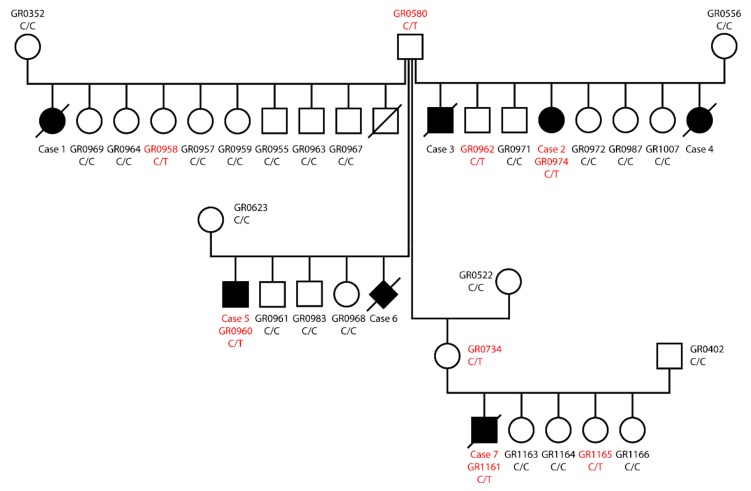
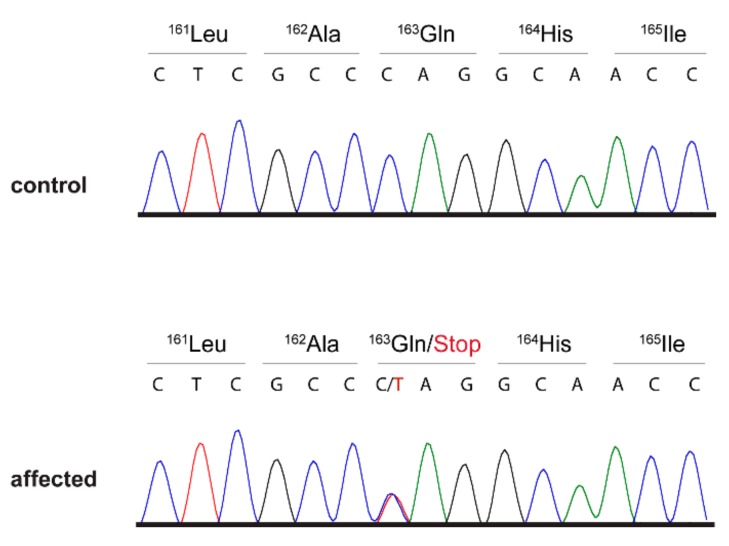
Causative genetic variants for more than 30 heritable eye disorders in dogs have been reported. For other clinically described eye disorders, the genetic cause is still unclear. We investigated four Golden Retriever litters segregating for highly variable congenital eye malformations. Several affected puppies had unilateral or bilateral retina dysplasia and/or optic nerve hypoplasia. The four litters shared the same father or grandfather suggesting a heritable condition with an autosomal dominant mode of inheritance. The genome of one affected dog was sequenced and compared to 601 control genomes. A heterozygous private nonsense variant, c.487C>T, was found in the gene. This variant is predicted to truncate about a third of the open reading frame, p.(Gln163*). We genotyped all available family members and 464 unrelated Golden Retrievers. All three available cases were heterozygous. Five additional close relatives including the common sire were also heterozygous, but did not show any obvious eye phenotypes. The variant was absent from the 464 unrelated Golden Retrievers and 17 non-affected siblings of the cases. The SIX6 protein is a homeobox transcription factor with a known role in eye development. In humans and other species, loss of function variants were reported to cause congenital eye malformations. This strongly suggests that the c.487C>T variant detected contributed to the observed eye malformations. We hypothesize that the residual amount of functional SIX6 protein likely to be expressed in heterozygous dogs is sufficient to explain the observed incomplete penetrance and the varying severity of the eye defects in the affected dogs.
已经报道了超过 30 种遗传性眼部疾病的致病遗传变异。对于其他临床描述的眼部疾病,遗传原因仍不清楚。我们研究了四个金猎犬窝,这些窝都有高度可变的先天性眼部畸形。一些受影响的小狗有单侧或双侧视网膜发育不良和/或视神经发育不良。这四个窝都有同一个父亲或祖父,这表明存在一种遗传性疾病,遗传方式为常染色体显性遗传。受影响的一只狗的基因组被测序并与 601 个对照基因组进行比较。在 基因中发现了一个杂合的私有无义变异,c.487C>T。该变体预计会截断大约三分之一的开放阅读框,p.(Gln163*)。我们对所有可用的家族成员和 464 只无关的金毛猎犬进行了基因分型。三个可用的病例均为杂合子。包括共同父本在内的另外五个近亲也为杂合子,但没有表现出任何明显的眼部表型。该变体在 464 只无关的金毛猎犬和 17 个病例的非受影响的兄弟姐妹中均不存在。SIX6 蛋白是一种同源盒转录因子,已知在眼睛发育中起作用。在人类和其他物种中,报道的功能丧失变异导致先天性眼部畸形。这强烈表明,检测到的 c.487C>T 变体导致了观察到的眼部畸形。我们假设,杂合子狗中表达的功能性 SIX6 蛋白的残留量可能足以解释受影响狗中观察到的不完全外显率和眼部缺陷的不同严重程度。