Department of Civil Engineering, Aalborg University, Thomas Manns Vej 23, 9220, Aalborg Øst, Denmark.
School of Architecture, Tsinghua University, Haidian District, 100084, Beijing, China.
Sci Rep. 2019 Jun 17;9(1):8670. doi: 10.1038/s41598-019-45054-w.
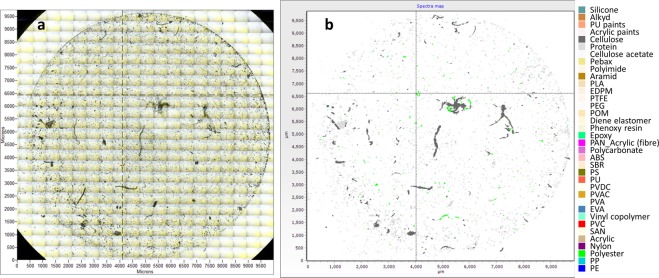
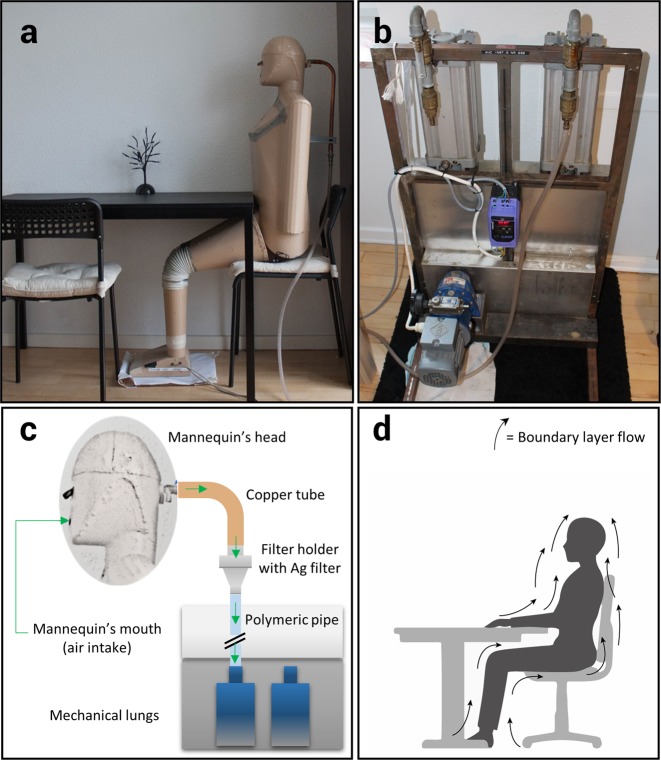
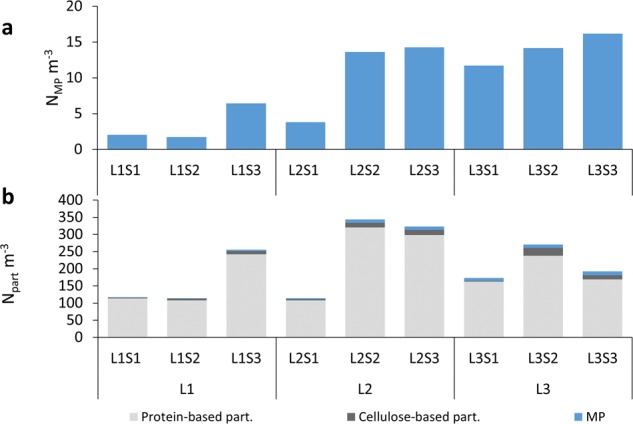
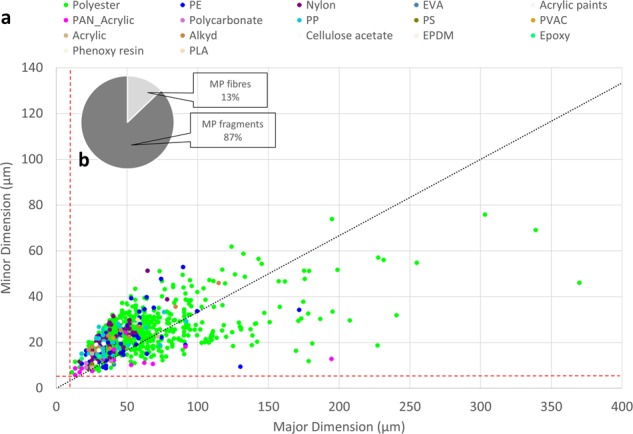
Humans are potentially exposed to microplastics through food, drink, and air. The first two pathways have received quite some scientific attention, while little is known about the latter. We address the exposure of humans to indoor airborne microplastics using a Breathing Thermal Manikin. Three apartments were investigated, and samples analysed through FPA-µFTIR-Imaging spectroscopy followed by automatic analyses down to 11 µm particle size. All samples were contaminated with microplastics, with concentrations between 1.7 and 16.2 particles m. Synthetic fragments and fibres accounted, on average, for 4% of the total identified particles, while nonsynthetic particles of protein and cellulose constituted 91% and 4%, respectively. Polyester was the predominant synthetic polymer in all samples (81%), followed by polyethylene (5%), and nylon (3%). Microplastics were typically of smaller size than nonsynthetic particles. As the identified microplastics can be inhaled, these results highlight the potential direct human exposure to microplastic contamination via indoor air.
人类可能通过食物、饮料和空气接触到微塑料。前两种途径已经引起了相当多的科学关注,而对于后者知之甚少。我们使用呼吸热模型来研究人类室内空气传播微塑料的暴露情况。研究了三个公寓,并通过 FPA-µFTIR-成像光谱法对样品进行分析,然后通过自动分析将粒径缩小到 11 µm。所有样品都被微塑料污染,浓度在 1.7 到 16.2 个颗粒/m 之间。合成碎片和纤维平均占总识别颗粒的 4%,而蛋白质和纤维素的非合成颗粒分别占 91%和 4%。在所有样品中,聚酯都是主要的合成聚合物(81%),其次是聚乙烯(5%)和尼龙(3%)。微塑料的尺寸通常比非合成颗粒小。由于所识别的微塑料可以被吸入,这些结果突出了人类通过室内空气直接接触微塑料污染的潜在风险。