Department of Pediatric Newborn Medicine, Brigham and Women's Hospital, Brigham and Women's Hospital, Boston, MA, USA.
Harvard Medical School, Brigham and Women's Hospital, Boston, MA, USA.
J Perinatol. 2019 Aug;39(8):1057-1064. doi: 10.1038/s41372-019-0404-z. Epub 2019 Jun 18.
To determine (1) whether higher maternal body mass index (BMI) and Cesarean (C) Section mode of delivery are associated with neonatal hypoglycemia (NH) and (2) whether timing of NH onset differs by risk factors.
Retrospective cohort study (n = 4602) to determine the odds of NH, NH requiring IV dextrose and timing of NH onset among infants with established and plausible (BMI and C-section) risk factors.
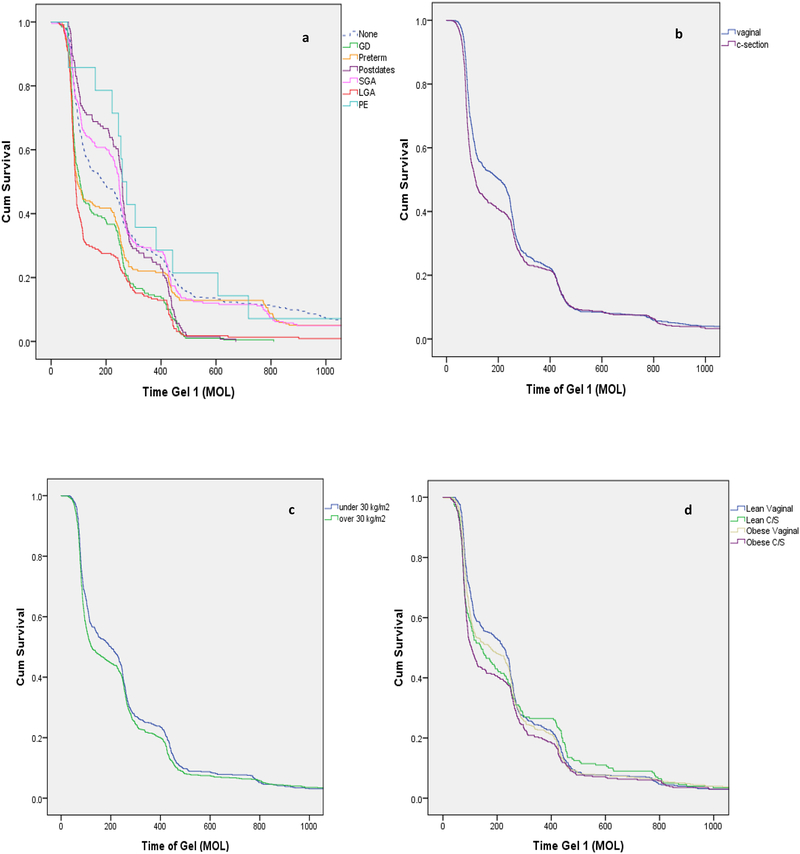
Infants born to class III obese mothers had higher odds of NH (OR 1.3, 95% CI 1.0-1.8) and of requiring IV dextrose (OR 2.2, 95% CI 1.2-3.9). Infants born via C-section had higher odds of requiring IV dextrose (OR 1.4, 95% CI 1.1-1.9). Infants who were delivered to high BMI mothers and by C-section developed NH earlier than the reference group.
Determining the predictors and timing of NH onset may help develop tailored evaluation and management strategies for at-risk neonates.
确定(1)较高的产妇体重指数(BMI)和剖宫产(C)分娩方式是否与新生儿低血糖(NH)有关,以及(2)NH 发作的时间是否因危险因素而不同。
回顾性队列研究(n=4602),以确定已确定和可能存在(BMI 和 C 节段)危险因素的婴儿发生 NH、NH 需要静脉注射葡萄糖以及 NH 发作时间的几率。
III 级肥胖母亲所生婴儿发生 NH 的几率更高(OR 1.3,95%CI 1.0-1.8),需要静脉注射葡萄糖的几率也更高(OR 2.2,95%CI 1.2-3.9)。剖宫产分娩的婴儿需要静脉注射葡萄糖的几率更高(OR 1.4,95%CI 1.1-1.9)。由高 BMI 母亲和剖宫产分娩的婴儿比参考组更早出现 NH。
确定 NH 发作的预测因素和时间可能有助于为高危新生儿制定个性化的评估和管理策略。