British Heart Foundation Centre for Cardiovascular Science, Queen's Medical Research Institute, University of Edinburgh, 47 Little France Crescent, Edinburgh, EH14 6TJ, UK.
Tommy's Centre for Maternal and Fetal Health, Medical Research Council Centre for Reproductive Health, Queen's Medical Research Institute, University of Edinburgh, Edinburgh, UK.
Diabetologia. 2019 Aug;62(8):1412-1419. doi: 10.1007/s00125-019-4891-4. Epub 2019 Jun 19.
AIMS/HYPOTHESIS: Maternal obesity in pregnancy is associated with cardiovascular disease and mortality rate in the offspring. We aimed to determine whether maternal obesity is also associated with increased incidence of type 2 and type 1 diabetes in the offspring, independently of maternal diabetes as a candidate mechanistic pathway.
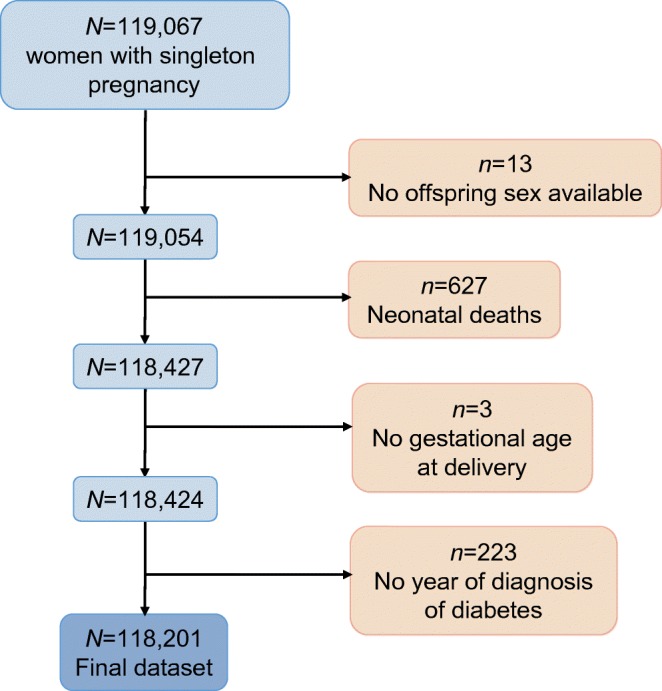
Birth records of 118,201 children from 1950 to 2011 in the Aberdeen Maternity and Neonatal Databank were linked to Scottish Care Information-Diabetes, the national register for diagnosed diabetes in Scotland, to identify incident and prevalent type 1 and type 2 diabetes up to 1 January 2012. Maternal BMI was calculated from height and weight measured at the first antenatal visit. The effect of maternal obesity on offspring outcomes was tested using time-to-event analysis with Cox proportional hazards regression to compare outcomes in offspring of mothers in underweight, overweight or obese categories of BMI, compared with offspring of women with normal BMI.
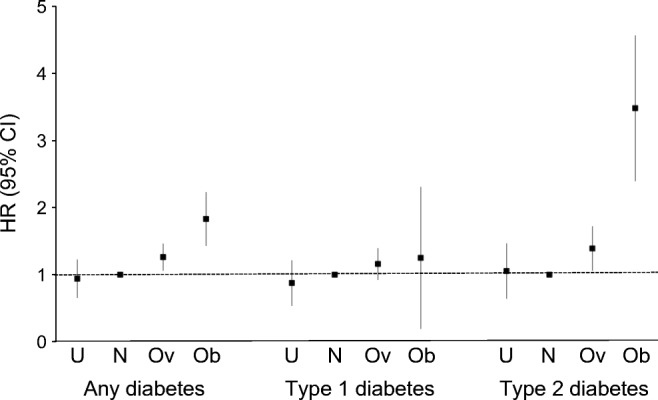
Offspring of obese (BMI ≥30 kg/m) and overweight (BMI 25-29.9 kg/m) mothers had an increased hazard of type 2 diabetes compared with mothers with normal BMI, after adjustment for gestation when weight was measured, maternal history of diabetes before pregnancy, maternal history of hypertension, age at delivery, parity, socioeconomic status, and sex of the offspring: HR 3.48 (95% CI 2.33, 5.06) and HR 1.39 (1.06, 1.83), respectively.
CONCLUSIONS/INTERPRETATION: Maternal obesity is associated with increased incidence of type 2 diabetes in the offspring. Evidence-based strategies that reduce obesity among women of reproductive age and that might reduce the incidence of diabetes in their offspring are urgently required.
目的/假设:孕期母体肥胖与后代心血管疾病和死亡率相关。我们旨在确定母体肥胖是否也与后代 2 型和 1 型糖尿病的发病率增加相关,而不考虑母体糖尿病作为候选机制途径。
从 1950 年至 2011 年的阿伯丁母婴数据库中链接了 118201 名儿童的出生记录和苏格兰护理信息-糖尿病,这是苏格兰诊断糖尿病的国家登记处,以确定截至 2012 年 1 月 1 日的 1 型和 2 型糖尿病的发病和现患病例。在首次产前检查时,根据身高和体重计算母体 BMI。使用时间事件分析和 Cox 比例风险回归来测试母体肥胖对后代结局的影响,比较体重指数处于消瘦、超重或肥胖类别的母亲的后代与体重指数正常的母亲的后代的结局。
与体重指数正常的母亲相比,肥胖(BMI≥30kg/m)和超重(BMI 25-29.9kg/m)母亲的后代发生 2 型糖尿病的风险增加,调整了测量体重时的妊娠时间、怀孕前母亲的糖尿病病史、母亲的高血压病史、分娩年龄、产次、社会经济地位和后代的性别:HR 3.48(95%CI 2.33,5.06)和 HR 1.39(1.06,1.83)。
结论/解释:母体肥胖与后代 2 型糖尿病的发病率增加相关。迫切需要针对育龄妇女的循证策略来减少肥胖,并可能降低其后代的糖尿病发病率。