Health Economics and Policy Research, School of Commerce, Faculty of Business, Education, Law and Arts, Centre for Health, Informatics and Economic Research, University of Southern Queensland, Toowoomba, Queensland, Australia.
Health Economics and Financing Research, International Centre for Diarrhoeal Disease Research, Dhaka, Bangladesh.
PLoS One. 2019 Jun 19;14(6):e0218515. doi: 10.1371/journal.pone.0218515. eCollection 2019.
Child health remains an important public health concern at the global level, with preventable diseases such as diarrheal disease, acute respiratory infection (ARI) and fever posing a large public health burden in low- and middle-income countries including Bangladesh. Improvements in socio-economic conditions have tended to benefit advantaged groups in societies, which has resulted in widespread inequalities in health outcomes. This study examined how socioeconomic inequality is associated with childhood morbidity in Bangladesh, and identified the factors affecting three illnesses: diarrhea, ARI and fever.
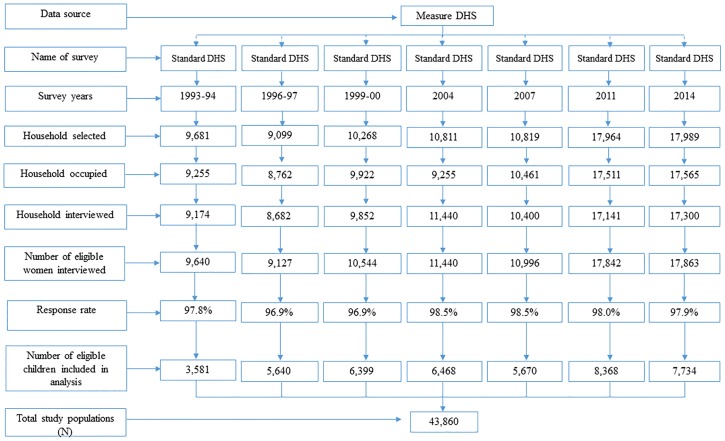
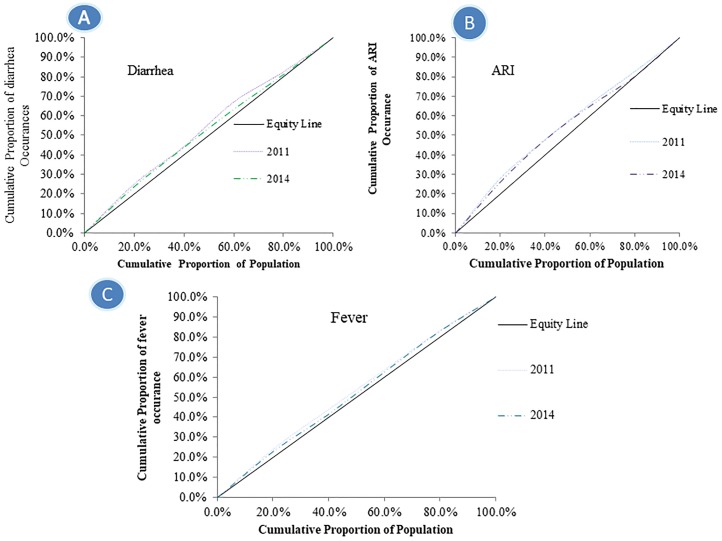
A total of 43,860 sample observations from the Bangladesh Demographic and Health Survey, spanning a 22-year period (1993-2014), were analysed. Concentration curve and concentration index methods were used to evaluate changes in the degree of household wealth-related inequalities and related trends in childhood morbidity. Regression-based decomposition analyses were used to attribute the inequality disparities to individual determinants for the three selected causes of childhood morbidity.
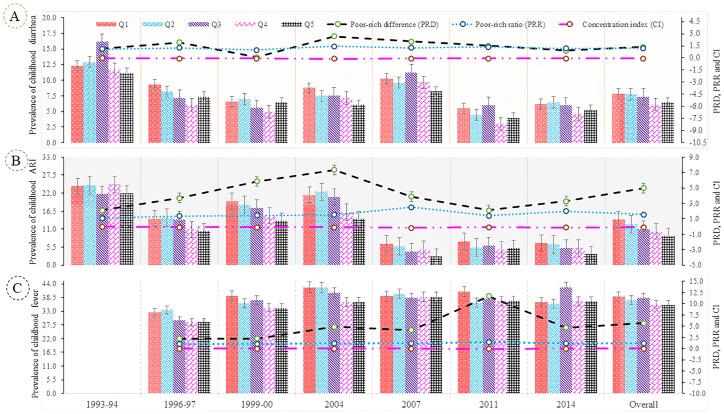
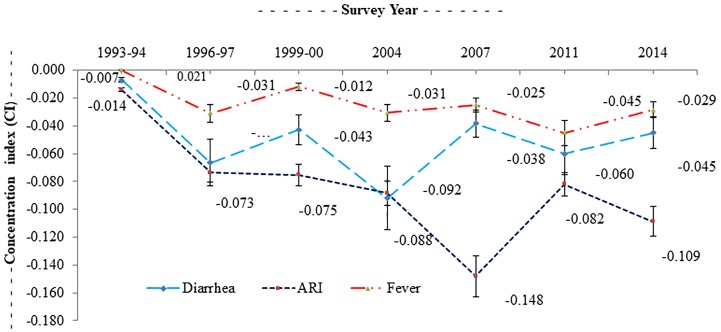
The overall magnitude of inequality in relation to childhood morbidity has been declining slowly over the 22-year period. The magnitude of socio-economic inequality as a cause of childhood morbidity varied during the period. Decomposition analyses attributed the inequalities to poor maternal education attainment, inadequate pre-delivery care, adverse chronic undernutrition status and low immunisation coverage.
High rates of childhood morbidity were observed, although these have declined over time. Socio-economic inequality is strongly associated with childhood morbidity. Socio-economically disadvantaged communities need to be assisted and interventions should emphasise improvements of, and easier access to, health care services. These will be key to improving the health status of children in Bangladesh and should reduce economic inequality through improved health over time.
儿童健康仍然是全球公共卫生关注的重要问题,在孟加拉国等低收入和中等收入国家,腹泻病、急性呼吸道感染(ARI)和发热等可预防疾病对公共卫生造成了巨大负担。社会经济条件的改善往往使社会中的优势群体受益,这导致了健康结果的广泛不平等。本研究考察了社会经济不平等与孟加拉国儿童发病的关系,并确定了影响三种疾病(腹泻、ARI 和发热)的因素。
对跨越 22 年(1993-2014 年)的孟加拉国人口与健康调查的 43860 个样本观察值进行了分析。使用集中曲线和集中指数方法评估了与家庭财富相关的不平等程度的变化以及儿童发病的相关趋势。基于回归的分解分析用于将不平等差异归因于三个选定儿童发病原因的个体决定因素。
与儿童发病相关的整体不平等程度在 22 年期间缓慢下降。社会经济不平等作为儿童发病原因的程度在期间有所变化。分解分析将不平等归因于母亲教育程度低、分娩前护理不足、慢性不良营养状况和低免疫接种率。
尽管儿童发病的比例很高,但随着时间的推移,这些比例有所下降。社会经济不平等与儿童发病密切相关。社会经济处于不利地位的社区需要得到帮助,干预措施应强调改善和更容易获得医疗保健服务。这将是改善孟加拉国儿童健康状况的关键,并应通过改善健康状况随着时间的推移减少经济不平等。