School of Computing, Mathematics and Engineering, Charles Sturt University, Wagga Wagga, NSW, 2678, Australia.
Department of Statistics, Jahangirnagar University, Dhaka, 1342, Bangladesh.
BMC Pediatr. 2022 Mar 5;22(1):117. doi: 10.1186/s12887-022-03166-9.
Although efforts have been made by the international community to improve childhood health, risk factors linked with the healthiness of preschool-age children in low and middle-income countries (LMICs) are very diverse. Therefore, this paper examines the prevalence and determinants of fever, acute respiratory infection and diarrhea of preschool children in Bangladesh.
A sample of 8,421 children from the latest country representative BDHS-2017-18 survey was analyzed by utilizing both the bivariate and multivariate techniques.
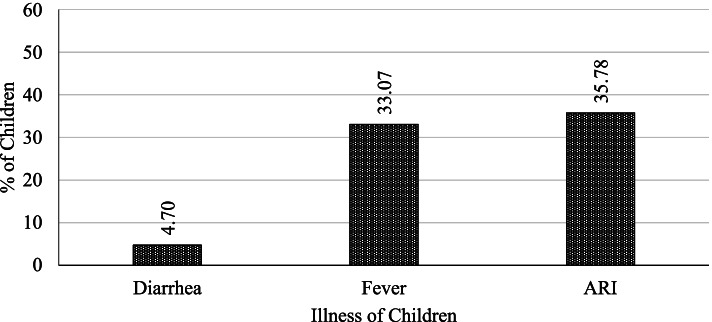
The results revealed that about 4.7, 33.1, and 35.8% of the children aged under 5 years had suffered from diarrhea, fever and ARI respectively during the 2 weeks preceding the date of the survey. Demographic, socio-economic, and community and health characteristics likely to play an important role in suffering under-five children from diarrhea, fever, and ARI in Bangladesh. The child's age of 13-24 months, delivery by cesarean section, unsafe drinking water, unhygienic toilet facility, low level of family wealth index and parental education, a higher number of living children in the household, rural residency and regional difference were all found to be most crucial determinants of the occurrences of fever, ARI and diarrhea.
Interventions should focus on improving these significant demographic, socioeconomic, and community and health risk factors. A special attention is necessary to the people who live in rural areas and geospatially disadvantaged regions.
尽管国际社会为改善儿童健康做出了努力,但与中低收入国家(LMICs)学龄前儿童健康相关的风险因素非常多样化。因此,本文研究了孟加拉国学龄前儿童发热、急性呼吸道感染和腹泻的流行情况及其决定因素。
利用双变量和多变量技术,对最新的国家代表性 BDHS-2017-18 调查中的 8421 名儿童样本进行了分析。
调查结果显示,在调查日期前两周,约有 4.7%、33.1%和 35.8%的 5 岁以下儿童分别患有腹泻、发热和急性呼吸道感染。人口统计学、社会经济以及社区和卫生特征可能在孟加拉国 5 岁以下儿童腹泻、发热和急性呼吸道感染方面发挥重要作用。儿童年龄在 13-24 个月之间、剖宫产分娩、不安全饮用水、不卫生的厕所设施、家庭财富指数和父母教育水平较低、家庭中儿童数量较多、农村居住和地区差异均被认为是发热、急性呼吸道感染和腹泻发生的最关键决定因素。
干预措施应重点关注改善这些重要的人口统计学、社会经济以及社区和卫生风险因素。需要特别关注生活在农村地区和地理上处于不利地位的人群。