Bishop Nicole, Boone Darrell, Williams Kerry-Lynn, Avery Roger, Dubrowski Adam
Medical Education and Simulation, Memorial University of Newfoundland, St. John's, CAN.
General Surgery, Memorial University of Newfoundland, St. John's, CAN.
Cureus. 2019 Apr 3;11(4):e4373. doi: 10.7759/cureus.4373.
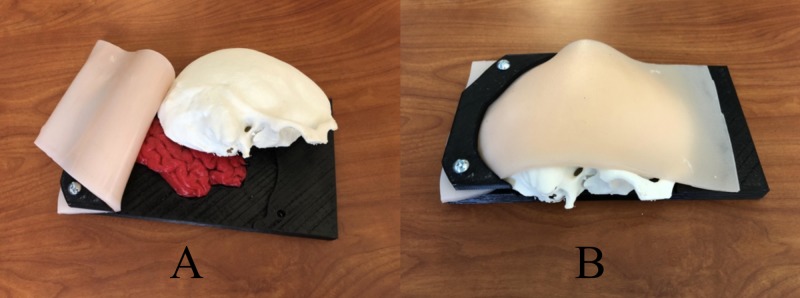
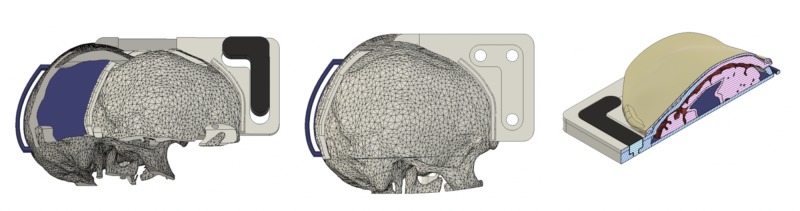
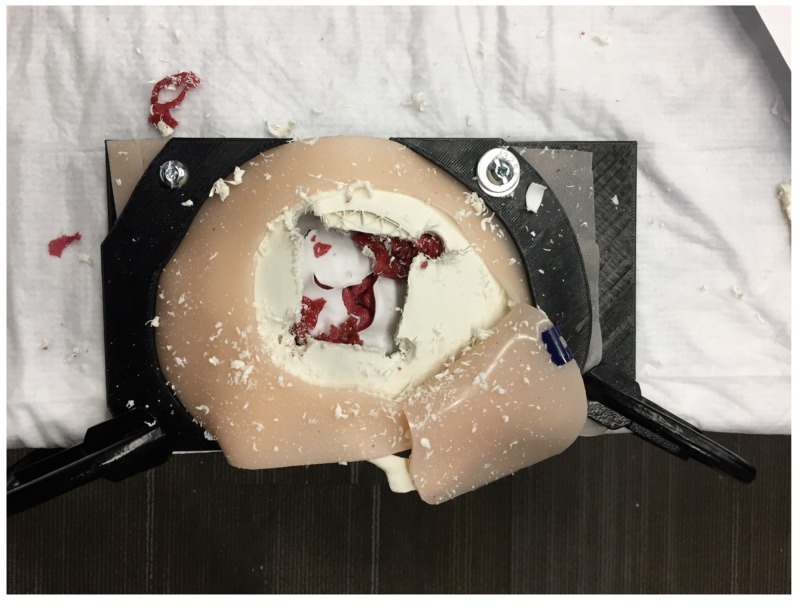
Patients with a traumatic head injury (THI) require immediate surgical intervention, as rapidly expanding intracranial hematomas can be imminently life-threatening, not permitting transfer time to neurosurgical care in a tertiary care center. In rural and remote areas, where neurosurgeons may not be readily available, surgical intervention by Community General Surgeons (CGS) may be required. Currently, the CGS in Newfoundland and Labrador (NL) do not have access to, or have experience training with, an emergent burr hole/craniotomy (EBHC) simulator. One of the barriers is the availability of inexpensive and reliable simulators to practice these skills. Therefore, a low-cost, three-dimensional (3D) printed EBHC simulator was designed and 3D-printed by MUN Med 3D (St John's, NL). The aim of this technical report is to assess the need for such simulator in rural and remote healthcare centers and report on the iterative development of the EBHC simulator. The 3D-printed EBHC simulator developed by MUN Med 3D was utilized during a general surgery workshop at the 26 Annual Rural and Remote Medicine Conference in St. John's, NL. A total of six 3D-printed EBHC simulators were provided for the hour and a half workshop. At the end of the workshop, 16 participants were asked to provide feedback on the need for this simulator in their rural or remote environment as well as feedback on the physical attributes. The feedback received from the participants was overall positive, informative, and supported the need for the 3D-printed EBHC simulator.
创伤性颅脑损伤(THI)患者需要立即进行手术干预,因为迅速扩大的颅内血肿可能会即刻危及生命,不允许将患者转运至三级护理中心接受神经外科治疗。在农村和偏远地区,可能无法随时找到神经外科医生,因此可能需要社区普通外科医生(CGS)进行手术干预。目前,纽芬兰和拉布拉多省(NL)的社区普通外科医生无法使用紧急钻孔/开颅术(EBHC)模拟器,也没有使用该模拟器进行培训的经验。其中一个障碍是缺乏用于练习这些技能的廉价且可靠的模拟器。因此,由MUN Med 3D(纽芬兰和拉布拉多省圣约翰斯)设计并3D打印了一种低成本的三维(3D)打印EBHC模拟器。本技术报告的目的是评估农村和偏远医疗中心对这种模拟器的需求,并报告EBHC模拟器的迭代开发情况。在纽芬兰和拉布拉多省圣约翰斯举行的第26届年度农村和偏远地区医学会议的普通外科研讨会上,使用了由MUN Med 3D开发的3D打印EBHC模拟器。在为时一个半小时的研讨会上,总共提供了六个3D打印的EBHC模拟器。研讨会结束时,16名参与者被要求就这种模拟器在他们所在的农村或偏远地区的需求以及其物理属性提供反馈。从参与者那里收到的反馈总体上是积极的、信息丰富的,并支持对3D打印EBHC模拟器的需求。