1 Department of Medical Biochemistry, Faculty of Medicine, Hacettepe University, Ankara, Turkey.
2 Division of Hematology, Department of Internal Medicine, Faculty of Medicine, Hacettepe University, Ankara, Turkey.
Clin Appl Thromb Hemost. 2019 Jan-Dec;25:1076029619858409. doi: 10.1177/1076029619858409.
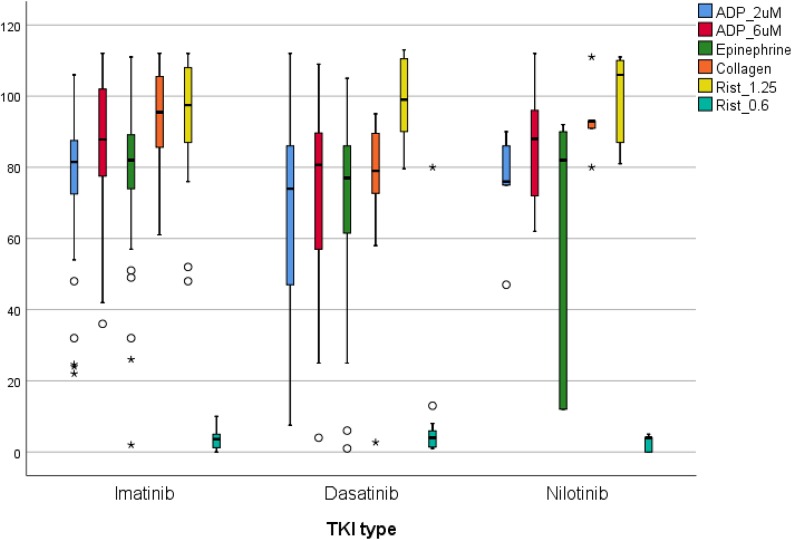
Bleeding has been reported in patients with chronic myeloid leukemia (CML) using tyrosine kinase inhibitors (TKIs). In this study, we aimed to evaluate platelet functions and associated bleeding symptoms in patients with CML using TKIs. A standardized questionnaire that was developed for inherited bleeding disorders (ISTH/SSC Bleeding Assessment Tool) was used to score bleeding symptoms in 68 chronic phase patients with CML receiving imatinib (n = 47), dasatinib (n = 15), or nilotinib (n = 6). Light transmission aggregometry was used for platelet function testing. None of the patients had major bleeding (score > 3). Minor bleeding was observed in 25.6% and 20% of the patients in imatinib and dasatinib treatment groups. Impaired/decreased platelet aggregation was observed in 29.8% of imatinib treatment group, 50% of nilotinib group, and 40% of dasatinib group. A secondary aggregation abnormality compatible with the release defect was observed in 26% of patients with CML; 25.5%, 33.3%, and 16.7% of patients receiving imatinib, dasatinib, and nilotinib, respectively. No correlation was found between bleeding symptoms and the impaired platelet function. We can conclude that TKIs may impair in vitro platelet aggregation but this impairment is not associated with bleeding diathesis.
已有使用酪氨酸激酶抑制剂(TKI)治疗慢性髓性白血病(CML)患者发生出血的报道。在这项研究中,我们旨在评估使用 TKI 的 CML 患者的血小板功能和相关出血症状。我们使用专为遗传性出血性疾病开发的标准化问卷(ISTH/SSC 出血评估工具)对 68 名接受伊马替尼(n = 47)、达沙替尼(n = 15)或尼洛替尼(n = 6)治疗的慢性期 CML 患者的出血症状进行评分。采用光透射聚集法进行血小板功能检测。无患者发生重大出血(评分>3)。在接受伊马替尼和达沙替尼治疗的患者中分别有 25.6%和 20%观察到轻微出血。在伊马替尼治疗组中观察到 29.8%、尼洛替尼组中 50%和达沙替尼组中 40%的血小板聚集受损/减少。观察到 26%的 CML 患者存在与释放缺陷相符的继发性聚集异常;分别有 25.5%、33.3%和 16.7%的接受伊马替尼、达沙替尼和尼洛替尼治疗的患者存在这种异常。未发现出血症状与血小板功能受损之间存在相关性。我们可以得出结论,TKI 可能会损害体外血小板聚集,但这种损害与出血倾向无关。