Computational Biology and Systems Biomedicine Group, Biodonostia Health Research Institute, Calle Doctor Beguiristain s/n, San Sebastián, 20014, Spain.
Computational Biomedicine Data Analysis Platform, Biodonostia Health Research Institute, Calle Doctor Beguiristain s/n, San Sebastián, 20014, Spain.
Sci Rep. 2019 Jun 20;9(1):8930. doi: 10.1038/s41598-019-45438-y.
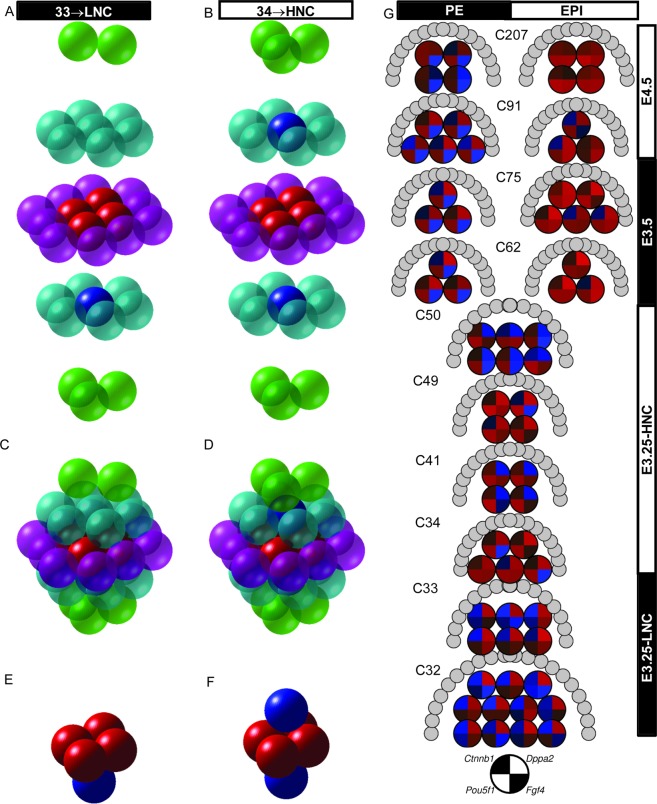
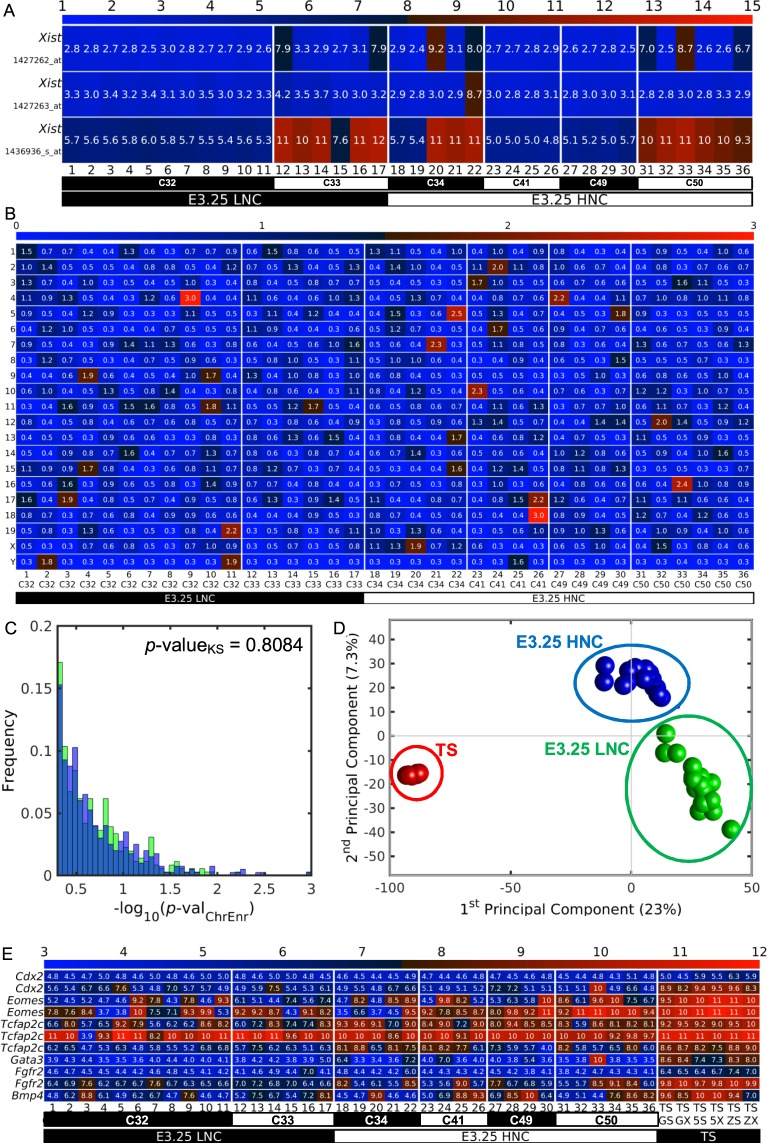
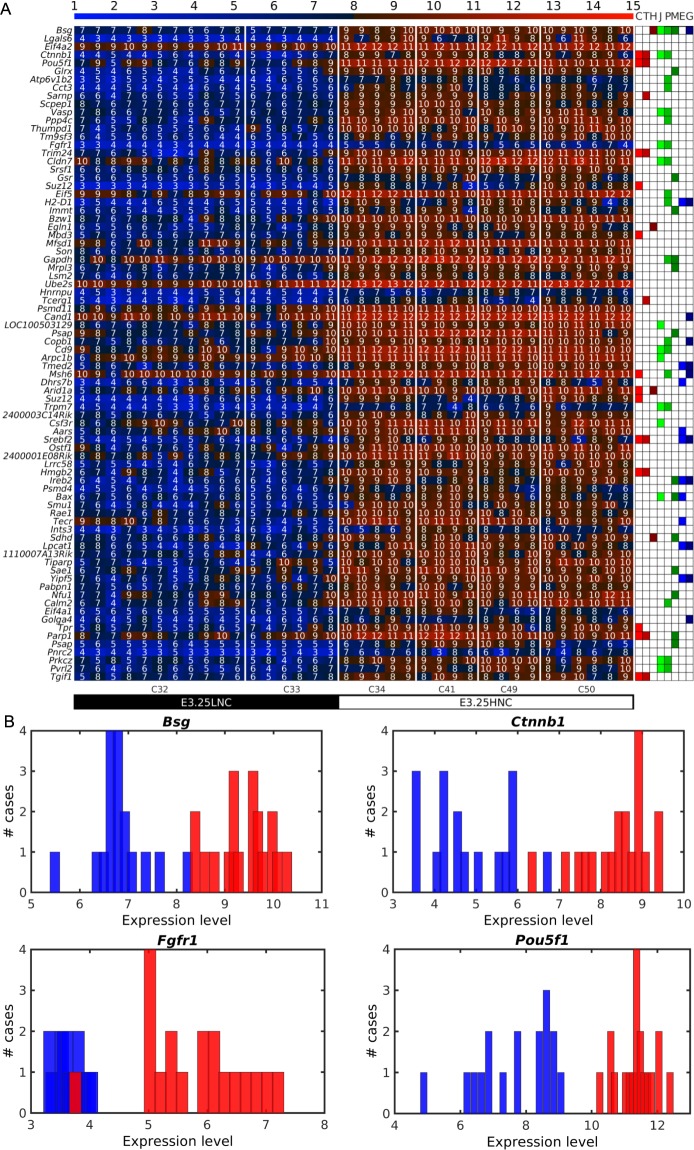
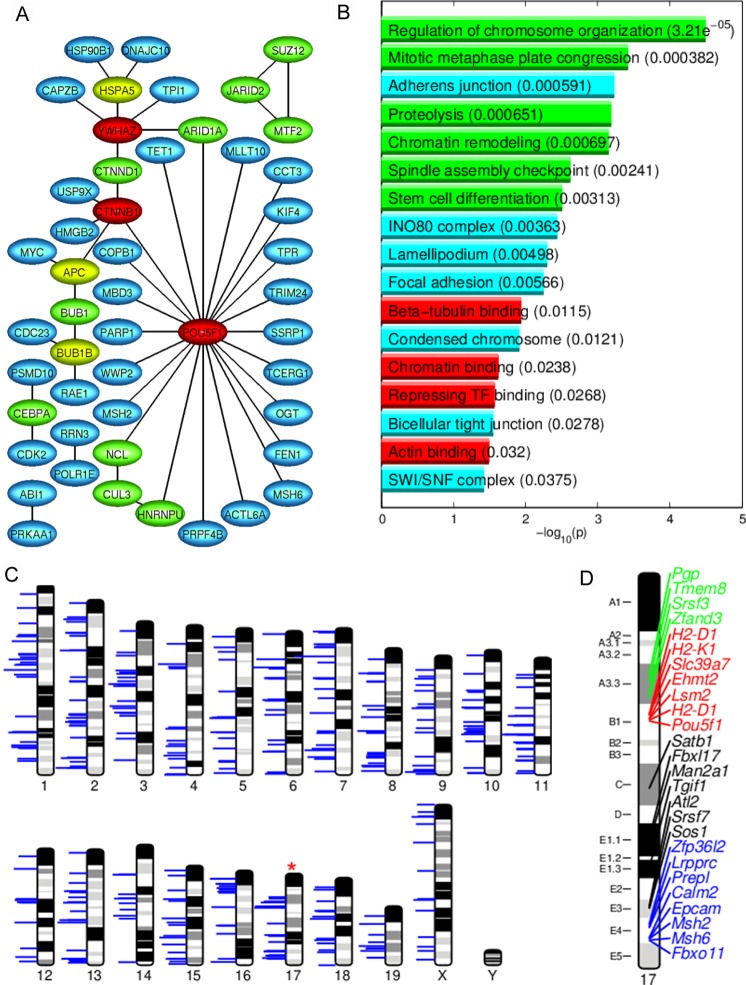
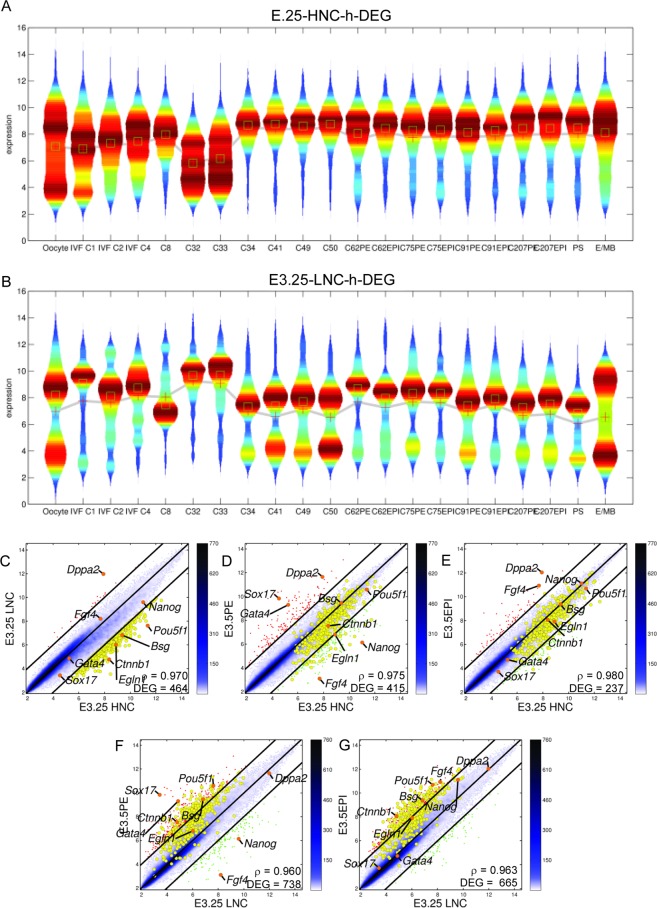
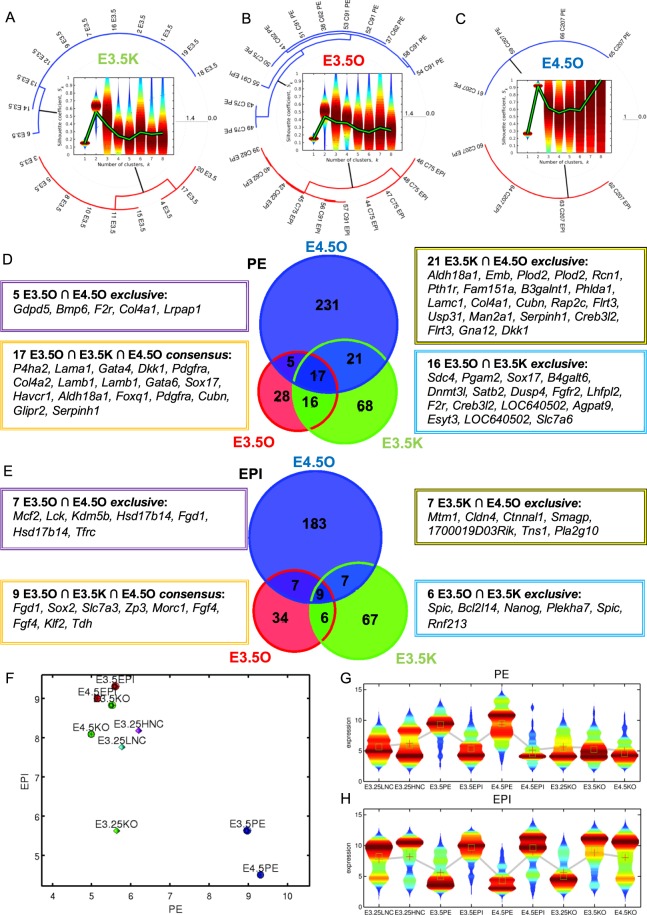
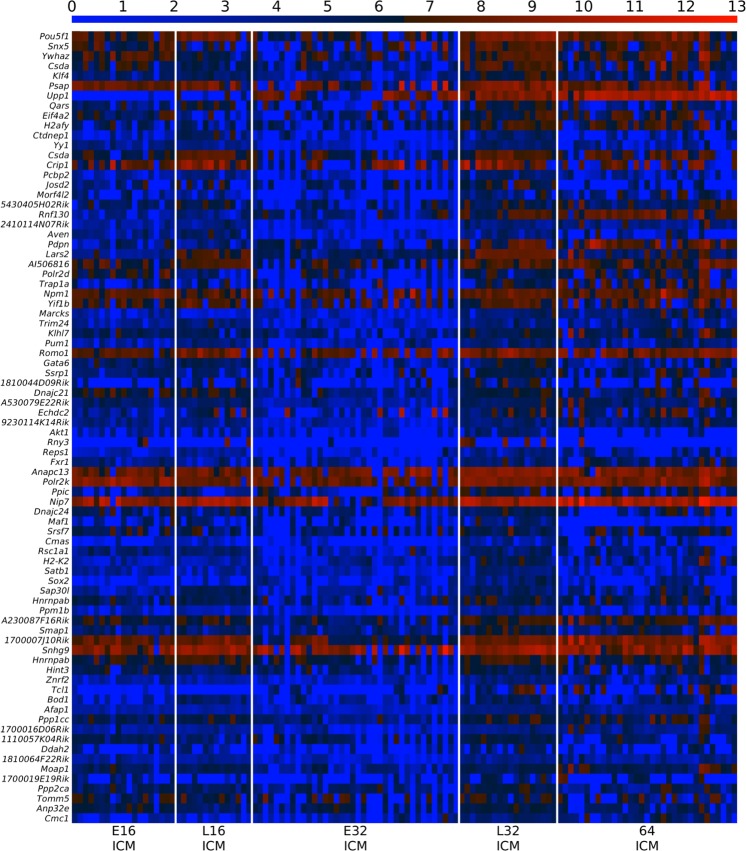
Our computational analysis focuses on the 32- to 64-cell mouse embryo transition, Embryonic day (E3.25), whose study in literature is concentrated mainly on the search for an early onset of the second cell-fate decision, the specification of the inner cell mass (ICM) to primitive endoderm (PE) and epiblast (EPI). We analysed single-cell (sc) microarray transcriptomics data from E3.25 using Hierarchical Optimal k-Means (HOkM) clustering, and identified two groups of ICM cells: a group of cells from embryos with less than 34 cells (E3.25-LNCs), and another group of cells from embryos with more than 33 cells (E3.25-HNCs), corresponding to two developmental stages. Although we found massive underlying heterogeneity in the ICM cells at E3.25-HNC with over 3,800 genes with transcriptomics bifurcation, many of which are PE and EPI markers, we showed that the E3.25-HNCs are neither PE nor EPI. Importantly, analysing the differently expressed genes between the E3.25-LNCs and E3.25-HNCs, we uncovered a non-autonomous mechanism, based on a minimal number of four inner-cell contacts in the ICM, which activates Oct4 in the preimplantation embryo. Oct4 is highly expressed but unstable at E3.25-LNC, and stabilizes at high level at E3.25-HNC, with Bsg highly expressed, and the chromatin remodelling program initialised to establish an early naïve pluripotent state. Our results indicate that the pluripotent state we found to exist in the ICM at E3.25-HNC is the in vivo counterpart of a new, very early pluripotent state. We compared the transcriptomics profile of this in vivo E3.25-HNC pluripotent state, together with the profiles of E3.25-LNC, E3.5 EPI and E4.5 EPI cells, with the profiles of all embryonic stem cells (ESCs) available in the GEO database from the same platform (over 600 microarrays). The shortest distance between the set of inner cells (E3.25, E3.5 and E4.5) and the ESCs is between the E3.25-HNC cells and 2i + LIF ESCs; thus, the developmental transition from 33 to 34 cells decreases dramatically the distance with the naïve ground state of the 2i + LIF ESCs. We validated the E3.25 events through analysis of scRNA-seq data from early and late 32-cell ICM cells.
我们的计算分析集中在 32 到 64 细胞的小鼠胚胎过渡,胚胎日(E3.25),其在文献中的研究主要集中在寻找第二个细胞命运决定的早期开始,内细胞团(ICM)向原始内胚层(PE)和外胚层(EPI)的特化。我们使用层次最优 k-均值(HOkM)聚类分析了 E3.25 的单细胞(sc)微阵列转录组学数据,并鉴定了两组 ICM 细胞:一组来自细胞数少于 34 个的胚胎(E3.25-LNCs),另一组来自细胞数超过 33 个的胚胎(E3.25-HNCs),分别对应两个发育阶段。尽管我们发现 E3.25-HNC 中的 ICM 细胞存在大量潜在的异质性,超过 3800 个基因的转录组学分支,但其中许多是 PE 和 EPI 标记物,我们表明 E3.25-HNCs 既不是 PE 也不是 EPI。重要的是,分析 E3.25-LNCs 和 E3.25-HNCs 之间差异表达的基因,我们揭示了一种非自主机制,基于 ICM 中内细胞接触的最小数量为四个,激活植入前胚胎中的 Oct4。Oct4 在 E3.25-LNC 中高度表达但不稳定,在 E3.25-HNC 中高水平稳定,Bs 高度表达,染色质重塑程序启动以建立早期原始多能状态。我们的结果表明,我们在 E3.25-HNC 中发现的 ICM 中存在的多能状态是一种新的、非常早期的多能状态的体内对应物。我们将这种体内 E3.25-HNC 多能状态的转录组学特征与 E3.25-LNC、E3.5 EPI 和 E4.5 EPI 细胞的特征,以及 GEO 数据库中同一平台上所有胚胎干细胞(ESCs)的特征进行了比较(超过 600 个微阵列)。内细胞集(E3.25、E3.5 和 E4.5)和 ESCs 之间的最短距离是 E3.25-HNC 细胞和 2i+LIF ESCs 之间的距离;因此,从 33 个细胞到 34 个细胞的发育转变极大地降低了与 2i+LIF ESCs 的原始基础状态的距离。我们通过分析早期和晚期 32 细胞 ICM 细胞的 scRNA-seq 数据验证了 E3.25 事件。