Wellcome Trust - Medical Research Council Cambridge Stem Cell Institute, University of Cambridge, Tennis Court Road, Cambridge CB2 1QR, UK.
Development. 2014 Mar;141(5):1001-10. doi: 10.1242/dev.096875. Epub 2014 Feb 6.
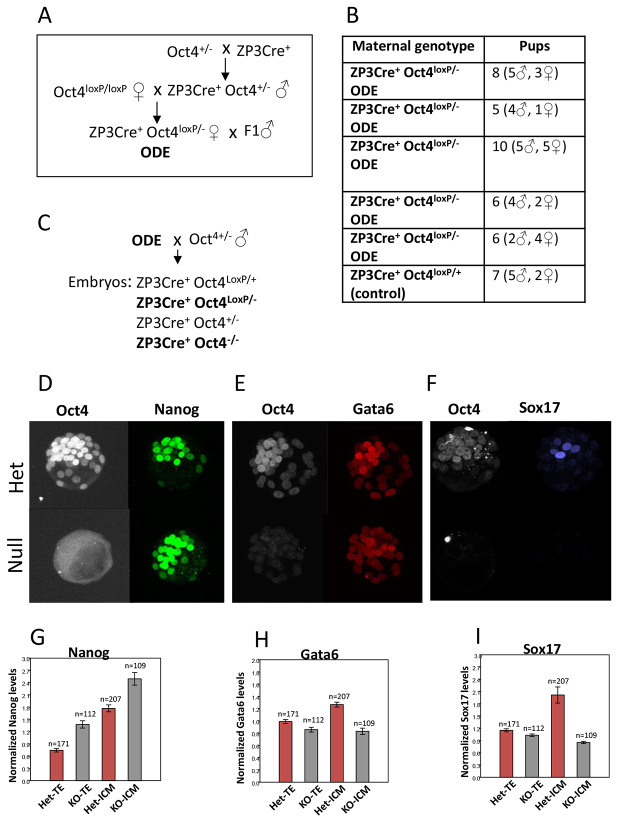
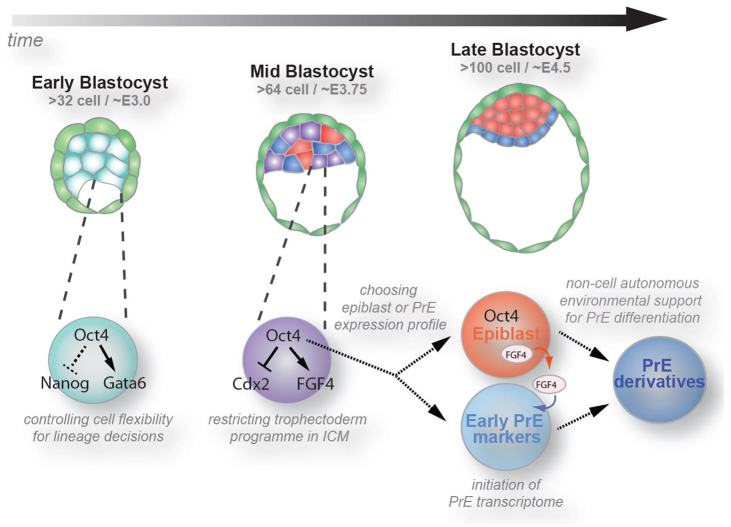
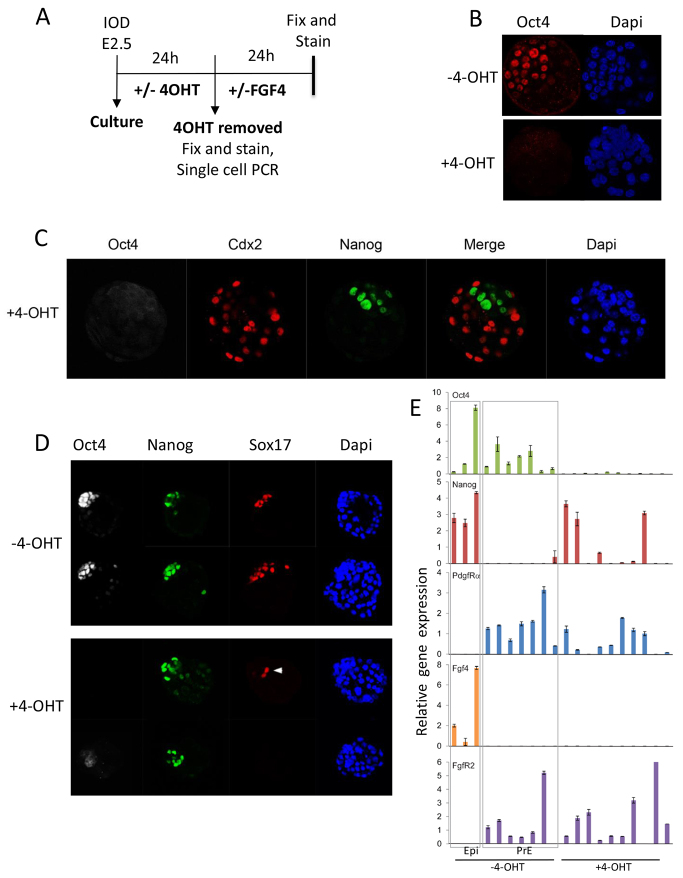
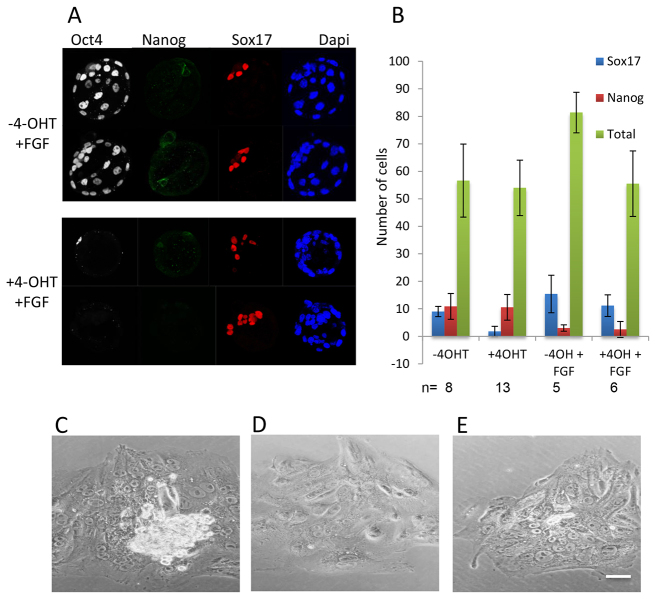
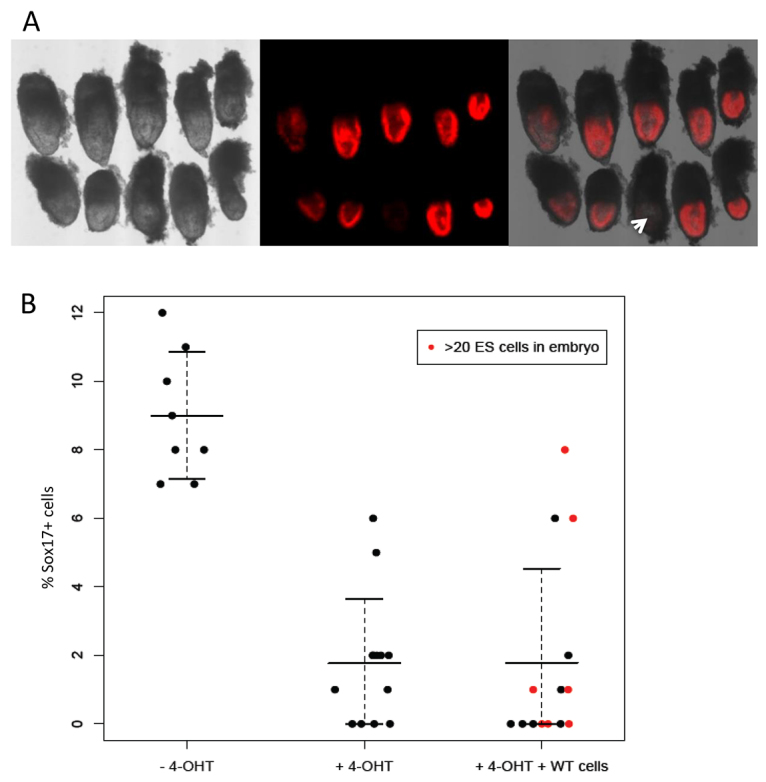
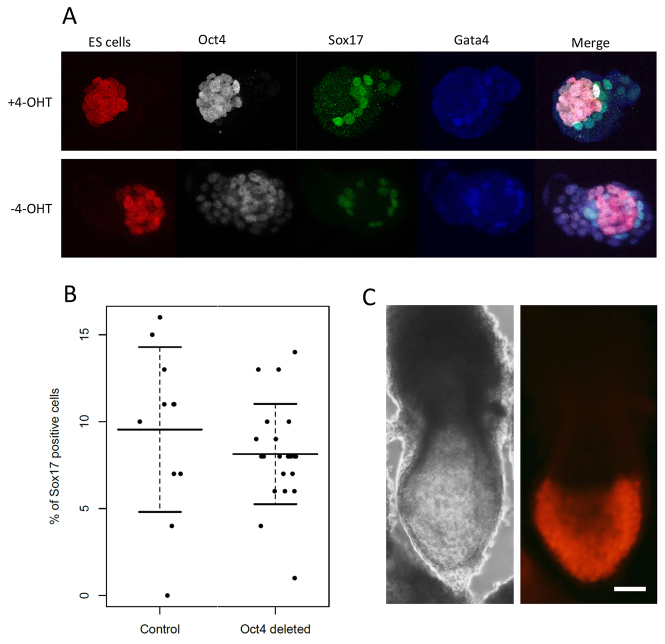
The transcription factor Oct4 is required in vitro for establishment and maintenance of embryonic stem cells and for reprogramming somatic cells to pluripotency. In vivo, it prevents the ectopic differentiation of early embryos into trophoblast. Here, we further explore the role of Oct4 in blastocyst formation and specification of epiblast versus primitive endoderm lineages using conditional genetic deletion. Experiments involving mouse embryos deficient for both maternal and zygotic Oct4 suggest that it is dispensable for zygote formation, early cleavage and activation of Nanog expression. Nanog protein is significantly elevated in the presumptive inner cell mass of Oct4 null embryos, suggesting an unexpected role for Oct4 in attenuating the level of Nanog, which might be significant for priming differentiation during epiblast maturation. Induced deletion of Oct4 during the morula to blastocyst transition disrupts the ability of inner cell mass cells to adopt lineage-specific identity and acquire the molecular profile characteristic of either epiblast or primitive endoderm. Sox17, a marker of primitive endoderm, is not detected following prolonged culture of such embryos, but can be rescued by provision of exogenous FGF4. Interestingly, functional primitive endoderm can be rescued in Oct4-deficient embryos in embryonic stem cell complementation assays, but only if the host embryos are at the pre-blastocyst stage. We conclude that cell fate decisions within the inner cell mass are dependent upon Oct4 and that Oct4 is not cell-autonomously required for the differentiation of primitive endoderm derivatives, as long as an appropriate developmental environment is established.
转录因子 Oct4 在体外对于建立和维持胚胎干细胞以及重编程体细胞核为多能性是必需的。在体内,它防止早期胚胎的异位分化为滋养层。在这里,我们使用条件性基因缺失进一步探索了 Oct4 在囊胚形成和内细胞团与原始内胚层谱系特化中的作用。涉及缺乏母源和合子 Oct4 的小鼠胚胎的实验表明,它对于合子形成、早期分裂和 Nanog 表达的激活是可有可无的。Nanog 蛋白在 Oct4 缺失胚胎的假定内细胞团中显著升高,表明 Oct4 在减弱 Nanog 水平方面具有意想不到的作用,这可能对滋养层成熟过程中的分化启动很重要。在桑葚胚到囊胚转变期间诱导 Oct4 缺失会破坏内细胞团细胞获得谱系特异性身份的能力,并获得与内胚层或原始内胚层特征一致的分子特征。原始内胚层的标志物 Sox17 在这些胚胎的长时间培养后未被检测到,但可以通过提供外源性 FGF4 来挽救。有趣的是,在胚胎干细胞互补测定中,在 Oct4 缺陷胚胎中可以挽救功能性原始内胚层,但前提是宿主胚胎处于囊胚前阶段。我们得出结论,内细胞团中的细胞命运决定依赖于 Oct4,并且只要建立了适当的发育环境,Oct4 对于原始内胚层衍生物的分化就不是细胞自主必需的。