Laboratorio Clínico, Hospital Dr. Luis Calvo Mackenna, Santiago, Chile.
Departamento de Pediatría y Cirugía Infantil, Campus Oriente, Hospital Dr. Luis Calvo Mackenna, Facultad de Medicina, Universidad de Chile, Santiago, Chile.
Sci Rep. 2019 Jun 20;9(1):8863. doi: 10.1038/s41598-019-45345-2.
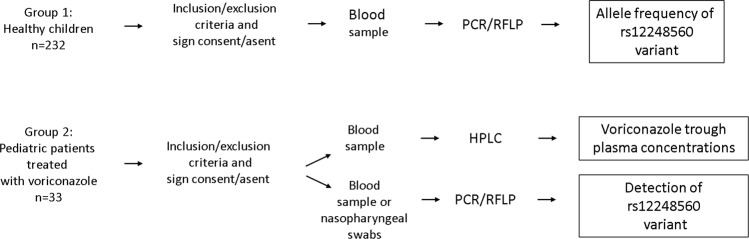
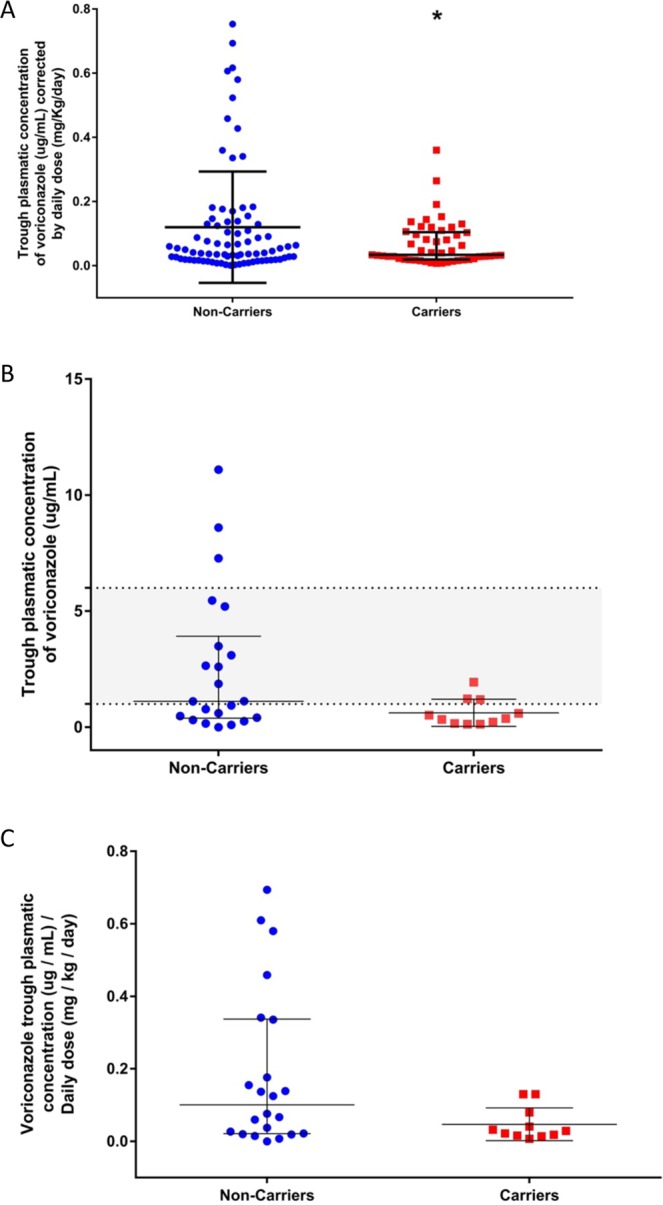
Invasive fungal infections (IFIs) are the most frequent cause of morbidity and mortality in immunocompromised children. Voriconazole is the first-line antifungal choice in the treatment of IFIs like aspergillosis. Voriconazole pharmacokinetics vary widely among patients and voriconazole is metabolized mainly in the liver by the CYP2C19 enzyme, which is highly polymorphic. The CYP2C1917 allele is characterized by the presence of four single nucleotide polymorphisms expressing an ultra-rapid enzyme phenotype with an accelerated voriconazole metabolism, is associated with low (sub-therapeutic) plasma levels in patients treated with the standard dose. Considering that in our center a high percentage of children have sub-therapeutic levels of voriconazole when treated with standard doses, we sought to determine the frequency of the CYP2C1917 polymorphism (rs12248560) in a Chilean population and determine the association between voriconazole concentrations and the rs12248560 variant in immunocompromised children. First, we evaluated the frequency of the rs12248560 variant in a group of 232 healthy Chilean children, and we found that 180 children (77.6%) were non-carriers of the rs12248560 variant, 49 children (21.1%) were heterozygous carriers for rs12248560 variant and only 3 children (1.3%) were homozygous carriers for rs12248560 variant, obtaining an allelic frequency of 12% for variant in a Chilean population. To determine the association between voriconazole concentrations and the rs12248560 variant, we analyzed voriconazole plasma concentrations in a second group of 33 children treated with voriconazole. In these patients, carriers of the rs12248560 variant presented significantly lower voriconazole plasma concentrations than non-carriers (p = 0,011). In this study, we show the presence of the rs12248560 variant in a Chilean population and its accelerating effect on the pharmacokinetics of voriconazole in pediatric patients. From these data, it would be advisable to consider the variant of the patient prior to calculating the dosage of voriconazole.
侵袭性真菌感染(IFI)是免疫功能低下儿童发病和死亡的最常见原因。伏立康唑是治疗曲霉病等 IFI 的一线抗真菌药物。伏立康唑的药代动力学在患者之间差异很大,伏立康唑主要由 CYP2C19 酶在肝脏中代谢,该酶高度多态性。CYP2C1917 等位基因的特点是存在四个单核苷酸多态性,表达一种超快酶表型,加速伏立康唑代谢,与接受标准剂量治疗的患者的低(治疗窗以下)血浆水平相关。鉴于我们中心的许多儿童在接受标准剂量治疗时伏立康唑的血浆水平处于治疗窗以下,我们试图确定智利人群中 CYP2C1917 多态性(rs12248560)的频率,并确定免疫功能低下儿童中伏立康唑浓度与 rs12248560 变异体之间的关联。首先,我们在一组 232 名智利健康儿童中评估了 rs12248560 变体的频率,发现 180 名儿童(77.6%)不是 rs12248560 变体的携带者,49 名儿童(21.1%)为 rs12248560 变体的杂合子携带者,只有 3 名儿童(1.3%)是 rs12248560 变体的纯合子携带者,智利人群中变体的等位基因频率为 12%。为了确定伏立康唑浓度与 rs12248560 变体之间的关联,我们分析了接受伏立康唑治疗的 33 名儿童的伏立康唑血浆浓度。在这些患者中,携带 rs12248560 变体的患者的伏立康唑血浆浓度明显低于非携带者(p=0.011)。在这项研究中,我们展示了智利人群中 rs12248560 变体的存在及其对儿科患者伏立康唑药代动力学的加速作用。根据这些数据,在计算伏立康唑剂量之前,考虑患者的变体是明智的。