Department of Architecture and Civil Engineering, Division of Water Environment Technology, Chalmers University of Technology, Gothenburg, Sweden.
Chemistry and Molecular Biology, University of Gothenburg, Gothenburg, Sweden.
Microb Biotechnol. 2019 Sep;12(5):962-975. doi: 10.1111/1751-7915.13449. Epub 2019 Jun 22.
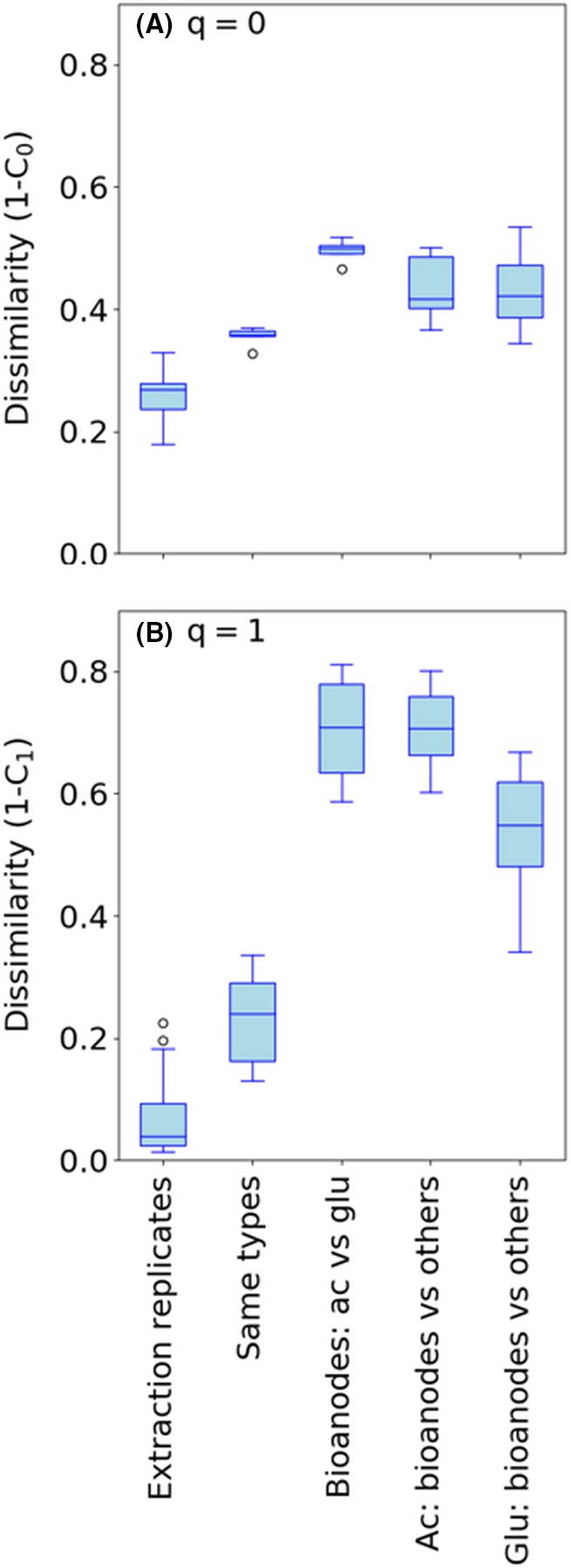
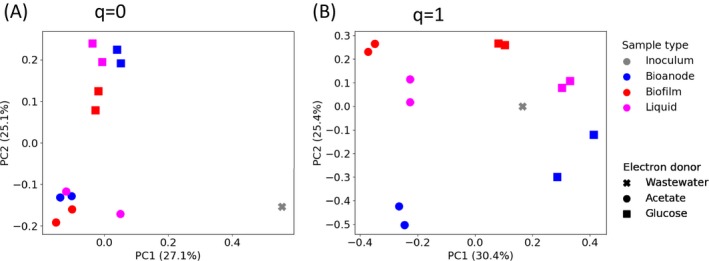
In microbial fuel cells (MFCs), microorganisms generate electrical current by oxidizing organic compounds. MFCs operated with different electron donors harbour different microbial communities, and it is unknown how that affects their response to starvation. We analysed the microbial communities in acetate- and glucose-fed MFCs and compared their responses to 10 days starvation periods. Each starvation period resulted in a 4.2 ± 1.4% reduction in electrical current in the acetate-fed MFCs and a 10.8 ± 3.9% reduction in the glucose-fed MFCs. When feed was resumed, the acetate-fed MFCs recovered immediately, whereas the glucose-fed MFCs required 1 day to recover. The acetate-fed bioanodes were dominated by Desulfuromonas spp. converting acetate into electrical current. The glucose-fed bioanodes were dominated by Trichococcus sp., functioning as a fermenter, and a member of Desulfuromonadales, using the fermentation products to generate electrical current. Suspended biomass and biofilm growing on non-conductive regions within the MFCs had different community composition than the bioanodes. However, null models showed that homogenizing dispersal of microorganisms within the MFCs affected the community composition, and in the glucose-fed MFCs, the Trichococcus sp. was abundant in all locations. The different responses to starvation can be explained by the more complex pathway requiring microbial interactions to convert glucose into electrical current.
在微生物燃料电池(MFC)中,微生物通过氧化有机化合物产生电流。以不同电子供体运行的 MFC 拥有不同的微生物群落,而这如何影响它们对饥饿的反应尚不清楚。我们分析了乙酸盐和葡萄糖喂养的 MFC 中的微生物群落,并比较了它们对 10 天饥饿期的反应。每个饥饿期都会导致乙酸盐喂养的 MFC 中电流减少 4.2±1.4%,而葡萄糖喂养的 MFC 中电流减少 10.8±3.9%。当恢复进料时,乙酸盐喂养的 MFC 立即恢复,而葡萄糖喂养的 MFC 需要 1 天才能恢复。乙酸盐喂养的生物阳极由将乙酸盐转化为电流的脱硫单胞菌属主导。葡萄糖喂养的生物阳极由发酵器功能的 Trichococcus sp. 和脱硫单胞菌目的一个成员主导,它们利用发酵产物产生电流。悬浮在生物燃料电池内非导电区域生长的生物量和生物膜与生物阳极的群落组成不同。然而,零模型表明,均匀分散微生物在 MFC 内的扩散会影响群落组成,并且在葡萄糖喂养的 MFC 中,Trichococcus sp. 在所有位置都很丰富。对饥饿的不同反应可以用更复杂的途径来解释,该途径需要微生物相互作用将葡萄糖转化为电流。