National Center for Injury Prevention and Control, Centers for Disease Control and Prevention (CDC), Atlanta, GA, USA.
National Center for Injury Prevention and Control, Centers for Disease Control and Prevention (CDC), Atlanta, GA, USA.
J Subst Abuse Treat. 2019 Aug;103:9-13. doi: 10.1016/j.jsat.2019.05.003. Epub 2019 May 10.
To classify and compare US nationwide opioid-related hospital inpatient discharges over time by discharge type: 1) opioid use disorder (OUD) diagnosis without opioid overdose, detoxification, or rehabilitation services, 2) opioid overdose, 3) OUD diagnosis or opioid overdose with detoxification services, and 4) OUD diagnosis or opioid overdose with rehabilitation services.
Survey-weighted national analysis of hospital discharges in the Healthcare Cost and Utilization Project National Inpatient Sample yielded age-adjusted annual rates per 100,000 population. Annual percentage change (APC) in the rate of opioid-related discharges by type during 1993-2016 was assessed.
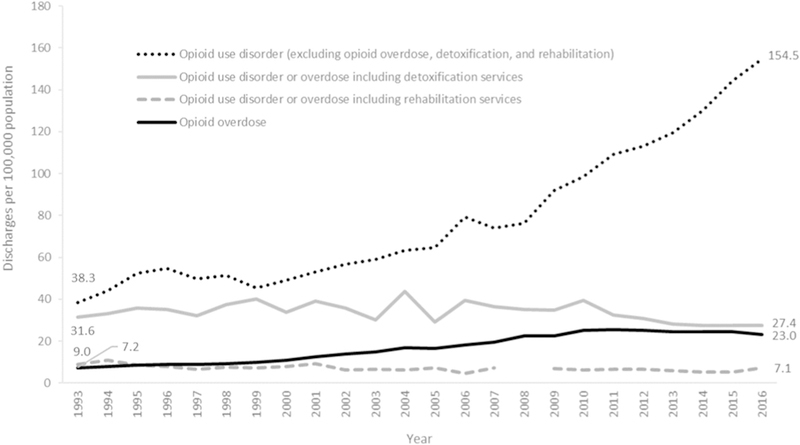
The annual rate of hospital discharges documenting OUD without opioid overdose, detoxification, or rehabilitation services quadrupled during 1993-2016, and at an increased rate (8% annually) during 2003-2016. The discharge rate for all types of opioid overdose increased an average 5-9% annually during 1993-2010; discharges for non-heroin overdoses declined 2010-2016 (3-12% annually) while heroin overdose discharges increased sharply (23% annually). The rate of discharges including detoxification services among OUD and overdose patients declined (-4% annually) during 2008-2016 and rehabilitation services (e.g., counselling, pharmacotherapy) among those discharges decreased (-2% annually) during 1993-2016.
Over the past two decades, the rate of both OUD diagnoses and opioid overdoses increased substantially in US hospitals while rates of inpatient detoxification and rehabilitation services identified by diagnosis codes declined. It is critical that inpatients diagnosed with OUD or treated for opioid overdose are linked effectively to substance use disorder treatment at discharge.
根据出院类型对美国全国范围内与阿片类药物相关的住院患者出院情况进行分类和比较:1)无阿片类药物使用障碍(OUD)诊断、阿片类药物过量、戒毒或康复服务,2)阿片类药物过量,3)OUD 诊断或阿片类药物过量伴戒毒服务,以及 4)OUD 诊断或阿片类药物过量伴康复服务。
利用医疗保健成本和利用项目国家住院患者样本中的调查加权全国分析,得出每 10 万人年龄调整后的年出院率。评估 1993-2016 年期间按类型划分的阿片类药物相关出院率的年百分比变化(APC)。
1993-2016 年期间,无阿片类药物过量、戒毒或康复服务的 OUD 住院记录的年出院率翻了两番,2003-2016 年期间以更快的速度(每年 8%)增加。所有类型的阿片类药物过量的出院率在 1993-2010 年期间平均每年增加 5-9%;2010-2016 年期间,非海洛因过量的出院率下降(每年 3-12%),而海洛因过量的出院率急剧上升(每年 23%)。2008-2016 年期间,OUD 和过量患者中包括戒毒服务的出院率下降(每年-4%),而这些出院患者中康复服务(如咨询、药物治疗)的出院率下降(每年-2%)。
在过去的二十年中,美国医院中 OUD 诊断和阿片类药物过量的发生率大幅增加,而诊断代码识别的住院戒毒和康复服务的比例下降。至关重要的是,患有 OUD 诊断或阿片类药物过量治疗的住院患者在出院时应有效地与物质使用障碍治疗联系起来。