Morgan Jake R, Wang Jianing, Barocas Joshua A, Jaeger Jenifer L, Durham Natalie N, Babakhanlou-Chase Hermik, Bharel Monica, Walley Alexander Y, Linas Benjamin P
Department of Health Law, Policy, and Management, Boston University School of Public Health, Boston, MA, USA.
Department of Medicine, Section of Infectious Diseases, Boston Medical Center, Boston, MA, USA.
J Subst Abuse Treat. 2020 May;112:42-48. doi: 10.1016/j.jsat.2020.01.017. Epub 2020 Jan 30.
Inpatient treatment for substance use disorders is a collection of strategies ranging from short term detoxification to longer term residential treatment. How those with opioid use disorder (OUD) navigate this inpatient treatment system after an encounter for detoxification and subsequent risk of opioid-related overdose is not well understood.
We used a comprehensive Massachusetts database to characterize the movement of people with OUD through inpatient care from 2013 to 2015, identifying admissions to inpatient detoxification, subsequent inpatient care, and opioid overdose while navigating treatment. We measured the person-years accumulated during each transition period to calculate rates of opioid-related overdose, and investigated how overdose differed in select populations.
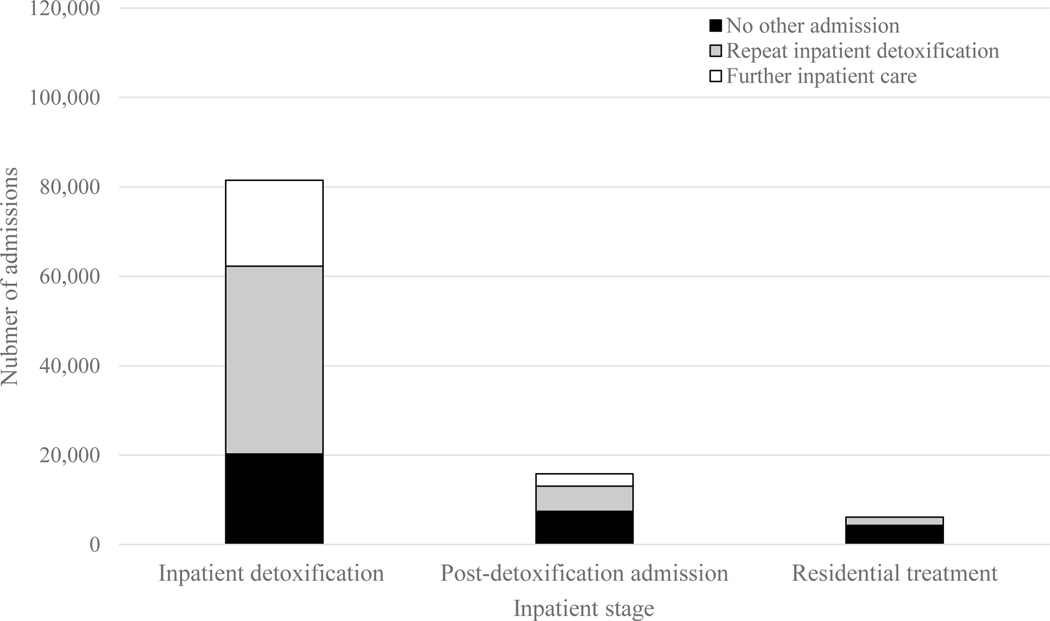
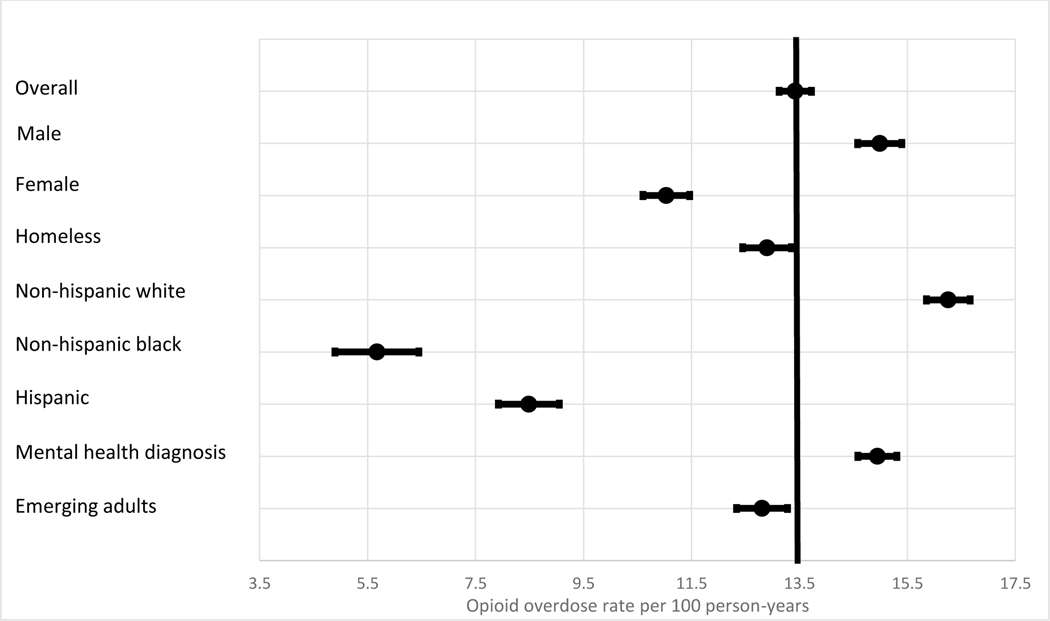
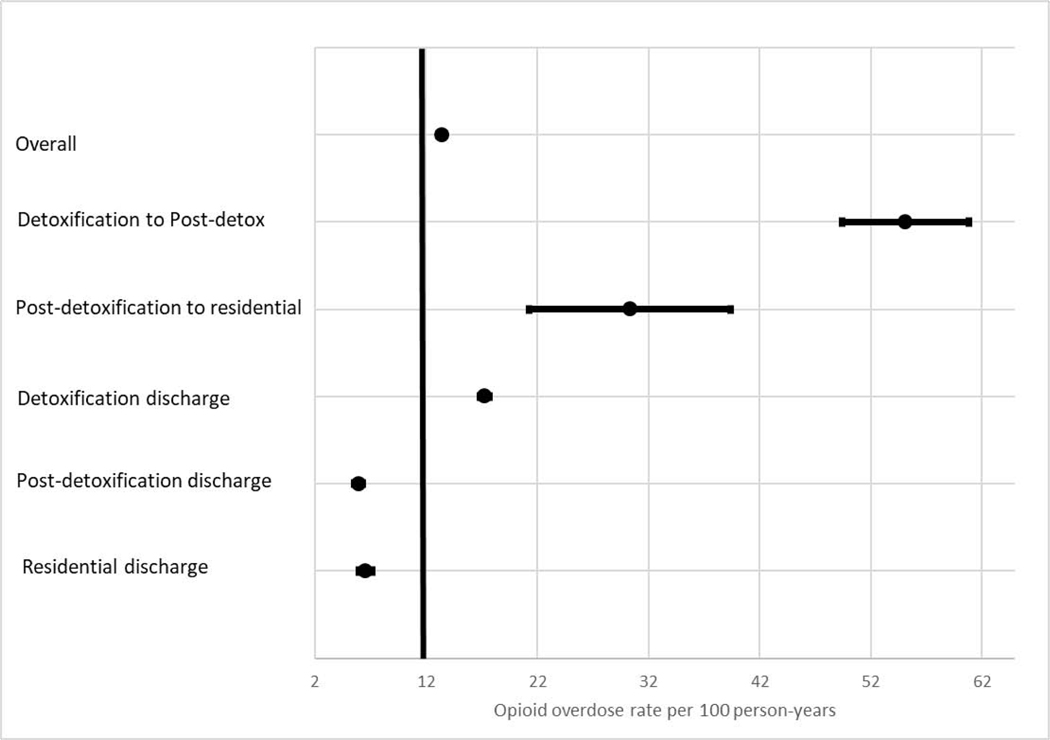
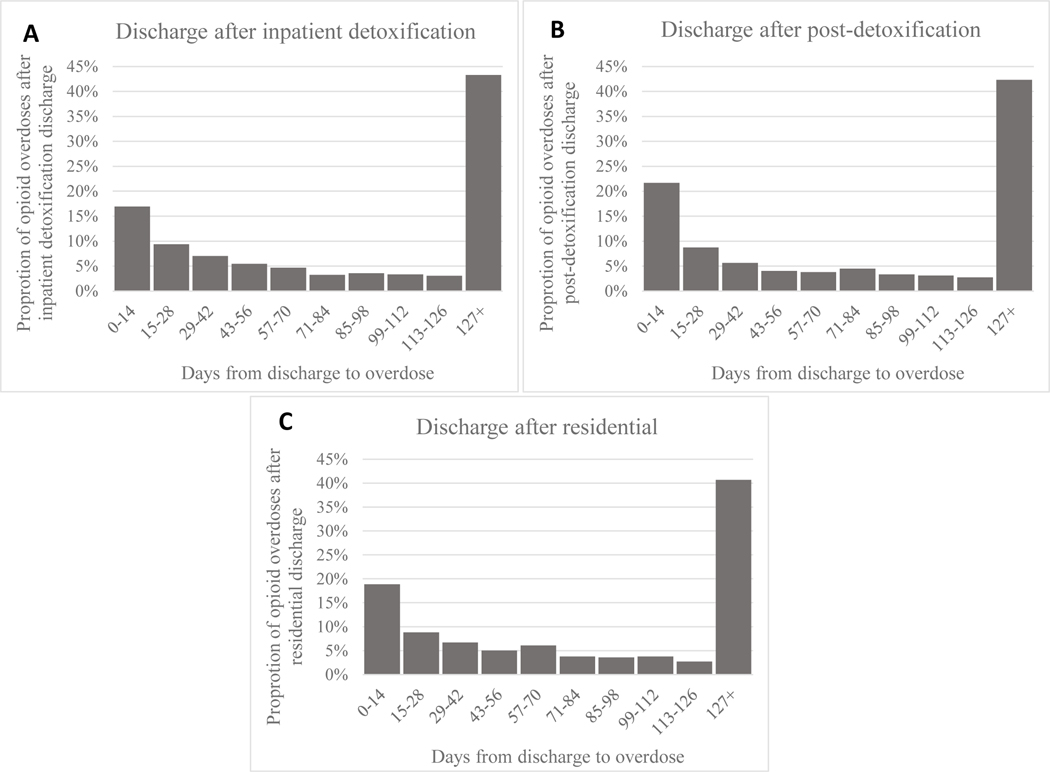
Sixty-one percent of inpatient detoxification admissions resulted in a subsequent inpatient detoxification admission without progressing to further inpatient care. Overall, there were 287 fatal and 7337 non-fatal overdoses. Persons exiting treatment after detoxification had the greatest risk of overdose (17.3 per 100 person-years) compared to those who exited after subsequent inpatient care (ranging from 5.9 to 6.6 overdoses per 100 person-years). Non-Hispanic whites were most at risk for opioid related overdose with 16 overdoses per 100 person-years and non-Hispanic blacks had the lowest risk with 5 overdoses per 100 person-years.
The majority of inpatient detoxification admissions do not progress to further inpatient care. Recurrent inpatient detoxification admission is common, likely signifying relapse. Rather than functioning as the first step to inpatient care, inpatient detoxification might be more effective as a venue for implementing strategies to expand addiction services or treatment such as medications for opioid use disorder.
物质使用障碍的住院治疗是一系列策略,涵盖从短期戒毒到长期住院治疗。目前对于阿片类物质使用障碍(OUD)患者在经历戒毒治疗后如何在这个住院治疗系统中就医以及随后发生阿片类物质相关过量用药的风险,人们了解得并不充分。
我们使用了马萨诸塞州的一个综合数据库,来描述2013年至2015年期间患有OUD的患者在住院治疗过程中的就医情况,确定住院戒毒治疗的入院情况、后续的住院治疗以及在接受治疗期间发生的阿片类物质过量用药情况。我们测量了每个过渡阶段累积的人年数,以计算阿片类物质相关过量用药的发生率,并研究了特定人群中过量用药情况的差异。
61%的住院戒毒治疗入院患者随后再次入院接受戒毒治疗,而没有进入进一步的住院治疗。总体而言,有287例致命过量用药和7337例非致命过量用药。与在后续住院治疗后出院的患者相比(每100人年有5.9至6.6例过量用药),戒毒治疗后出院的患者过量用药风险最高(每100人年有17.3例)。非西班牙裔白人阿片类物质相关过量用药风险最高,每100人年有16例过量用药,而非西班牙裔黑人风险最低,每100人年有5例过量用药。
大多数住院戒毒治疗入院患者没有进入进一步的住院治疗。反复住院戒毒治疗很常见,这可能意味着复发。住院戒毒治疗与其作为住院治疗的第一步,不如作为实施扩大成瘾服务或治疗策略(如阿片类物质使用障碍药物)的场所可能更有效。