
体内双能 CT 成像的几何校准和材料鉴别实验研究。
The Experimental Study on Geometric Calibration and Material Discrimination for In Vivo Dual-Energy CT Imaging.
机构信息
The Key Laboratory of Rheological Science and Technology of the Education Ministry of China, Chongqing University, Chongqing 400044, China.
The Key Lab of Optoelectronic Technology and Systems of the Education Ministry of China, Chongqing University, Chongqing 400044, China.
出版信息
Biomed Res Int. 2019 May 22;2019:7614589. doi: 10.1155/2019/7614589. eCollection 2019.
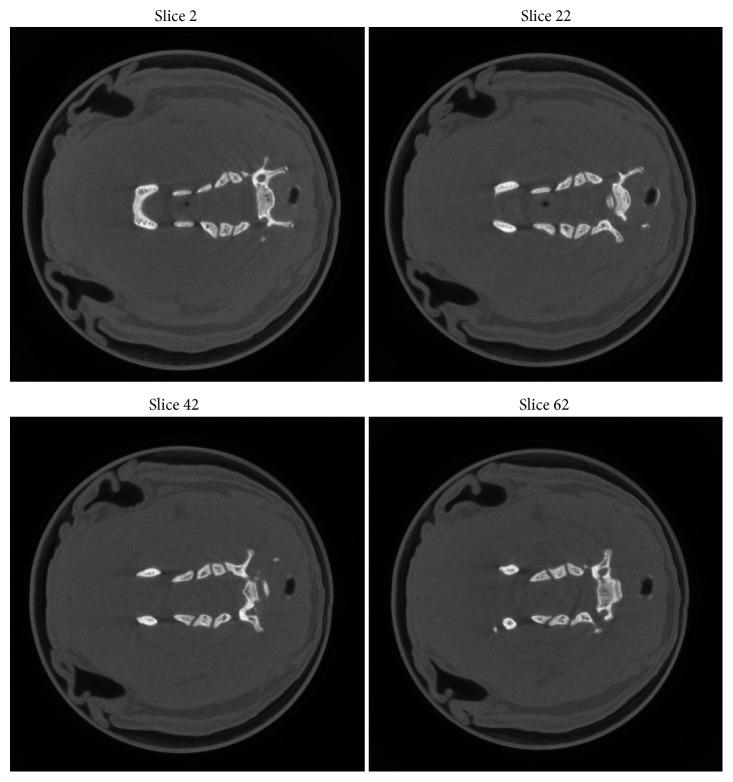
Photon-counting detector (PCD) can identify absorption features in the multiple ranges of photon energies, which has a great potential in material discrimination. In this paper, we focused on in vivo dual-energy CT imaging to characterize different biomedical compositions. The precision of material decomposition in post-reconstruction space depends on the quality of reconstructed CT images; we used the locally linear embedding (LLE) based online geometric calibration method and GPU-based reconstruction toolbox to reconstruct high-quality CT images. Then, we performed the real experiment and studied materials decomposition with basis material model to discriminate soft tissue and cortical bone of small animal. Finally, the experimental results demonstrated that the proposed method could reconstruct small animal CT images with more slim structures and details, and improve the precision of materials decomposition in dual-energy CT imaging.
光子计数探测器(PCD)可以识别光子能量的多个范围内的吸收特征,在物质鉴别方面具有很大的潜力。在本文中,我们专注于体内双能 CT 成像,以描述不同的生物医学成分。在重建后空间中的材料分解精度取决于重建 CT 图像的质量;我们使用基于局部线性嵌入(LLE)的在线几何校准方法和基于 GPU 的重建工具包来重建高质量的 CT 图像。然后,我们进行了实际实验,使用基础物质模型对材料分解进行了研究,以区分小动物的软组织和皮质骨。最后,实验结果表明,所提出的方法可以重建具有更纤细结构和细节的小动物 CT 图像,并提高双能 CT 成像中材料分解的精度。




 Zotero 插件