Casado-Espada Nerea M, de Alarcón Rubén, de la Iglesia-Larrad Javier I, Bote-Bonaechea Berta, Montejo Ángel L
Psychiatry Service, Institute of Biomedical Research of Salamanca (IBSAL), University Clinical Hospital of Salamanca, Paseo San Vicente, SN 37007 Salamanca, Spain.
Nursing School E.U.E.F., University of Salamanca, Av. Donantes de Sangre SN 37007 Salamanca, Spain.
J Clin Med. 2019 Jun 25;8(6):908. doi: 10.3390/jcm8060908.
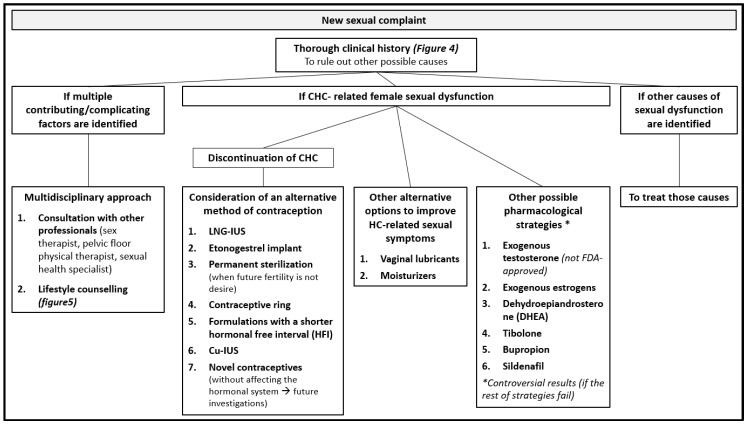
In recent decades, hormonal contraceptives (HC) has made a difference in the control of female fertility, taking an unequivocal role in improving contraceptive efficacy. Some side effects of hormonal treatments have been carefully studied. However, the influence of these drugs on female sexual functioning is not so clear, although variations in the plasma levels of sexual hormones could be associated with sexual dysfunction. Permanent hormonal modifications, during menopause or caused by some endocrine pathologies, could be directly related to sexual dysfunction in some cases but not in all of them. HC use seems to be responsible for a decrease of circulating androgen, estradiol, and progesterone levels, as well as for the inhibition of oxytocin functioning. Hormonal contraceptive use could alter women's pair-bonding behavior, reduce neural response to the expectation of erotic stimuli, and increase sexual jealousy. There are contradictory results from different studies regarding the association between sexual dysfunction and hormonal contraceptives, so it could be firmly said that additional research is needed. When contraceptive-related female sexual dysfunction is suspected, the recommended therapy is the discontinuation of contraceptives with consideration of an alternative method, such as levonorgestrel-releasing intrauterine systems, copper intrauterine contraceptives, etonogestrel implants, the permanent sterilization of either partner (when future fertility is not desired), or a contraceptive ring.
近几十年来,激素避孕药(HC)在控制女性生育方面发挥了作用,在提高避孕效果方面发挥了明确作用。激素治疗的一些副作用已得到仔细研究。然而,这些药物对女性性功能的影响尚不清楚,尽管性激素血浆水平的变化可能与性功能障碍有关。在更年期或由某些内分泌疾病引起的永久性激素改变,在某些情况下可能与性功能障碍直接相关,但并非所有情况都是如此。使用HC似乎会导致循环雄激素、雌二醇和孕酮水平降低,以及抑制催产素功能。使用激素避孕药可能会改变女性的伴侣关系行为,降低对性刺激预期的神经反应,并增加性嫉妒。关于性功能障碍与激素避孕药之间的关联,不同研究有相互矛盾的结果,因此可以肯定地说,需要更多的研究。当怀疑存在与避孕相关的女性性功能障碍时,推荐的治疗方法是停用避孕药,并考虑使用其他方法,如左炔诺孕酮宫内节育系统、铜宫内节育器、依托孕烯植入剂、伴侣一方的永久性绝育(如果不想要未来生育)或避孕环。