UCL MRC Unit for Lifelong Health and Ageing, 1-19 Torrington Place, Fitzrovia, London WC1E 7HB, UK; Barts Heart Center, The Cardiovascular Magnetic Resonance Imaging Unit and The Inherited Cardiovascular Diseases Unit, St. Bartholomew's Hospital, West Smithfield, London, EC1A 7BE, UK.
Translational Mass Spectrometry Research Group, UCL Institute of Child Health and Great Ormond Street Hospital, 30 Guilford Street, London WC1N 1EH, UK; Institute of Child Health, University College London, London, WC1N 1EH, UK.
Mol Cell Proteomics. 2020 Jan;19(1):114-127. doi: 10.1074/mcp.RA119.001586. Epub 2019 Jun 26.
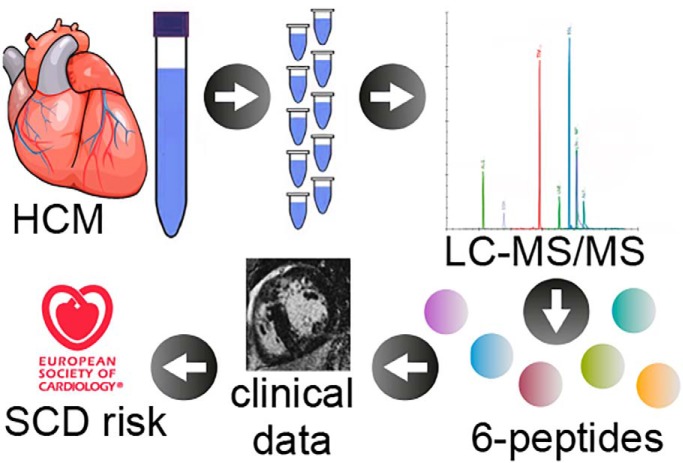
Hypertrophic cardiomyopathy (HCM) is defined by pathological left ventricular hypertrophy (LVH). It is the commonest inherited cardiac condition and a significant number of high risk cases still go undetected until a sudden cardiac death (SCD) event. Plasma biomarkers do not currently feature in the assessment of HCM disease progression, which is tracked by serial imaging, or in SCD risk stratification, which is based on imaging parameters and patient/family history. There is a need for new HCM plasma biomarkers to refine disease monitoring and improve patient risk stratification. To identify new plasma biomarkers for patients with HCM, we performed exploratory myocardial and plasma proteomics screens and subsequently developed a multiplexed targeted liquid chromatography-tandem/mass spectrometry-based assay to validate the 26 peptide biomarkers that were identified. The association of discovered biomarkers with clinical phenotypes was prospectively tested in plasma from 110 HCM patients with LVH (LVH+ HCM), 97 controls, and 16 HCM sarcomere gene mutation carriers before the development of LVH (subclinical HCM). Six peptides (aldolase fructose-bisphosphate A, complement C3, glutathione S-transferase omega 1, Ras suppressor protein 1, talin 1, and thrombospondin 1) were increased significantly in the plasma of LVH+ HCM compared with controls and correlated with imaging markers of phenotype severity: LV wall thickness, mass, and percentage myocardial scar on cardiovascular magnetic resonance imaging. Using supervised machine learning (ML), this six-biomarker panel differentiated between LVH+ HCM and controls, with an area under the curve of ≥ 0.87. Five of these peptides were also significantly increased in subclinical HCM compared with controls. In LVH+ HCM, the six-marker panel correlated with the presence of nonsustained ventricular tachycardia and the estimated five-year risk of sudden cardiac death. Using quantitative proteomic approaches, we have discovered six potentially useful circulating plasma biomarkers related to myocardial substrate changes in HCM, which correlate with the estimated sudden cardiac death risk.
肥厚型心肌病(HCM)的定义为病理性左心室肥厚(LVH)。它是最常见的遗传性心脏病,许多高危病例在发生心脏性猝死(SCD)事件之前仍未被发现。目前,血浆生物标志物并未用于评估 HCM 疾病进展,疾病进展的监测依赖于连续的影像学检查,而 SCD 风险分层则基于影像学参数和患者/家族史。需要新的 HCM 血浆生物标志物来改善疾病监测并提高患者风险分层。为了鉴定 HCM 患者的新的血浆生物标志物,我们进行了探索性心肌和血浆蛋白质组学筛选,并随后开发了一种多重靶向液相色谱-串联质谱(LC-MS/MS)检测方法,以验证鉴定出的 26 种肽生物标志物。在发生 LVH(LVH+HCM)之前,我们前瞻性地在 110 名 HCM 患者(LVH+HCM)、97 名对照者和 16 名 HCM 肌节基因突变携带者的血浆中检测了发现的生物标志物与临床表型的相关性,这些患者没有发生 LVH(亚临床 HCM)。与对照组相比,在 LVH+HCM 患者的血浆中,有 6 种肽(醛缩酶果糖-二磷酸 A、补体 C3、谷胱甘肽 S-转移酶 omega 1、Ras 抑制蛋白 1、桩蛋白 1 和血栓素 1)显著增加,且与心血管磁共振成像上的表型严重程度的影像学标志物相关:左心室壁厚度、质量和心肌瘢痕百分比。使用有监督机器学习(ML),该六标志物面板可区分 LVH+HCM 与对照组,曲线下面积(AUC)≥0.87。与对照组相比,在亚临床 HCM 患者中,这 5 种肽也显著增加。在 LVH+HCM 患者中,六标志物面板与非持续性室性心动过速的存在以及估计的 5 年 SCD 风险相关。使用定量蛋白质组学方法,我们发现了六个与 HCM 心肌底物变化相关的潜在有用的循环血浆生物标志物,它们与估计的 SCD 风险相关。