Department of Marine Zoology, Senckenberg Research Institute and Natural History Museum, Senckenberganlage 25, 60325, Frankfurt am Main, Germany.
FB 15 Biological Sciences, Institute for Ecology, Evolution and Diversity, Goethe University Frankfurt, Max-von-Laue-Str. 13, 60438, Frankfurt am Main, Germany.
Sci Rep. 2019 Jun 26;9(1):9303. doi: 10.1038/s41598-019-45813-9.
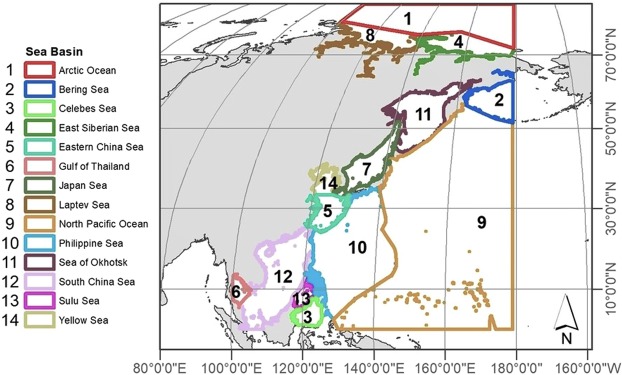
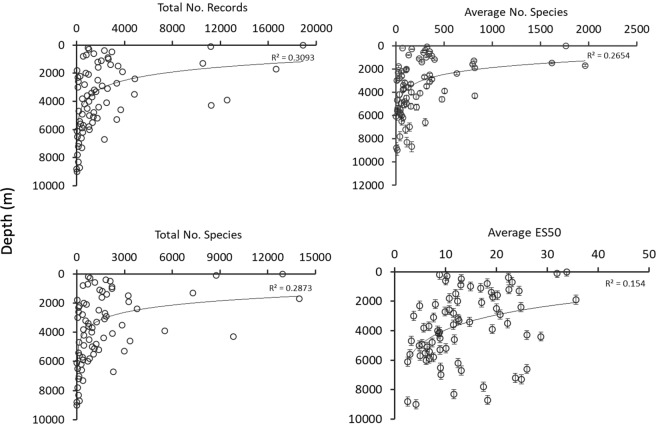
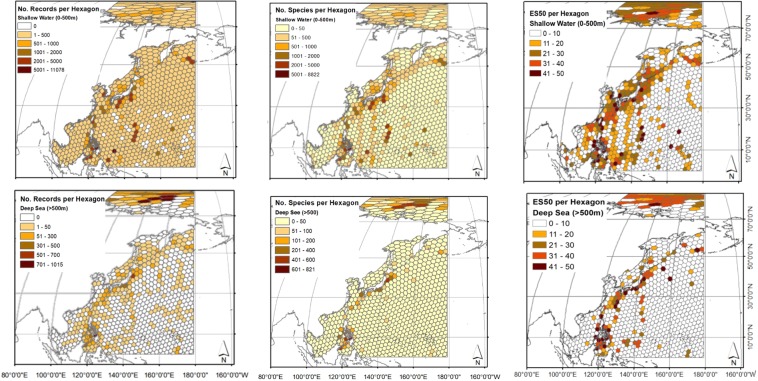
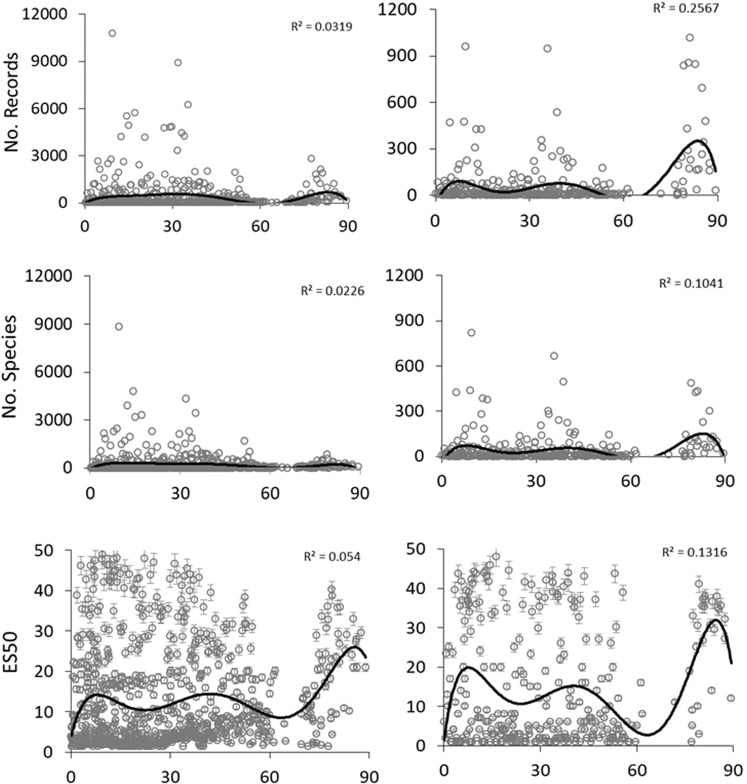
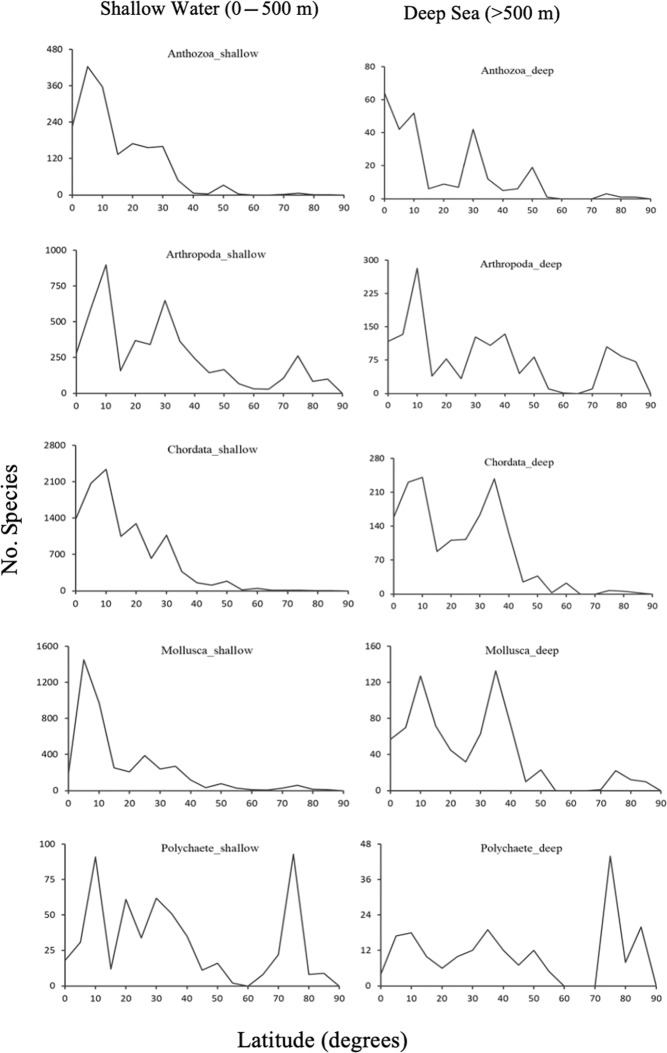
Global scale analyses have recently revealed that the latitudinal gradient in marine species richness is bimodal, peaking at low-mid latitudes but with a dip at the equator; and that marine species richness decreases with depth in many taxa. However, these overall and independently studied patterns may conceal regional differences that help support or qualify the causes in these gradients. Here, we analysed both latitudinal and depth gradients of species richness in the NW Pacific and its adjacent Arctic Ocean. We analysed 324,916 distribution records of 17,414 species from 0 to 10,900 m depth, latitude 0 to 90°N, and longitude 100 to 180°N. Species richness per c. 50 000 km hexagonal cells was calculated as alpha (local average), gamma (regional total) and ES50 (estimated species for 50 records) per latitudinal band and depth interval. We found that average ES50 and gamma species richness decreased per 5° latitudinal bands and 100 m depth intervals. However, average ES50 per hexagon showed that the highest species richness peaked around depth 2,000 m where the highest total number of species recorded. Most (83%) species occurred in shallow depths (0 to 500 m). The area around Bohol Island in the Philippines had the highest alpha species richness (more than 8,000 species per 50,000 km). Both alpha and gamma diversity trends increased from the equator to latitude 10°N, then further decreased, but reached another peak at higher latitudes. The latitudes 60-70°N had the lowest gamma and alpha diversity where there is almost no ocean in our study area. Model selection on Generalized Additive Models (GAMs) showed that the combined effects of all environmental predictors produced the best model driving species richness in both shallow and deep sea. The results thus support recent hypotheses that biodiversity, while highest in the tropics and coastal depths, is decreasing at the equator and decreases with depth below ~2000 m. While we do find the declines of species richness with latitude and depth that reflect temperature gradients, local scale richness proved poorly correlated with many environmental variables. This demonstrates that while regional scale patterns in species richness may be related to temperature, that local scale richness depends on a greater variety of variables.
全球尺度的分析最近表明,海洋物种丰富度的纬度梯度呈双峰模式,在低中纬度达到峰值,但在赤道处出现下降;而且在许多分类群中,海洋物种丰富度随深度的增加而减少。然而,这些整体和独立研究的模式可能掩盖了有助于支持或限定这些梯度成因的区域差异。在这里,我们分析了西北太平洋及其毗邻的北冰洋的纬度和深度梯度。我们分析了 17414 个物种的 324916 个分布记录,这些物种的分布范围为 0 至 10900 米深,纬度范围为 0 至 90°N,经度范围为 100 至 180°N。每 50000 公里六边形细胞的物种丰富度计算为 alpha(局部平均值)、gamma(区域总和)和 ES50(50 个记录的估计物种数)每个纬度带和深度间隔。我们发现,每 5°纬度带和 100 米深度间隔的平均 ES50 和 gamma 物种丰富度都在减少。然而,每个六边形的平均 ES50 表明,物种丰富度最高的峰值出现在水深约 2000 米处,那里记录的物种总数最高。大多数(83%)物种出现在浅水区(0 至 500 米)。菲律宾的 Bohol 岛周围地区的 alpha 物种丰富度最高(每 50000 公里超过 8000 个物种)。alpha 和 gamma 多样性趋势都从赤道到北纬 10°增加,然后进一步减少,但在更高的纬度再次达到峰值。60-70°N 的纬度处 gamma 和 alpha 多样性最低,我们研究区域几乎没有海洋。广义加性模型(GAMs)的模型选择表明,所有环境预测因子的综合效应产生了驱动浅海和深海物种丰富度的最佳模型。因此,这些结果支持了最近的假说,即生物多样性虽然在热带和沿海地区最高,但在赤道处减少,并且在 2000 米以下的深度减少。虽然我们确实发现了与温度梯度相关的纬度和深度的物种丰富度下降,但局部尺度的丰富度与许多环境变量的相关性很差。这表明,尽管物种丰富度的区域模式可能与温度有关,但局部尺度的丰富度取决于更多样化的变量。