Department of Neurology, Haaglanden Medical Center, PO BOX 2191, 2501, VC, The Hague, The Netherlands.
Department of Neurology, Leiden University Medical Center, Leiden, The Netherlands.
Support Care Cancer. 2020 Mar;28(3):1315-1324. doi: 10.1007/s00520-019-04916-9. Epub 2019 Jun 26.
It is unknown if the implementation of an advance care planning (ACP) program is feasible in daily clinical practice for glioblastoma patients. We aimed to develop an ACP program and assess the preferred content, the best time to introduce such a program in the disease trajectory, and possible barriers and facilitators for participation and implementation.
A focus group with health care professionals (HCPs) and individual semi-structured interviews with patients and proxies (of both living and deceased patients) were conducted.
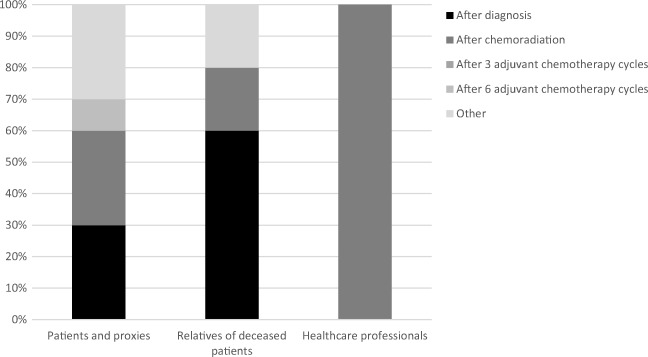
All predefined topics were considered relevant by participants, including the current situation, worries/fears, (supportive) treatment options, and preferred place of care/death. Although HCPs and proxies of deceased patients indicated that the program should be implemented relatively early in the disease trajectory, patient-proxy dyads were more ambiguous. Several patient-proxy dyads indicated that the program should be initiated later in the disease trajectory. If introduced early, topics about the end of life should be postponed. A frequently mentioned barrier for participation was that the program would be too confronting, while a facilitator was adequate access to information.
This study resulted in an ACP program specifically for glioblastoma patients. Although participants agreed on the program content, the optimal timing of introducing such a program was a matter of debate. Our solution is to offer the program shortly after diagnosis but let patients and proxies decide which topics they want to discuss and when. The impact of the program on several patient- and care-related outcomes will be evaluated in the next step.
目前尚不清楚在胶质母细胞瘤患者的日常临床实践中实施预先医疗指示(ACP)计划是否可行。我们旨在制定 ACP 计划,并评估其内容偏好、在疾病进程中引入该计划的最佳时间,以及参与和实施的可能障碍和促进因素。
对医疗保健专业人员(HCP)进行焦点小组讨论,并对患者及其代理人(包括存活和已故患者的代理人)进行个别半结构化访谈。
所有预先设定的主题均被参与者认为是相关的,包括现状、担忧/恐惧、(支持性)治疗选择以及首选的护理/死亡地点。尽管 HCP 和已故患者的代理人表示该计划应在疾病进程的早期实施,但患者-代理人对其的看法并不明确。一些患者-代理人表示,该计划应在疾病进程的后期启动。如果早期引入,应推迟有关生命末期的主题。参与的一个常见障碍是该计划过于具有挑战性,而一个促进因素是获得足够的信息。
本研究制定了专门针对胶质母细胞瘤患者的 ACP 计划。尽管参与者对计划内容达成了一致,但引入该计划的最佳时机仍存在争议。我们的解决方案是在诊断后不久提供该计划,但让患者和代理人决定他们希望讨论哪些主题以及何时讨论。该计划对患者和护理相关结局的影响将在下一步评估。