Department of Radiology, Qilu Hospital of Shandong University, Shandong Province, Jinan 250012, P.R. China.
Department of General Surgery, Jinan Central Hospital Affiliated to Shandong University, Shandong Province, Jinan 250013, P.R. China.
Thorac Cancer. 2019 Jul;10(7):1628-1635. doi: 10.1111/1759-7714.13129. Epub 2019 Jun 27.
Microwave ablation (MWA) has recently become an established treatment option for topical therapy of lung cancer patients. In this study, we evaluated whether MWA combined with chemotherapy could improve progression-free survival (PFS) of patients with stage IV lung adenocarcinoma compared with chemotherapy alone.
A total of 49 patients were enrolled into the study; 21 patients accepted MWA therapy combined with chemotherapy, 28 patients accepted only chemotherapy. Enumeration data were analyzed using χ2 test or Fisher's exact probability test and univariate analysis was analyzed using Kaplan-Meier survival curves. Multivariate analysis was carried out with the Cox proportional hazard model.
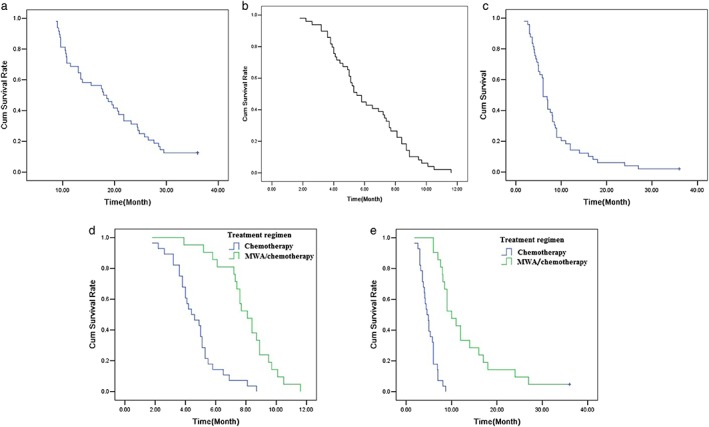
The treatment regimen was not correlated with clinical features of the patients, which included gender, age, smoking history, tumor site, tumor size and Eastern Cooperative Oncology Group (ECOG). The patients' 3-year overall survival (OS) was 12.5%, and median survival time was 19.3 months. The median PFS was 6.1 months and the 1-year PFS was 0.0%. The PFS was significantly associated with tumor size (P < 0.05), ECOG (P < 0.01) and treatment regimen (P < 0.01). The median time to local progression (TTLP) was 8.4 months and the 3-year TTLP was 2.0%. The TTLP was significantly associated with tumor size (P < 0.05) and treatment regimen (P < 0.01). Cox multivariate regression demonstrated that MWA combined with chemotherapy was the independent factor for both the PFS and TTLP.
MWA, as a topical treatment method, when combined with chemotherapy improved the PFS and TTLP of patients with stage IV lung adenocarcinoma.
微波消融(MWA)最近已成为治疗肺癌患者的一种标准治疗选择。在这项研究中,我们评估了 MWA 联合化疗与单独化疗相比是否能改善 IV 期肺腺癌患者的无进展生存期(PFS)。
共纳入 49 例患者,21 例接受 MWA 联合化疗治疗,28 例接受单纯化疗。计数资料采用 χ2 检验或 Fisher 确切概率法,单因素分析采用 Kaplan-Meier 生存曲线,多因素分析采用 Cox 比例风险模型。
治疗方案与患者的临床特征(包括性别、年龄、吸烟史、肿瘤部位、肿瘤大小和东部肿瘤协作组(ECOG)评分)无关。患者的 3 年总生存率(OS)为 12.5%,中位生存时间为 19.3 个月。中位无进展生存期(PFS)为 6.1 个月,1 年 PFS 为 0.0%。PFS 与肿瘤大小(P < 0.05)、ECOG 评分(P < 0.01)和治疗方案(P < 0.01)显著相关。局部进展时间(TTLP)的中位时间为 8.4 个月,3 年 TTLP 为 2.0%。TTLP 与肿瘤大小(P < 0.05)和治疗方案(P < 0.01)显著相关。Cox 多因素回归分析表明,MWA 联合化疗是 PFS 和 TTLP 的独立影响因素。
MWA 作为一种局部治疗方法,与化疗联合应用可改善 IV 期肺腺癌患者的 PFS 和 TTLP。