Division of Infectious Diseases, Massachusetts General Hospital, Boston, MA, USA.
Division of General Internal Medicine, Massachusetts General Hospital, Boston, MA, USA.
J Int AIDS Soc. 2019 Jun;22(6):e25326. doi: 10.1002/jia2.25326.
Changes to the U.S. President's Emergency Plan for AIDS Relief (PEPFAR) funding have led to closures of non-governmental HIV clinics with patient transfers to government-funded clinics. We sought to determine the success of transfers in South Africa using a national data source.
All adults (≥18 years) on antiretroviral therapy (ART) who visited a single PEPFAR-funded hospital-based HIV clinic in Durban, South Africa from March to June 2012 were transferred to community-based clinics. Previously, we matched patient records from the hospital-based HIV clinic with National Health Laboratory Services (NHLS) Corporate Data Warehouse (CDW) data to estimate the proportion of patients with a CD4 count or viral load (VL) in the CDW during the year before transfer. As a proxy for retention in care, in this study we evaluated whether patients had a CD4 count or VL at another facility within approximately three years of transfer. Patients referred to a private doctor at transfer were excluded from the analysis. We assessed predictors (age, sex, CD4 count, VL status, ART duration and location of future care) of not having post-transfer laboratory data using Cox proportional hazards models.
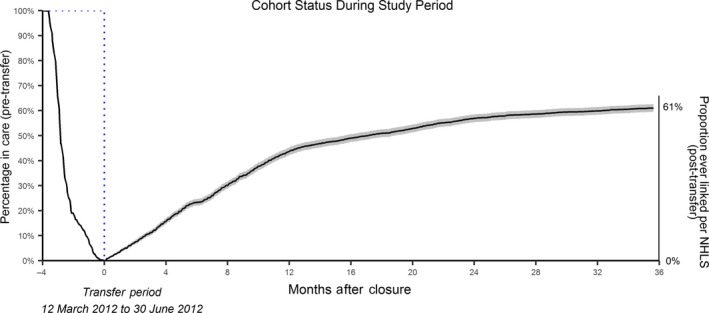
Of the 3893 patients referred to a government facility at transfer, 41% were male and median age was 39 years (IQR 34 to 46). There was a post-transfer CD4 count or VL from another facility for 23% of these individuals within six months, 44% within one year, 57% within two years and 61% within approximately three years. Male sex (aHR 1.20, 95% CI 1.10 to 1.31) and shorter duration on ART (<3 months, aHR 3.80, 95% CI 2.77 to 5.21; three months to one year, aHR 1.32, 95% CI 1.15 to 1.51, each compared with >1 year) were associated with not having a post-transfer record.
Using data from the NHLS CDW, 61% of patients had evidence of a post-transfer laboratory record at another facility within approximately three years after closure of a large South African HIV clinic. Males and those with shorter time on ART prior to transfer were at highest risk for lacking follow-up laboratory data. As patients transfer care, national data sources can be used to evaluate long-term patient care trajectories.
美国总统艾滋病救援紧急计划(PEPFAR)的资金变化导致了非政府艾滋病毒诊所的关闭,并将病人转移到政府资助的诊所。我们试图利用国家数据源来确定南非的转移是否成功。
2012 年 3 月至 6 月期间,所有在德班的一家 PEPFAR 资助的医院艾滋病诊所接受抗逆转录病毒治疗(ART)的成年人(≥18 岁)都被转移到社区诊所。在此之前,我们将医院艾滋病诊所的患者记录与国家卫生实验室服务(NHLS)企业数据仓库(CDW)的数据进行匹配,以估计在转移前一年中 CDW 中有 CD4 计数或病毒载量(VL)的患者比例。作为护理保留的替代指标,在这项研究中,我们评估了患者在转移后大约三年内是否在另一家机构进行了 CD4 计数或 VL。在转移时转介给私人医生的患者被排除在分析之外。我们使用 Cox 比例风险模型评估了无转移后实验室数据的预测因素(年龄、性别、CD4 计数、VL 状态、ART 持续时间和未来护理地点)。
在转诊到政府机构的 3893 名患者中,41%为男性,中位年龄为 39 岁(IQR 34 至 46)。在这部分人中,有 23%在六个月内、44%在一年内、57%在两年内和 61%在大约三年内从另一家机构获得了转移后的 CD4 计数或 VL。男性(aHR 1.20,95%CI 1.10 至 1.31)和 ART 持续时间较短(<3 个月,aHR 3.80,95%CI 2.77 至 5.21;3 个月至 1 年,aHR 1.32,95%CI 1.15 至 1.51,与>1 年相比,各有)与没有转移后记录相关。
利用 NHLS CDW 的数据,在一家大型南非艾滋病毒诊所关闭后大约三年内,61%的患者在另一家机构有转移后实验室记录的证据。男性和 ART 转移前时间较短的患者最有可能缺乏后续实验室数据。随着患者转移护理,国家数据源可用于评估长期患者护理轨迹。