Akamatsu Hajime, Kato Masayasu, Ochi Sunao, Mimuro Genki, Matsuoka Jun-Ichi, Takahashi Mami
Division of Lowland Farming, Hokuriku Research Center, Central Region Agricultural Research Center, National Agriculture and Food Research Organization, 1-2-1 Inada, Joetsu, Niigata 943-0193, Japan.
Biological Resources and Post-harvest Division, Japan International Research Center for Agricultural Sciences, 1-1 Ohwashi, Tsukuba, Ibaraki 305-8686, Japan.
Plant Pathol J. 2019 Jun;35(3):219-233. doi: 10.5423/PPJ.OA.11.2018.0252. Epub 2019 Jun 1.
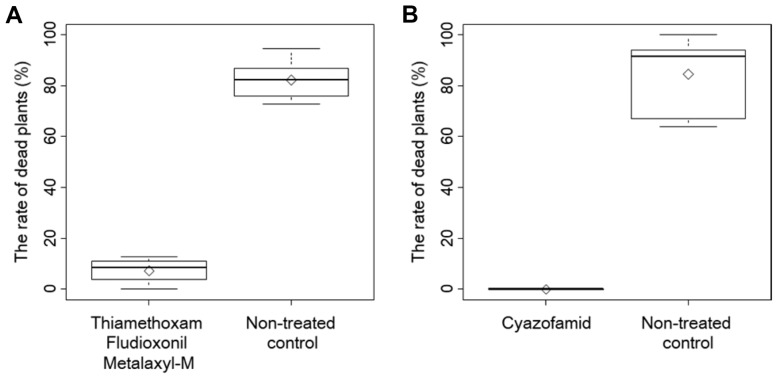
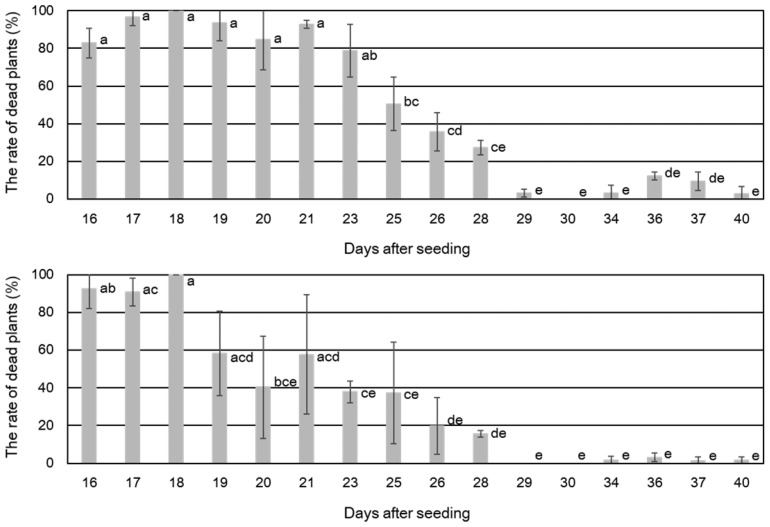
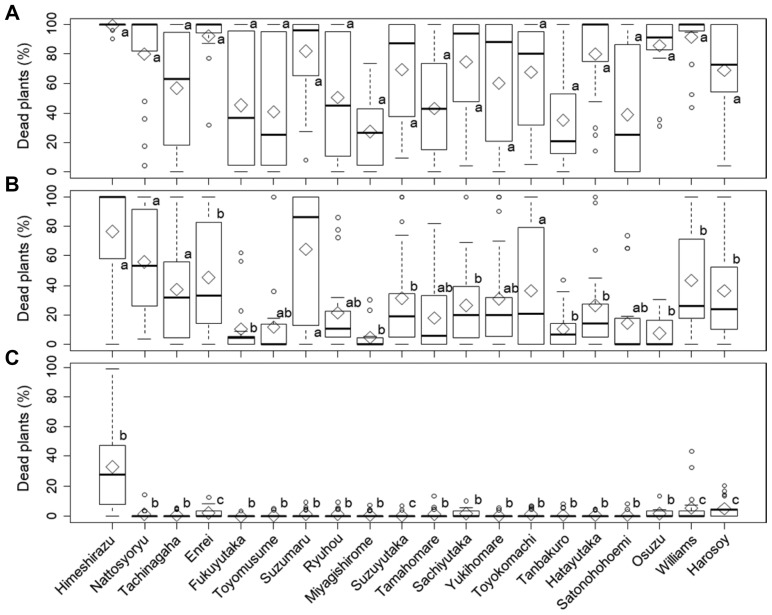
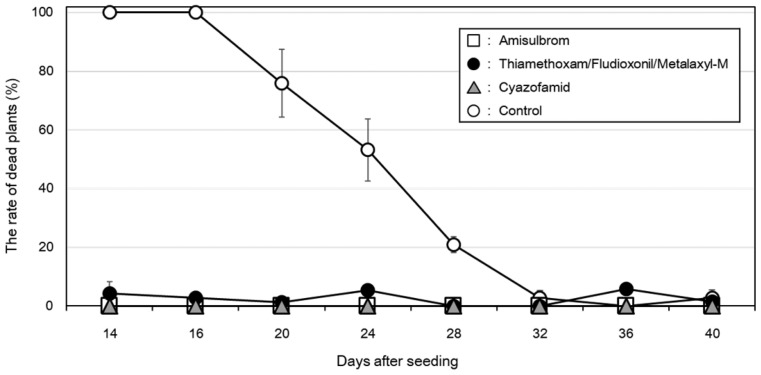
Soybean cultivars susceptible to Phytophthora root and stem rot are vulnerable to seed rot and damping-off of seedlings and young plants following an infection by . In this study, the disease responses of Japanese soybean cultivars including currently grown main cultivars during the early growth stages were investigated following infections by multiple isolates from Japanese fields. The extent of the resistance to 17 isolates after inoculations at 14, 21, and 28 days after seeding varied significantly among 18 Japanese and two US soybean cultivars. Moreover, the disease responses of each cultivar differed significantly depending on the isolate and the plant age at inoculation. Additionally, the treatment of 'Nattosyo-ryu' seeds with three fungicidal agrochemicals provided significant protection from when plants were inoculated at 14-28 days after seeding. These results indicate that none of the Japanese soybean cultivars are completely resistant to all tested isolates during the first month after sowing. However, the severity of the disease was limited when plants were inoculated during the later growth stages. Furthermore, the protective effects of the tested agrochemicals were maintained for at least 28 days after the seed treatment. Japanese soybean cultivars susceptible to Phytophthora root and stem rot that are grown under environmental conditions favorable for infections require the implementation of certain practices, such as seed treatments with appropriate agrochemicals, to ensure they are protected from during the early part of the soybean growing season.
对疫霉根腐茎腐病敏感的大豆品种,在感染 后易发生种子腐烂以及幼苗和幼株猝倒。在本研究中,对包括当前种植的主要品种在内的日本大豆品种在生长早期阶段感染来自日本田间的多个 分离株后的病害反应进行了调查。在播种后14、21和28天接种后,18个日本大豆品种和2个美国大豆品种对17个 分离株的抗性程度差异显著。此外,每个品种的病害反应因 分离株和接种时的植株年龄不同而有显著差异。此外,用三种农用杀真菌剂处理“纳豆酱油柳”种子,在播种后14 - 28天接种植株时,能显著保护其免受 侵害。这些结果表明,在播种后的第一个月内,没有一个日本大豆品种对所有测试的 分离株完全抗性。然而,在生长后期接种时,病害的严重程度受到限制。此外,种子处理后,测试农用化学品的保护作用至少维持28天。在有利于 感染的环境条件下种植的对疫霉根腐茎腐病敏感的日本大豆品种,需要采取某些措施,如用适当的农用化学品进行种子处理,以确保在大豆生长季节早期免受 侵害。