Ammendolia Carlo, Côté Pierre, Rampersaud Y Raja, Southerst Danielle, Schneider Michael, Ahmed Aksa, Bombardier Claire, Hawker Gillian, Budgell Brian
1Institute of Health Policy, Management and Evaluation, University of Toronto, 60 Murray Street, Rm L2-225, Toronto, Ontario M5T 3L9 Canada.
2Rebecca MacDonald Centre for Arthritis & Autoimmune Disease, Mount Sinai Hospital, 60 Murray Street, Rm L2-225, Toronto, Ontario M5T 3L9 Canada.
Chiropr Man Therap. 2019 Jun 19;27:24. doi: 10.1186/s12998-019-0245-z. eCollection 2019.
Lumbar spinal stenosis (LSS) leads to diminished blood flow to the spinal nerves causing neurogenic claudication and impaired walking ability. Animal studies have demonstrated increased blood flow to the spinal nerves and spinal cord with superficial para-spinal electrical stimulation of the skin.
The aim of this study was to assess the effectiveness of active para-spinal transcutaneous electrical nerve stimulation (TENS) compared to de-tuned TENS applied while walking, on improving walking ability in LSS.
This was a two-arm double-blinded (participant and assessor) randomized controlled trial.
We recruited 104 participants 50 years of age or older with neurogenic claudication, imaging confirmed LSS and limited walking ability.
The primary measure was walking distance measured by the self-paced walking test (SPWT) and the primary outcome was the difference in proportions among participants in both groups who achieved at least a 30% improvement in walking distance from baseline using relative risk with 95% confidence intervals.
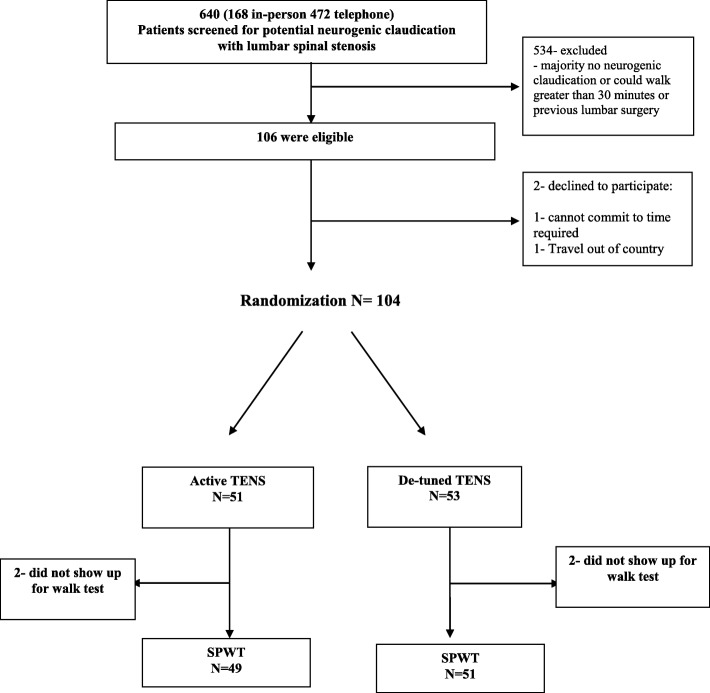
The active TENS group ( = 49) received para-spinal TENS from L3-S1 at a frequency of 65-100 Hz modulated over 3-s intervals with a pulse width of 100-200 usec, and turned on 2 min before the start and maintained during the SPWT. The de-tuned TENS group ( = 51) received similarly applied TENS for 30 s followed by ramping down to zero stimulus and turned off before the start and during the SPWT.Study funded by The Arthritis Society ($365,000 CAN) and salary support for Carlo Ammendolia funded by the Canadian Chiropractic Research Foundation ($500,000 CAN over 5 years).
From August 2014 to January 2016 a total of 640 potential participants were screened for eligibility; 106 were eligible and 104 were randomly allocated to active TENS or de-tuned TENS. Both groups showed significant improvement in walking distance but there was no significant difference between groups. The mean difference between active and de-tuned TENS groups was 46.9 m; 95% CI (- 118.4 to 212.1); = 0.57. A total of 71% (35/49) of active TENS and 74% (38/51) of de-tuned TENS participants achieved at least 30% improvement in walking distance; relative risk (RR), 0.96; 95% CI, (0.7 to 1.2) = 0.77.
Active TENS applied while walking is no better than de-tuned TENS for improving walking ability in patients with degenerative LSS and therefore should not be a recommended treatment in clinical practice.
ClinicalTrials.gov ID: NCT02592642. Registration October 30, 2015.
腰椎管狭窄症(LSS)会导致脊髓神经血流减少,引起神经源性间歇性跛行和行走能力受损。动物研究表明,对皮肤进行浅表的脊柱旁电刺激可增加脊髓神经和脊髓的血流量。
本研究旨在评估主动式脊柱旁经皮电神经刺激(TENS)与行走时应用的失谐TENS相比,对改善LSS患者行走能力的有效性。
这是一项双臂双盲(参与者和评估者)随机对照试验。
我们招募了104名50岁及以上患有神经源性间歇性跛行、影像学确诊为LSS且行走能力受限的参与者。
主要指标是通过自定步速行走测试(SPWT)测量的行走距离,主要结局是两组中使用相对风险和95%置信区间,行走距离从基线至少提高30%的参与者比例差异。
主动TENS组(n = 49)从L3 - S1接受脊柱旁TENS,频率为65 - 100Hz,以3秒为间隔调制,脉冲宽度为100 - 200微秒,在开始前2分钟开启并在SPWT期间维持。失谐TENS组(n = 51)接受类似应用的TENS 30秒,然后逐渐降至零刺激,并在开始前和SPWT期间关闭。该研究由关节炎协会资助(365,000加元),Carlo Ammendolia的薪资支持由加拿大整脊研究基金会资助(5年内500,000加元)。
从2014年8月到2016年1月,共筛选了640名潜在参与者的资格;106名符合条件,104名被随机分配到主动TENS组或失谐TENS组。两组的行走距离均有显著改善,但组间无显著差异。主动TENS组和失谐TENS组之间的平均差异为46.9米;95%置信区间(-118.4至212.1);P = 0.57。主动TENS组中71%(35/49)和失谐TENS组中74%(38/51)的参与者行走距离至少提高了30%;相对风险(RR),0.96;95%置信区间,(0.7至1.2);P = 0.77。
对于退行性LSS患者,行走时应用主动TENS在改善行走能力方面并不优于失谐TENS,因此在临床实践中不应作为推荐治疗方法。
ClinicalTrials.gov标识符:NCT02592642。2015年10月30日注册。