• 文献检索
  • 文档翻译
  • 深度研究
  • 学术资讯
  • Suppr Zotero 插件Zotero 插件
  • 邀请有礼
  • 套餐&价格
  • 历史记录
应用&插件
Suppr Zotero 插件Zotero 插件浏览器插件Mac 客户端Windows 客户端微信小程序
定价
高级版会员购买积分包购买API积分包
服务
文献检索文档翻译深度研究API 文档MCP 服务
关于我们
关于 Suppr公司介绍联系我们用户协议隐私条款
关注我们

Suppr 超能文献

核心技术专利:CN118964589B侵权必究
粤ICP备2023148730 号-1Suppr @ 2026

文献检索

告别复杂PubMed语法,用中文像聊天一样搜索,搜遍4000万医学文献。AI智能推荐,让科研检索更轻松。

立即免费搜索

文件翻译

保留排版,准确专业,支持PDF/Word/PPT等文件格式,支持 12+语言互译。

免费翻译文档

深度研究

AI帮你快速写综述,25分钟生成高质量综述,智能提取关键信息,辅助科研写作。

立即免费体验

定量评估腰椎管狭窄症所致神经源性间歇性跛行患者的步行能力——一项对比研究。

Quantification of walking ability in subjects with neurogenic claudication from lumbar spinal stenosis--a comparative study.

机构信息

Department of Physical Medicine and Rehabilitation, Harvard Medical School, 125 Nashua St, Boston, MA 02114, USA.

出版信息

Spine J. 2012 Feb;12(2):101-9. doi: 10.1016/j.spinee.2011.12.006. Epub 2011 Dec 29.

DOI:10.1016/j.spinee.2011.12.006
PMID:22209240
原文链接:https://pmc.ncbi.nlm.nih.gov/articles/PMC3315838/
Abstract

BACKGROUND CONTEXT

Walking limitations caused by neurogenic claudication (NC) are typically assessed with self-reported measures, although objective evaluation of walking using motorized treadmill test (MTT) or self-paced walking test (SPWT) has periodically appeared in the lumbar spinal stenosis (LSS) literature.

PURPOSE

This study compared the validity and responsiveness of MTT and SPWT for assessing walking ability before and after common treatments for NC.

STUDY DESIGN

Prospective observational cohort study.

PATIENT SAMPLE

Fifty adults were recruited from an urban spine center if they had LSS and substantial walking limitations from NC and were scheduled to undergo surgery (20%) or conservative treatment (80%).

OUTCOME MEASURES

Walking times, distances, and speeds along with the characteristics of NC symptoms were recorded for MTT and SPWT. Self-reported measures included back and leg pain intensity assessed with 0 to 10 numeric pain scales, disability assessed with Oswestry Disability Index, walking ability assessed with estimated walking times and distances, and NC symptoms assessed with the subscales from the Spinal Stenosis Questionnaires.

METHODS

Motorized treadmill test used a level track, and SPWT was conducted in a rectangular hallway. Walking speeds were self-selected, and test end points were NC, fatigue, or completion of the 30-minute test protocol. Results from MTT and SPWT were compared with each other and self-reported measures. Internal responsiveness was assessed by comparing changes in the initial results with the posttreatment results and external responsiveness by comparing walking test results that improved with those that did not improve by self-reported criteria.

RESULTS

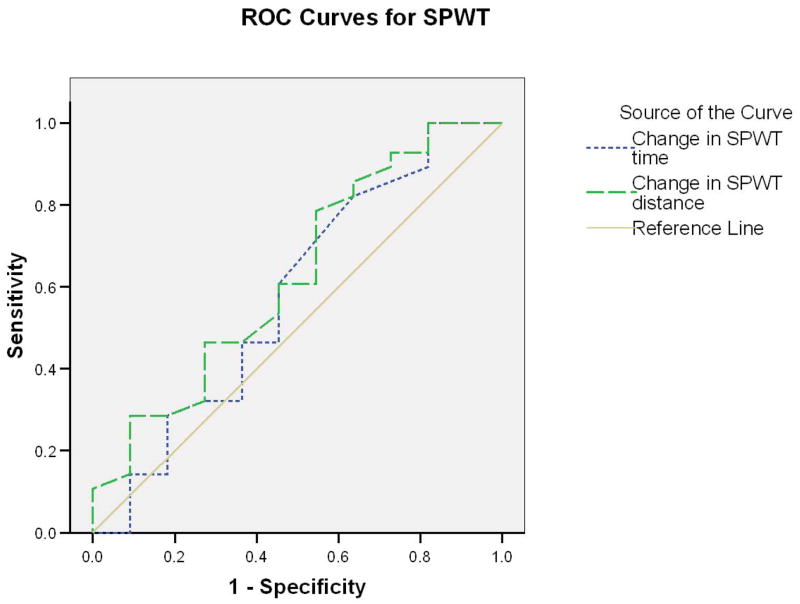
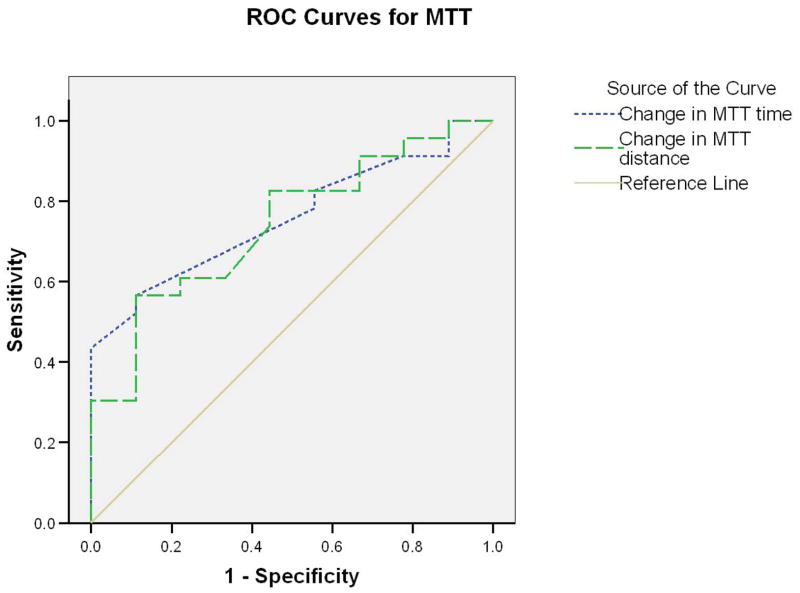
Mean age of the participants was 68 years, and 58% were male. Neurogenic claudication included leg pain (88%) and buttock(s) pain (12%). Five participants could not safely perform MTT. Walking speeds were faster and distances were greater with SPWT, although the results from both tests correlated with each other and self-reported measures. Of the participants, 72% reported improvement after treatment, which was confirmed by significant mean differences in self-reported measures. Motorized treadmill test results did not demonstrate internal responsiveness to change in clinical status after treatment but SPWT results did, with increased mean walking times (6 minutes) and distances (387 m). When responsiveness was assessed against external criterion, both SPWT and MTT demonstrated substantial divergence with self-reported changes in clinical status and alternative outcome measures.

CONCLUSIONS

Both MTT and SPWT can quantify walking abilities in NC. As outcome tools, SPWT demonstrated better internal responsiveness than MTT, but neither test demonstrated adequate external responsiveness. Neither test should be considered as a meaningful substitution for disease-specific measures of function.
https://cdn.ncbi.nlm.nih.gov/pmc/blobs/6a7d/3315838/83f8adb359d9/nihms347244f2.jpg
https://cdn.ncbi.nlm.nih.gov/pmc/blobs/6a7d/3315838/4abde368597e/nihms347244f1.jpg
https://cdn.ncbi.nlm.nih.gov/pmc/blobs/6a7d/3315838/83f8adb359d9/nihms347244f2.jpg
https://cdn.ncbi.nlm.nih.gov/pmc/blobs/6a7d/3315838/4abde368597e/nihms347244f1.jpg
https://cdn.ncbi.nlm.nih.gov/pmc/blobs/6a7d/3315838/83f8adb359d9/nihms347244f2.jpg
摘要

背景

神经源性跛行(NC)引起的行走受限通常通过自我报告的测量方法进行评估,尽管使用电动跑步机测试(MTT)或自我定速步行测试(SPWT)对步行进行客观评估在腰椎狭窄症(LSS)文献中时有出现。

目的

本研究比较了 MTT 和 SPWT 在评估 NC 常见治疗前后行走能力方面的有效性和反应性。

研究设计

前瞻性观察队列研究。

患者样本

如果患有 LSS 且由于 NC 导致行走受限严重,并计划接受手术(20%)或保守治疗(80%),则从城市脊柱中心招募 50 名成年人作为患者。

结局测量

记录 MTT 和 SPWT 的行走时间、距离和速度,以及 NC 症状的特征。自我报告的测量包括使用 0 到 10 的数字疼痛量表评估的腰背疼痛强度、使用 Oswestry 残疾指数评估的残疾程度、使用估计的行走时间和距离评估的行走能力,以及使用 Spinal Stenosis Questionnaires 的子量表评估的 NC 症状。

方法

电动跑步机测试使用水平轨道,SPWT 在矩形走廊进行。行走速度为自我选择,测试终点为 NC、疲劳或完成 30 分钟测试方案。将 MTT 和 SPWT 的结果与彼此以及自我报告的测量结果进行比较。内部反应性通过比较初始结果与治疗后结果来评估,外部反应性通过比较根据自我报告标准改善的步行测试结果与未改善的步行测试结果来评估。

结果

参与者的平均年龄为 68 岁,58%为男性。神经源性跛行包括腿部疼痛(88%)和臀部疼痛(12%)。有 5 名参与者无法安全地进行 MTT。尽管两种测试结果与彼此和自我报告的测量结果相关,但 SPWT 的行走速度更快,距离更远。在治疗后,72%的参与者报告有改善,这与自我报告的测量结果的显著差异相吻合。MTT 结果不能显示治疗后临床状态变化的内部反应性,但 SPWT 结果可以,行走时间(6 分钟)和距离(387 米)均有增加。当根据外部标准评估反应性时,SPWT 和 MTT 与自我报告的临床状态变化和替代结局测量结果都存在显著差异。

结论

MTT 和 SPWT 均可定量评估 NC 患者的行走能力。作为结局工具,SPWT 的内部反应性优于 MTT,但两者均未表现出足够的外部反应性。这两种测试都不应该被视为特定于疾病的功能测量的有意义替代方法。

相似文献

1
Quantification of walking ability in subjects with neurogenic claudication from lumbar spinal stenosis--a comparative study.定量评估腰椎管狭窄症所致神经源性间歇性跛行患者的步行能力——一项对比研究。
Spine J. 2012 Feb;12(2):101-9. doi: 10.1016/j.spinee.2011.12.006. Epub 2011 Dec 29.
2
Longitudinal construct validity and responsiveness of measures of walking capacity in individuals with lumbar spinal stenosis.腰椎管狭窄症患者步行能力测量指标的纵向结构效度和反应性
Spine J. 2014 Sep 1;14(9):1936-43. doi: 10.1016/j.spinee.2013.11.030. Epub 2013 Nov 26.
3
A criterion measure of walking capacity in lumbar spinal stenosis and its comparison with a treadmill protocol.一种用于腰椎椎管狭窄症的步行能力的标准测量方法及其与跑步机方案的比较。
Spine (Phila Pa 1976). 2009 Oct 15;34(22):2444-9. doi: 10.1097/BRS.0b013e3181b03fc8.
4
Objective functional assessment using the "Timed Up and Go" test in patients with lumbar spinal stenosis.采用“起立-行走计时测试”评估腰椎椎管狭窄症患者的功能。
Neurosurg Focus. 2019 May 1;46(5):E4. doi: 10.3171/2019.2.FOCUS18618.
5
An outcome measure of functionality in patients with lumber spinal stenosis: a validation study of the Iranian version of Neurogenic Claudication Outcome Score (NCOS).腰椎管狭窄症患者功能结局的测量指标:伊朗版神经源性跛行结局评分(NCOS)的验证研究。
BMC Neurol. 2012 Sep 24;12:101. doi: 10.1186/1471-2377-12-101.
6
Walking assessment in people with lumbar spinal stenosis: capacity, performance, and self-report measures.腰椎管狭窄症患者的步行评估:能力、表现和自我报告测量。
Spine J. 2011 Sep;11(9):816-23. doi: 10.1016/j.spinee.2010.10.019. Epub 2010 Dec 8.
7
Minimal clinically important differences in walking capacity and physical activity after nonsurgical treatment in patients with lumbar spinal stenosis: a secondary analysis of a randomized controlled trial.非手术治疗腰椎管狭窄症患者步行能力和体力活动的最小临床重要差异:一项随机对照试验的二次分析。
Spine J. 2024 Feb;24(2):256-262. doi: 10.1016/j.spinee.2023.10.011. Epub 2023 Oct 21.
8
Responsiveness of Outcome Measures in Nonsurgical Patients with Lumbar Spinal Stenosis: A Secondary Analysis From a Randomized Controlled Trial.非手术治疗腰椎管狭窄症患者结局测量指标的反应性:一项随机对照试验的二次分析。
Spine (Phila Pa 1976). 2021 Jun 15;46(12):788-795. doi: 10.1097/BRS.0000000000003920.
9
A Randomized, Double-blind, Placebo-Controlled Crossover Trial of Oxymorphone Hydrochloride and Propoxyphene/Acetaminophen Combination for the Treatment of Neurogenic Claudication Associated With Lumbar Spinal Stenosis.一项关于盐酸羟考酮与丙氧芬/对乙酰氨基酚联合用药治疗腰椎管狭窄症相关神经源性间歇性跛行的随机、双盲、安慰剂对照交叉试验。
Spine (Phila Pa 1976). 2015 May 15;40(10):684-91. doi: 10.1097/BRS.0000000000000837.
10
Comprehensive Nonsurgical Treatment Versus Self-directed Care to Improve Walking Ability in Lumbar Spinal Stenosis: A Randomized Trial.全面非手术治疗与自我护理改善腰椎管狭窄症患者的步行能力:一项随机试验。
Arch Phys Med Rehabil. 2018 Dec;99(12):2408-2419.e2. doi: 10.1016/j.apmr.2018.05.014. Epub 2018 Jun 20.

引用本文的文献

1
Minimal Clinically Important Difference in the Six-Minute Walking Distance 12 Months After Lumbar Spinal Stenosis Surgery.腰椎管狭窄症手术后12个月六分钟步行距离的最小临床重要差异
Cureus. 2025 Mar 25;17(3):e81153. doi: 10.7759/cureus.81153. eCollection 2025 Mar.
2
The Essence of Clinical Practice Guidelines for Lumbar Spinal Stenosis, 2021: 2. Diagnosis and Evaluation.《2021年腰椎管狭窄症临床实践指南精要:2. 诊断与评估》
Spine Surg Relat Res. 2023 Jul 27;7(4):300-305. doi: 10.22603/ssrr.2022-0080.
3
Correlation between clinical scoring systems and quantitative MRI parameters in degenerative lumbar spinal stenosis.

本文引用的文献

1
Walking ability during daily life in patients with osteoarthritis of the knee or the hip and lumbar spinal stenosis: a cross sectional study.膝关节或髋关节骨关节炎以及腰椎椎管狭窄症患者日常生活中的步行能力:一项横断面研究。
BMC Musculoskelet Disord. 2010 Oct 12;11:233. doi: 10.1186/1471-2474-11-233.
2
Validity and reproducibility of self-report measures of walking capacity in lumbar spinal stenosis.腰椎管狭窄症患者行走能力自评量表的有效性和可重复性。
Spine (Phila Pa 1976). 2010 Nov 1;35(23):2097-102. doi: 10.1097/BRS.0b013e3181f5e13b.
3
Trends, major medical complications, and charges associated with surgery for lumbar spinal stenosis in older adults.
退行性腰椎管狭窄症临床评分系统与定量MRI参数之间的相关性
J Clin Orthop Trauma. 2022 Oct 20;35:102050. doi: 10.1016/j.jcot.2022.102050. eCollection 2022 Dec.
4
Relationship between changes in physical function parameters and Roland-Morris disability questionnaire score after decompression surgery for lumbar spinal canal stenosis.腰椎管狭窄减压术后身体功能参数变化与 Roland-Morris 残疾问卷评分的关系。
Nagoya J Med Sci. 2022 Aug;84(3):570-579. doi: 10.18999/nagjms.84.3.570.
5
Walking Biomechanics and Spine Loading in Patients With Symptomatic Lumbar Spinal Stenosis.有症状的腰椎管狭窄症患者的行走生物力学与脊柱负荷
Front Bioeng Biotechnol. 2021 Nov 18;9:751155. doi: 10.3389/fbioe.2021.751155. eCollection 2021.
6
Physical and Psychological Factors Associated With Walking Capacity in Patients With Lumbar Spinal Stenosis With Neurogenic Claudication: A Systematic Scoping Review.腰椎管狭窄症伴神经源性间歇性跛行患者步行能力相关的生理和心理因素:一项系统综述。
Front Neurol. 2021 Sep 9;12:720662. doi: 10.3389/fneur.2021.720662. eCollection 2021.
7
Evaluation of the effects of differences in silicone hardness on rat model of lumbar spinal stenosis.评估不同硬度硅橡胶材料对大鼠腰椎管狭窄模型的影响。
PLoS One. 2021 May 13;16(5):e0251464. doi: 10.1371/journal.pone.0251464. eCollection 2021.
8
Evaluating the Reproducibility of the Walking Test for Intermittent Claudication Associated with Lumbar Spinal Stenosis.评估腰椎管狭窄症相关间歇性跛行步行试验的可重复性。
Asian Spine J. 2022 Jun;16(3):411-418. doi: 10.31616/asj.2020.0505. Epub 2021 May 10.
9
Assessing the Impact of Neurogenic Claudication on Outcomes Following Decompression With Lumbar Interbody Fusions in Patients With Lumbar Spinal Stenosis.评估神经源性间歇性跛行对腰椎管狭窄症患者行腰椎椎间融合减压术后疗效的影响。
Global Spine J. 2021 Mar;11(2):203-211. doi: 10.1177/2192568220902746. Epub 2020 Feb 6.
10
Quality of life and objective functional impairment in lumbar spinal stenosis: a protocol for a systematic review and meta-analysis of moderators.生活质量和腰椎管狭窄症的客观功能障碍:系统评价和调节因素荟萃分析的方案。
BMJ Open. 2019 Nov 21;9(11):e032314. doi: 10.1136/bmjopen-2019-032314.
老年人腰椎管狭窄症手术的趋势、主要医疗并发症和费用。
JAMA. 2010 Apr 7;303(13):1259-65. doi: 10.1001/jama.2010.338.
4
Lumbar spinal stenosis: prognostic factors for bilateral microsurgical decompression using a unilateral approach.腰椎管狭窄症:单侧入路双侧显微减压的预后因素。
Neurosurgery. 2009 Dec;65(6 Suppl):182-7; discussion187. doi: 10.1227/01.NEU.0000341906.65696.08.
5
A criterion measure of walking capacity in lumbar spinal stenosis and its comparison with a treadmill protocol.一种用于腰椎椎管狭窄症的步行能力的标准测量方法及其与跑步机方案的比较。
Spine (Phila Pa 1976). 2009 Oct 15;34(22):2444-9. doi: 10.1097/BRS.0b013e3181b03fc8.
6
Functional and clinical evaluation for the surgical treatment of degenerative stenosis of the lumbar spinal canal.腰椎管退变性狭窄症手术治疗的功能与临床评估
J Neurosurg Spine. 2009 Sep;11(3):347-52. doi: 10.3171/2009.3.SPINE08692.
7
Surgical compared with nonoperative treatment for lumbar degenerative spondylolisthesis. four-year results in the Spine Patient Outcomes Research Trial (SPORT) randomized and observational cohorts.腰椎退行性滑脱症手术治疗与非手术治疗的比较:脊柱患者预后研究试验(SPORT)随机分组及观察队列的四年结果
J Bone Joint Surg Am. 2009 Jun;91(6):1295-304. doi: 10.2106/JBJS.H.00913.
8
Spinal stenosis prevalence and association with symptoms: the Framingham Study.脊柱狭窄的患病率及其与症状的关联:弗雷明汉研究
Spine J. 2009 Jul;9(7):545-50. doi: 10.1016/j.spinee.2009.03.005. Epub 2009 Apr 23.
9
Gait analysis does not correlate with clinical and MR imaging parameters in patients with symptomatic lumbar spinal stenosis.在有症状的腰椎管狭窄症患者中,步态分析与临床及磁共振成像参数不相关。
BMC Musculoskelet Disord. 2008 Jun 20;9:89. doi: 10.1186/1471-2474-9-89.
10
Reliability of readings of magnetic resonance imaging features of lumbar spinal stenosis.腰椎管狭窄症磁共振成像特征读数的可靠性
Spine (Phila Pa 1976). 2008 Jun 15;33(14):1605-10. doi: 10.1097/BRS.0b013e3181791af3.