National Institute for Health Research Birmingham Biomedical Research Centre and Liver Unit at University Hospitals Birmingham NHS Foundation Trust, Birmingham, UK.
Centre for Liver & Gastrointestinal Research, Institute of Immunology and Immunotherapy, University of Birmingham, Birmingham, UK.
Aliment Pharmacol Ther. 2019 Jul;50(2):193-203. doi: 10.1111/apt.15316. Epub 2019 Jun 10.
Obesity and type 2 diabetes are drivers of non-alcoholic fatty liver disease (NAFLD). Glucagon-like peptide-1 analogues effectively treat obesity and type 2 diabetes and may offer potential for NAFLD treatment.
To evaluate the effect of the glucagon-like peptide-1 analogue, semaglutide, on alanine aminotransferase (ALT) and high-sensitivity C-reactive protein (hsCRP) in subjects at risk of NAFLD.
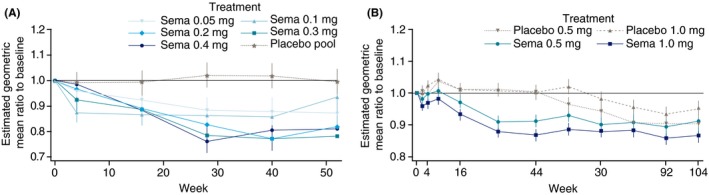
Data from a 104-week cardiovascular outcomes trial in type 2 diabetes (semaglutide 0.5 or 1.0 mg/week) and a 52-week weight management trial (semaglutide 0.05-0.4 mg/day) were analysed. Treatment ratios vs placebo were estimated for ALT (both trials) and hsCRP (weight management trial only) using a mixed model for repeated measurements, with or without adjustment for change in body weight.
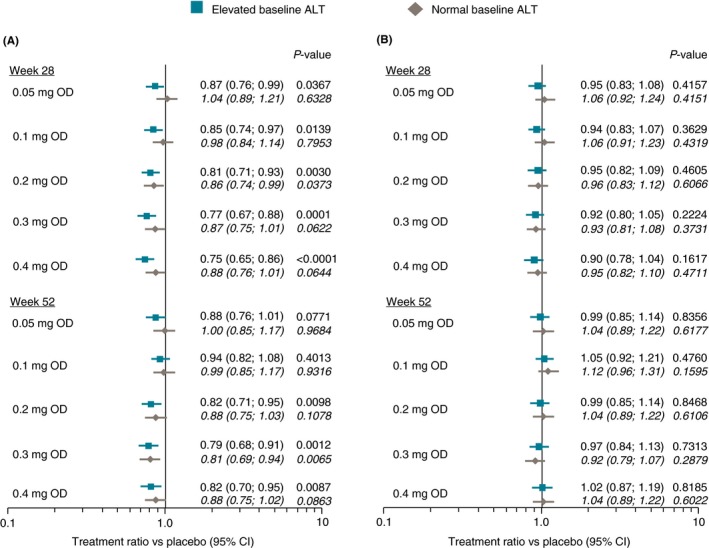
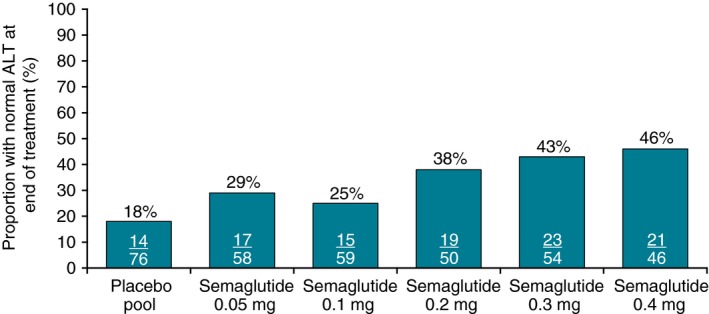
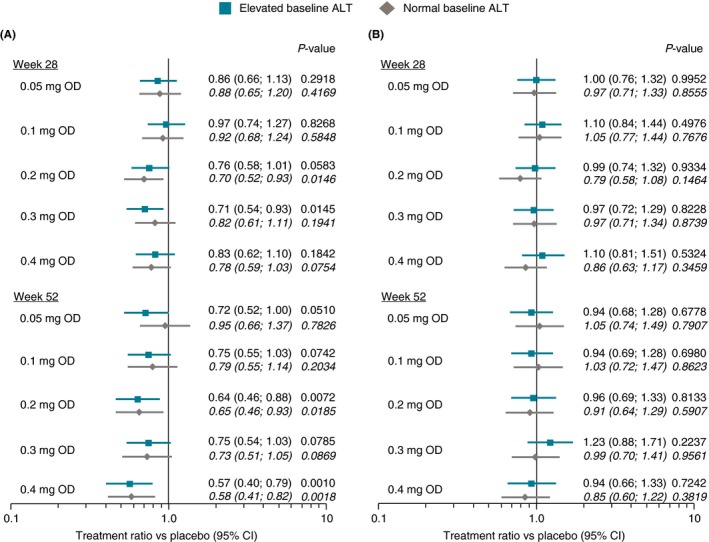
Elevated baseline ALT (men >30 IU/L; women >19 IU/L) was present in 52% (499/957) of weight management trial subjects. In this group with elevated ALT, end-of-treatment ALT reductions were 6%-21% (P<0.05 for doses≥0.2 mg/day) and hsCRP reductions 25%-43% vs placebo (P < 0.05 for 0.2 and 0.4 mg/day). Normalisation of elevated baseline ALT occurred in 25%-46% of weight management trial subjects, vs 18% on placebo. Elevated baseline ALT was present in 41% (1325/3268) of cardiovascular outcomes trial subjects. In this group with elevated ALT, no significant ALT reduction was noted at end-of-treatment for 0.5 mg/week, while a 9% reduction vs placebo was seen for 1.0 mg/week (P = 0.0024). Treatment ratios for changes in ALT and hsCRP were not statistically significant after adjustment for weight change.
Semaglutide significantly reduced ALT and hsCRP in clinical trials in subjects with obesity and/or type 2 diabetes.
肥胖症和 2 型糖尿病是导致非酒精性脂肪性肝病(NAFLD)的因素。胰高血糖素样肽-1 类似物可有效治疗肥胖症和 2 型糖尿病,并且可能对 NAFLD 的治疗具有潜在作用。
评估胰高血糖素样肽-1 类似物司美格鲁肽对非酒精性脂肪性肝病风险患者的丙氨酸氨基转移酶(ALT)和高敏 C 反应蛋白(hsCRP)的影响。
分析了两项临床试验的数据,分别为为期 104 周的 2 型糖尿病心血管结局试验(司美格鲁肽 0.5 或 1.0mg/周)和为期 52 周的体重管理试验(司美格鲁肽 0.05-0.4mg/天)。使用重复测量混合模型,无论是否调整体重变化,均评估 ALT(两项试验)和 hsCRP(仅体重管理试验)相对于安慰剂的治疗比值。
在体重管理试验中,52%(499/957)的受试者基线 ALT 升高(男性>30IU/L;女性>19IU/L)。在这些 ALT 升高的患者中,治疗结束时 ALT 降低 6%-21%(剂量≥0.2mg/天时 P<0.05),hsCRP 降低 25%-43%(0.2 和 0.4mg/天)。体重管理试验中 25%-46%的患者 ALT 恢复正常,而安慰剂组为 18%。心血管结局试验中,41%(1325/3268)的受试者基线 ALT 升高。在这些 ALT 升高的患者中,0.5mg/周治疗结束时未观察到 ALT 显著降低,而 1.0mg/周时与安慰剂相比降低 9%(P=0.0024)。调整体重变化后,ALT 和 hsCRP 变化的治疗比值无统计学意义。
在肥胖症和/或 2 型糖尿病患者的临床试验中,司美格鲁肽显著降低了 ALT 和 hsCRP。