Sudhanthar Sathyanarayan, Lapinski Jillian, Turner Jane, Gold Jonathan, Sigal Yakov, Thakur Kripa, Napolova Olga, Stiffler Michael
Pediatrics and Human Development, Michigan State University College of Human Medicine, East Lansing, Michigan, USA.
BMJ Open Qual. 2019 May 31;8(2):e000589. doi: 10.1136/bmjoq-2018-000589. eCollection 2019.
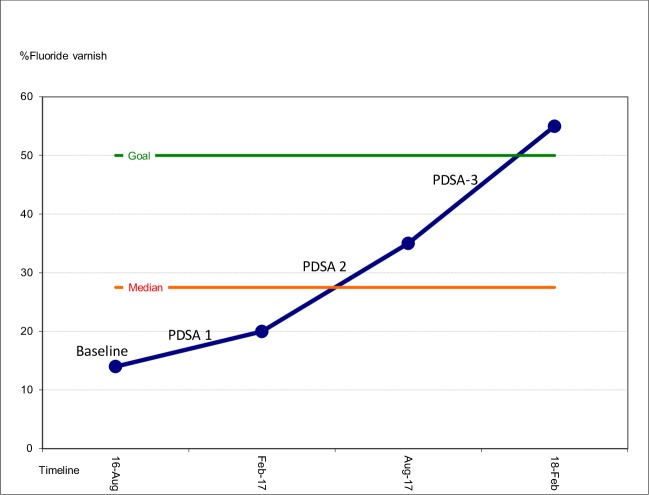
Dental caries affect 97% of people during their lifetime. A total of 59% of children aged 12-19 will have at least one documented cavity. The American Academy of Pediatrics recommends fluoridated toothpaste to all children starting at tooth eruption, regardless of caries risk. Besides, fluoride varnish is recommended for all children every 3-6 months from tooth emergence until they have a permanent dental home. This project aimed to increase oral fluoride varnish application for children starting at 6 months or the time of tooth eruption up to 3 years of age by at least 50% over 18 months. The stakeholders identified were physicians, nurses, medical assistants and the health information team. We obtained baseline data about oral health screening and fluoride varnish from both the clinic sites. The quality improvement (QI) project was based on Plan-Do-Study-Act (PDSA) cycles with a 6-month gap in-between the three cycles. For the first cycle, all medical staff members participated in 2-hour knowledge and skills training on dental caries and current recommendations on fluoride varnish. PDSA cycle 2 involved having automatic reminders for providers in electronic medical records. PDSA cycle 3 planned to have automatic fluoride orders for the recommended age groups. The QI team analysed the results after every 6 months, and improvements were made based on the input from data and medical staff. The number of patients who had fluoride varnish applied increased from 14% (n=50) to 55% at the end of PDSA cycle 3. Administration of the varnish did not affect the flow of the patients in busy primary care practice. The rate of improvement was across all the age groups, providers and in both clinical sites. It is possible to adhere to the oral fluoride varnish guidelines in a busy primary care practice, which may help benefit young children who are at risk for caries.
龋齿在人们一生中影响着97%的人。12至19岁的儿童中,总计59%会至少有一处有记录的龋洞。美国儿科学会建议,所有儿童从牙齿萌出开始就使用含氟牙膏,无论其患龋风险如何。此外,建议所有儿童从牙齿萌出到有固定的牙科诊疗机构期间,每3至6个月使用一次氟化物涂漆。该项目旨在使6个月大或牙齿萌出时起至3岁的儿童口腔氟化物涂漆的使用在18个月内至少增加50%。确定的利益相关者包括医生、护士、医疗助理和健康信息团队。我们从两个诊所地点获取了有关口腔健康筛查和氟化物涂漆的基线数据。质量改进(QI)项目基于计划-实施-研究-改进(PDSA)循环,三个循环之间间隔6个月。在第一个循环中,所有医务人员参加了为期2小时的关于龋齿和当前氟化物涂漆建议的知识与技能培训。PDSA循环2涉及在电子病历中为医疗服务提供者设置自动提醒。PDSA循环3计划为推荐年龄组设置自动氟化物医嘱。QI团队每6个月分析一次结果,并根据数据和医务人员的意见进行改进。在PDSA循环3结束时,接受氟化物涂漆的患者数量从14%(n = 50)增加到了55%。涂漆操作并未影响繁忙的初级保健机构中患者的就诊流程。各年龄组、医疗服务提供者以及两个临床地点的改善率均有所提高。在繁忙的初级保健机构中遵循口腔氟化物涂漆指南是可行的,这可能有助于使有患龋风险的幼儿受益。