Medical Genetics Institute, Shaare Zedek Medical Center, Jerusalem, Israel.
Departments of Medicine and Genome Sciences, University of Washington, Seattle, Washington, USA.
Clin Transl Gastroenterol. 2019 Jul;10(7):e00054. doi: 10.14309/ctg.0000000000000054.
Loss-of-function mutations of BMPR1A cause juvenile polyposis syndrome (JPS), but large genomic deletions in BMPR1A are rare, reported in few families only, and data regarding the associated phenotype are limited.
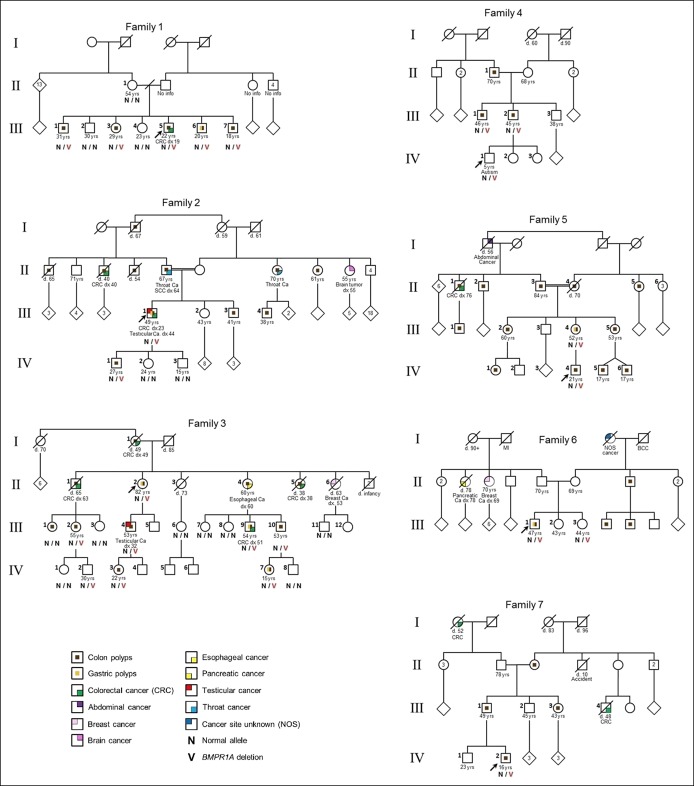
We investigated clinical features and genomic data of 7 extended seemingly unrelated families with a genomic deletion of the entire coding region of BMPR1A. We defined mutation size, mutation prevalence, and tumor pathogenesis using whole-genome sequencing, targeted genotyping, and haplotype analysis.
Patients with JPS from 7 families of Bukharin Jewish ancestry carried a deletion of 429 kb, encompassing the BMPR1A coding sequence and 8 downstream genes. Haplotype analysis and testing controls identified this as a common founder mutation occurring in 1/124 individuals of Bukharin origin. Tumor testing did not demonstrate loss of heterozygosity. Among carriers, JPS was almost fully penetrant, but clinical features varied widely, ranging from mild to very severe, including pan-enteric polyps, gastritis, and colorectal, esophageal, and testicular cancer, and carriers with phenotypes, which would not have raised suspicion of JPS.
The phenotype in this large cohort was extremely variable, although all carriers shared the same variant and the same genetic background. New observations include a preponderance of adenomatous rather than juvenile polyps, possible association with testicular cancer, and unexpected upper gastrointestinal involvement.
BMPR1A 功能丧失性突变可导致幼年性息肉综合征(JPS),但 BMPR1A 的大片段基因组缺失非常罕见,仅在少数几个家系中报道过,且与之相关的表型数据有限。
我们研究了 7 个具有 BMPR1A 整个编码区缺失的扩展的看似非相关家族的临床特征和基因组数据。我们使用全基因组测序、靶向基因分型和单倍型分析来定义突变大小、突变流行率和肿瘤发病机制。
来自 7 个布哈拉犹太裔 JPS 家族的患者携带了 429 kb 的缺失,包括 BMPR1A 编码序列和 8 个下游基因。单倍型分析和对照测试将其鉴定为布哈拉起源的 1/124 个体中常见的共同起始突变。肿瘤检测未显示杂合性丢失。在携带者中,JPS 几乎完全外显,但临床特征差异很大,从轻度到非常严重不等,包括全肠息肉、胃炎、结直肠、食管和睾丸癌,以及表型不会引起 JPS 怀疑的携带者。
在这个大型队列中,表型非常多样化,尽管所有携带者都携带相同的变异和相同的遗传背景。新的观察结果包括腺瘤性息肉而非幼年性息肉居多、可能与睾丸癌有关以及意外的上消化道受累。