• 文献检索
  • 文档翻译
  • 深度研究
  • 学术资讯
  • Suppr Zotero 插件Zotero 插件
  • 邀请有礼
  • 套餐&价格
  • 历史记录
应用&插件
Suppr Zotero 插件Zotero 插件浏览器插件Mac 客户端Windows 客户端微信小程序
定价
高级版会员购买积分包购买API积分包
服务
文献检索文档翻译深度研究API 文档MCP 服务
关于我们
关于 Suppr公司介绍联系我们用户协议隐私条款
关注我们

Suppr 超能文献

核心技术专利:CN118964589B侵权必究
粤ICP备2023148730 号-1Suppr @ 2026

文献检索

告别复杂PubMed语法,用中文像聊天一样搜索,搜遍4000万医学文献。AI智能推荐,让科研检索更轻松。

立即免费搜索

文件翻译

保留排版,准确专业,支持PDF/Word/PPT等文件格式,支持 12+语言互译。

免费翻译文档

深度研究

AI帮你快速写综述,25分钟生成高质量综述,智能提取关键信息,辅助科研写作。

立即免费体验

“以不同的方式看待疼痛”:一项定性研究,探讨了疼痛和风湿病专家对儿童和青少年幼年特发性关节炎多维移动健康疼痛数据的解释在不同和相似之处。

"Seeing Pain Differently": A Qualitative Investigation Into the Differences and Similarities of Pain and Rheumatology Specialists' Interpretation of Multidimensional Mobile Health Pain Data From Children and Young People With Juvenile Idiopathic Arthritis.

机构信息

NIHR Manchester Musculoskeletal Biomedical Research Centre, Central Manchester University Hospitals NHS Foundation Trust, Manchester Academic Health Science Centre, Manchester, United Kingdom.

Arthritis Research UK Centre for Epidemiology, Centre for Musculoskeletal Research, Faculty of Biology, Medicine and Health, The University of Manchester, Manchester, United Kingdom.

出版信息

JMIR Mhealth Uhealth. 2019 Jul 2;7(7):e12952. doi: 10.2196/12952.

DOI:10.2196/12952
PMID:31267979
原文链接:https://pmc.ncbi.nlm.nih.gov/articles/PMC6632104/
Abstract

BACKGROUND

In contrast to the use of traditional unidimensional paper-based scales, a mobile health (mHealth) assessment of pain in children and young people (CYP) with juvenile idiopathic arthritis (JIA) enables comprehensive and complex multidimensional pain data to be captured remotely by individuals. However, how professionals use multidimensional pain data to interpret and synthesize pain reports gathered using mHealth tools is not yet known.

OBJECTIVE

The aim of this study was to explore the salience and prioritization of different mHealth pain features as interpreted by key stakeholders involved in research and management of pain in CYP with JIA.

METHODS

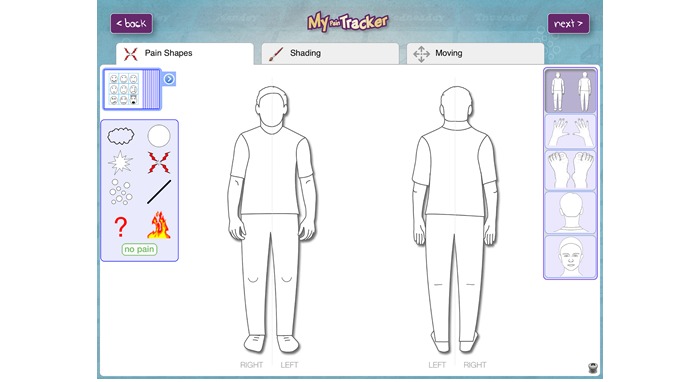
Pain and rheumatology specialists were purposively recruited via professional organizations. Face-to-face focus groups were conducted for each specialist group. Participants were asked to rank order 9 static vignette scenarios created from real patient mHealth multidimensional pain data. These data had been collected by a researcher in a separate study using My Pain Tracker, a valid and acceptable mHealth iPad pain communication tool that collects information about intensity, severity, location, emotion, and pictorial pain qualities. In the focus groups, specialists discussed their decision-making processes behind each rank order in the focus groups. The total group rank ordering of vignette scenarios was calculated. Qualitative data from discussions were analyzed using latent thematic analysis.

RESULTS

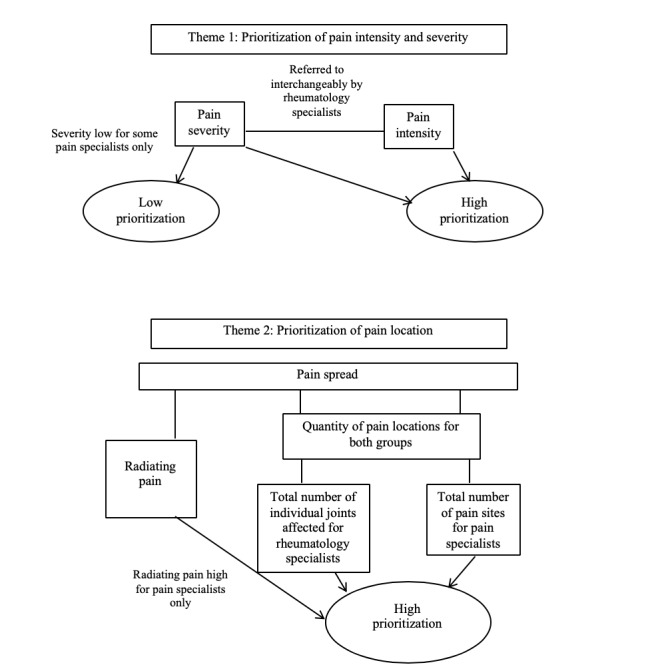
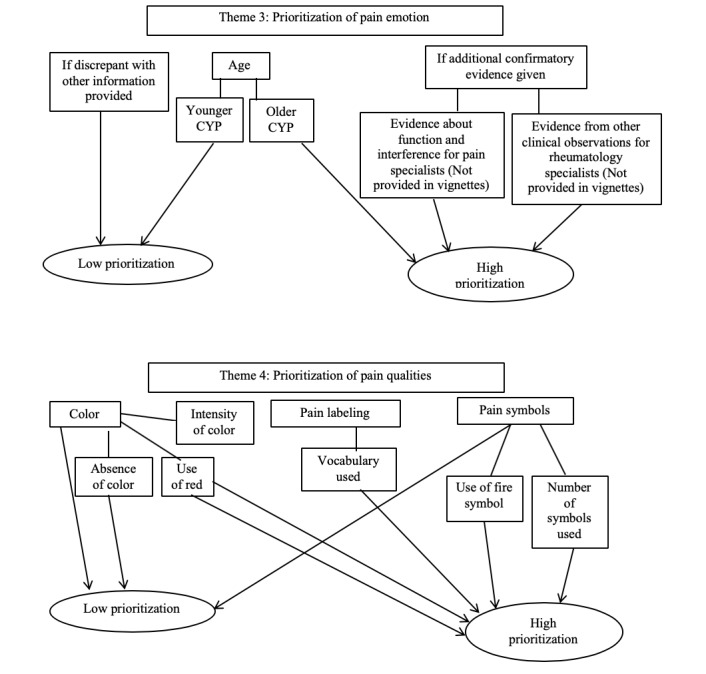
A total of 9 pain specialists took part in 1 focus group and 10 rheumatology specialists in another. In pain specialists, the consensus for the highest pain experience (44%) was poorer than their ranking of the lowest pain experiences (55%). Conversely, in rheumatology specialists, the consensus for the highest pain experience (70%) was stronger than their ranking of the lowest pain experience (50%). Pain intensity was a high priority for pain specialists, but rheumatology specialists gave high priority to intensity and severity taken together. Pain spread was highly prioritized, with the number of pain locations (particular areas or joints) being a high priority for both groups; radiating pain was a high priority for pain specialists only. Pain emotion was challenging for both groups and was only perceived to be a high priority when specialists had additional confirmatory evidence (such as information about pain interference or clinical observations) to validate the pain emotion report. Pain qualities such as particular word descriptors, use of the color red, and fire symbols were seen to be high priority by both groups in interpretation of CYP pain reports.

CONCLUSIONS

Pain interpretation is complex. Findings from this study of specialists' decision-making processes indicate which aspects of pain are prioritized and weighted more heavily than others by those interpreting mHealth data. Findings are useful for developing electronic graphical summaries which assist specialists in interpreting patient-reported mHealth pain data more efficiently in clinical and research settings.
https://cdn.ncbi.nlm.nih.gov/pmc/blobs/97ad/6632104/6abcfdb7b440/mhealth_v7i7e12952_fig3.jpg
https://cdn.ncbi.nlm.nih.gov/pmc/blobs/97ad/6632104/bafe9a42039e/mhealth_v7i7e12952_fig1.jpg
https://cdn.ncbi.nlm.nih.gov/pmc/blobs/97ad/6632104/a4c9ec5d6d7a/mhealth_v7i7e12952_fig2.jpg
https://cdn.ncbi.nlm.nih.gov/pmc/blobs/97ad/6632104/6abcfdb7b440/mhealth_v7i7e12952_fig3.jpg
https://cdn.ncbi.nlm.nih.gov/pmc/blobs/97ad/6632104/bafe9a42039e/mhealth_v7i7e12952_fig1.jpg
https://cdn.ncbi.nlm.nih.gov/pmc/blobs/97ad/6632104/a4c9ec5d6d7a/mhealth_v7i7e12952_fig2.jpg
https://cdn.ncbi.nlm.nih.gov/pmc/blobs/97ad/6632104/6abcfdb7b440/mhealth_v7i7e12952_fig3.jpg
摘要

背景

与传统的一维纸质量表的使用相比,移动医疗(mHealth)可远程对儿童和青少年(CYP)的疼痛进行全面、复杂的多维评估,由个体采集疼痛数据。然而,专业人员如何使用多维疼痛数据来解释和综合使用 mHealth 工具收集的疼痛报告还不得而知。

目的

本研究旨在探讨参与儿童和青少年幼年特发性关节炎(JIA)疼痛研究和管理的关键利益相关者如何解释 mHealth 疼痛特征的重要性和优先级。

方法

通过专业组织有针对性地招募疼痛和风湿病专家。为每个专家小组进行面对面的焦点小组讨论。要求参与者对 9 个静态情景案例进行排序,这些案例是从使用 My Pain Tracker 的真实患者 mHealth 多维疼痛数据中创建的。该研究使用 My Pain Tracker 收集有关强度、严重程度、位置、情绪和图像疼痛质量的信息,这是一种有效的、可接受的 mHealth iPad 疼痛交流工具,该工具已由一名研究人员在单独的研究中收集。在焦点小组中,专家们讨论了他们在每个焦点小组中进行排序的决策过程。计算了情景案例的总组排序。使用潜在主题分析对讨论中的定性数据进行分析。

结果

共有 9 名疼痛专家参加了 1 个焦点小组,10 名风湿病专家参加了另一个焦点小组。在疼痛专家中,对最高疼痛体验(44%)的共识低于对最低疼痛体验(55%)的共识。相反,在风湿病专家中,对最高疼痛体验(70%)的共识高于对最低疼痛体验(50%)的共识。疼痛强度是疼痛专家的首要任务,但风湿病专家更重视强度和严重程度相结合。疼痛扩散受到高度重视,疼痛部位的数量(特定区域或关节)是两组的高度优先事项;放射痛是疼痛专家的高度优先事项。情绪疼痛对两组来说都是一个挑战,只有当专家有额外的确认性证据(例如关于疼痛干扰或临床观察的信息)来验证疼痛情绪报告时,他们才会认为疼痛情绪是一个高度优先事项。两组都认为疼痛质量(如特定的单词描述、使用红色和火焰符号)是解释 CYP 疼痛报告的高度优先事项。

结论

疼痛解释是复杂的。本研究中对专家决策过程的研究结果表明,解释 mHealth 数据的人更重视疼痛的哪些方面,并对这些方面赋予更高的权重。研究结果对于开发电子图形摘要很有用,这些摘要有助于专家在临床和研究环境中更有效地解释患者报告的 mHealth 疼痛数据。

相似文献

1
"Seeing Pain Differently": A Qualitative Investigation Into the Differences and Similarities of Pain and Rheumatology Specialists' Interpretation of Multidimensional Mobile Health Pain Data From Children and Young People With Juvenile Idiopathic Arthritis.“以不同的方式看待疼痛”:一项定性研究,探讨了疼痛和风湿病专家对儿童和青少年幼年特发性关节炎多维移动健康疼痛数据的解释在不同和相似之处。
JMIR Mhealth Uhealth. 2019 Jul 2;7(7):e12952. doi: 10.2196/12952.
2
"Asking Too Much?": Randomized N-of-1 Trial Exploring Patient Preferences and Measurement Reactivity to Frequent Use of Remote Multidimensional Pain Assessments in Children and Young People With Juvenile Idiopathic Arthritis.“要求过高?”:一项随机单病例试验,探究青少年特发性关节炎患儿及青少年对频繁使用远程多维疼痛评估的患者偏好及测量反应性
J Med Internet Res. 2020 Jan 30;22(1):e14503. doi: 10.2196/14503.
3
What matters most for patients, parents, and clinicians in the course of juvenile idiopathic arthritis? A qualitative study.在青少年特发性关节炎病程中,对患者、家长及临床医生而言最重要的是什么?一项定性研究。
J Rheumatol. 2014 Nov;41(11):2260-9. doi: 10.3899/jrheum.131536. Epub 2014 Sep 15.
4
"I'd like more options!": Interviews to explore young people and family decision-making needs for pain management in juvenile idiopathic arthritis.“我想要更多的选择!”:探索青少年和家庭在青少年特发性关节炎疼痛管理方面决策需求的访谈。
Pediatr Rheumatol Online J. 2023 Jul 26;21(1):74. doi: 10.1186/s12969-023-00849-0.
5
"Reluctant to Assess Pain": A Qualitative Study of Health Care Professionals' Beliefs About the Role of Pain in Juvenile Idiopathic Arthritis.“不愿评估疼痛”:一项关于医疗保健专业人员对幼年特发性关节炎中疼痛角色的信念的定性研究。
Arthritis Care Res (Hoboken). 2020 Jan;72(1):69-77. doi: 10.1002/acr.23827.
6
Effectiveness of eHealth and mHealth Interventions Supporting Children and Young People Living With Juvenile Idiopathic Arthritis: Systematic Review and Meta-analysis.电子健康和移动健康干预措施对儿童和青少年幼年特发性关节炎的有效性:系统评价和荟萃分析。
J Med Internet Res. 2022 Feb 2;24(2):e30457. doi: 10.2196/30457.
7
Mobile Health Adoption in Mental Health: User Experience of a Mobile Health App for Patients With an Eating Disorder.移动心理健康:移动健康应用在进食障碍患者中的用户体验。
JMIR Mhealth Uhealth. 2019 May 31;7(6):e12920. doi: 10.2196/12920.
8
Modified Delphi study to identify priority clinical questions for the Australian living guidelines for the management of Juvenile Idiopathic Arthritis.改良 Delphi 研究,以确定澳大利亚青少年特发性关节炎管理临床实践指南的优先临床问题。
Pediatr Rheumatol Online J. 2022 Jul 23;20(1):52. doi: 10.1186/s12969-022-00710-w.
9
Development and Acceptability of a Patient Decision Aid for Pain Management in Juvenile Idiopathic Arthritis: The JIA Option Map.《青少年特发性关节炎患者疼痛管理决策辅助工具的制定与可接受性研究:JIA 选择图》。
Patient. 2020 Dec;13(6):719-728. doi: 10.1007/s40271-020-00458-z. Epub 2020 Oct 9.
10
Transitional care in clinical networks for young people with juvenile idiopathic arthritis: current situation and challenges.青少年特发性关节炎青年患者临床网络中的过渡性护理:现状与挑战。
Clin Rheumatol. 2016 Apr;35(4):893-9. doi: 10.1007/s10067-015-2950-x. Epub 2015 Apr 30.

引用本文的文献

1
Digital health tools in juvenile idiopathic arthritis: a systematic literature review.青少年特发性关节炎中的数字健康工具:一项系统文献综述
Pediatr Rheumatol Online J. 2025 May 1;23(1):45. doi: 10.1186/s12969-025-01094-3.
2
Associations between physical exercise patterns and pain symptoms in individuals with endometriosis: a cross-sectional mHealth-based investigation.基于 mHealth 的横断面研究:个体中运动模式与子宫内膜异位症疼痛症状之间的关联。
BMJ Open. 2022 Jul 18;12(7):e059280. doi: 10.1136/bmjopen-2021-059280.
3
Effectiveness of eHealth and mHealth Interventions Supporting Children and Young People Living With Juvenile Idiopathic Arthritis: Systematic Review and Meta-analysis.

本文引用的文献

1
Patterns of pain over time among children with juvenile idiopathic arthritis.儿童幼年特发性关节炎随时间变化的疼痛模式。
Arch Dis Child. 2018 May;103(5):437-443. doi: 10.1136/archdischild-2017-313337. Epub 2017 Nov 25.
2
Open issues in the assessment and management of pain in juvenile idiopathic arthritis.青少年特发性关节炎疼痛评估与管理中的未决问题。
Clin Exp Rheumatol. 2017 Sep-Oct;35 Suppl 107(5):123-126. Epub 2017 Sep 28.
3
Cognitive developmental influences on the ability of preschool-aged children to self-report their pain intensity.
电子健康和移动健康干预措施对儿童和青少年幼年特发性关节炎的有效性:系统评价和荟萃分析。
J Med Internet Res. 2022 Feb 2;24(2):e30457. doi: 10.2196/30457.
4
Identifying the content and context of pain within paediatric rheumatology healthcare professional curricula in the UK: a summative content analysis.确定英国儿科风湿病学医疗保健专业课程中疼痛的内容和背景:一项总结性内容分析
Pediatr Rheumatol Online J. 2021 Aug 21;19(1):129. doi: 10.1186/s12969-021-00614-1.
5
Behavioral Pain Assessment Implementation in Long-Term Care Using a Tablet App: Case Series and Quasi-Experimental Design.长期护理中使用平板电脑应用程序进行行为疼痛评估的实施:病例系列和准实验设计。
JMIR Mhealth Uhealth. 2020 Apr 22;8(4):e17108. doi: 10.2196/17108.
6
"Asking Too Much?": Randomized N-of-1 Trial Exploring Patient Preferences and Measurement Reactivity to Frequent Use of Remote Multidimensional Pain Assessments in Children and Young People With Juvenile Idiopathic Arthritis.“要求过高?”:一项随机单病例试验,探究青少年特发性关节炎患儿及青少年对频繁使用远程多维疼痛评估的患者偏好及测量反应性
J Med Internet Res. 2020 Jan 30;22(1):e14503. doi: 10.2196/14503.
认知发展对学龄前儿童自我报告疼痛强度能力的影响。
Pain. 2016 May;157(5):997-1001. doi: 10.1097/j.pain.0000000000000476.
4
Construct validity and reliability of a real-time multidimensional smartphone app to assess pain in children and adolescents with cancer.一种实时多维智能手机应用评估癌症儿童和青少年疼痛的构建效度和信度。
Pain. 2015 Dec;156(12):2607-2615. doi: 10.1097/j.pain.0000000000000385.
5
Social communication model of pain.疼痛的社会交流模型。
Pain. 2015 Jul;156(7):1198-1199. doi: 10.1097/j.pain.0000000000000185.
6
Innovative delivery of pain management interventions: current trends and future progress.疼痛管理干预措施的创新递送:当前趋势与未来进展。
Clin J Pain. 2015 Jun;31(6):467-9. doi: 10.1097/AJP.0000000000000204.
7
Patient-reported joint count in juvenile idiopathic arthritis: the reliability of a manikin format.青少年特发性关节炎患者报告的关节计数:人体模型格式的可靠性
J Rheumatol. 2015 Mar;42(3):527-33. doi: 10.3899/jrheum.140073. Epub 2014 Nov 29.
8
A debate on the proposition that self-report is the gold standard in assessment of pediatric pain intensity.一场关于“自我报告是评估小儿疼痛强度的金标准”这一命题的辩论。
Clin J Pain. 2015 Aug;31(8):707-12. doi: 10.1097/AJP.0000000000000165.
9
"There's a Pain App for That": Review of Patient-targeted Smartphone Applications for Pain Management.“有一款针对疼痛的应用程序”:针对患者的疼痛管理智能手机应用程序综述
Clin J Pain. 2015 Jun;31(6):557-63. doi: 10.1097/AJP.0000000000000171.
10
Development and testing of painometer: a smartphone app to assess pain intensity.疼痛计的开发与测试:一款用于评估疼痛强度的智能手机应用程序
J Pain. 2014 Oct;15(10):1001-7. doi: 10.1016/j.jpain.2014.04.009. Epub 2014 May 20.