Center for Species Survival, Smithsonian Conservation Biology Institute, Front Royal, VA, United States of America.
George Mason University, Fairfax, VA, United States of America.
PLoS One. 2019 Jul 3;14(7):e0217986. doi: 10.1371/journal.pone.0217986. eCollection 2019.
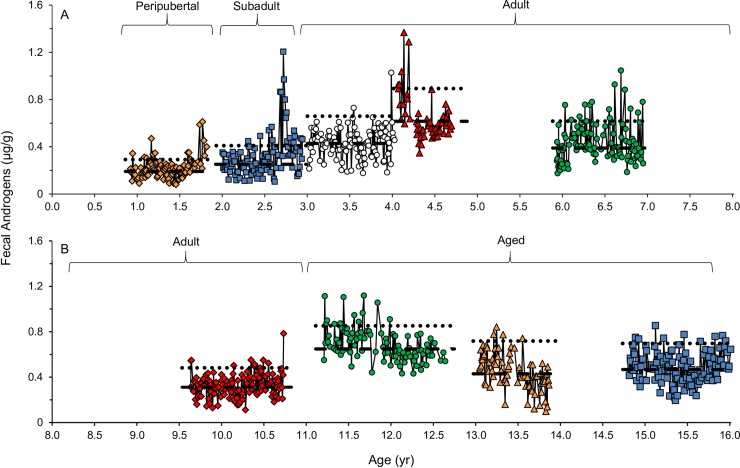
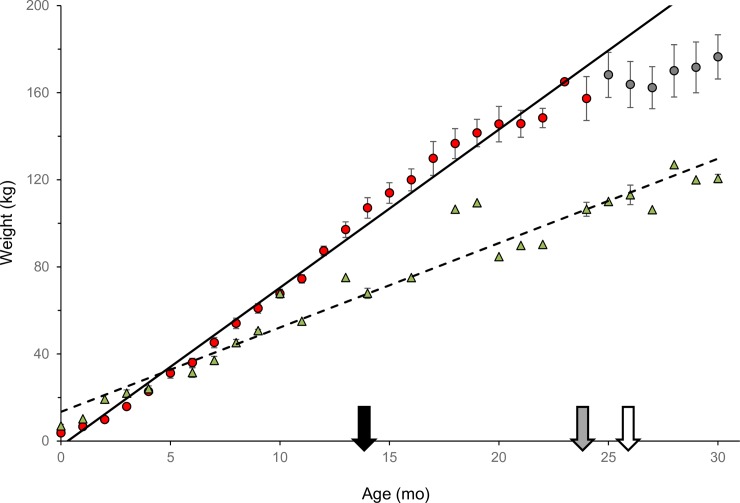
There is limited physiological information on onset of puberty in male lions. The aim of this study was to use longitudinal non-invasive monitoring to: 1) assess changes in steroid metabolite excretory patterns as a function of age and body weight; 2) determine correlations between fecal androgen (FAM) and glucocorticoid (FGM) metabolite concentrations; and 3) confirm spermiogenesis non-invasively through urinalysis. Specifically, FAM and FGM metabolites were analyzed in samples collected twice weekly from 21 male lions at 17 institutions (0.9-16 years of age) for 3.8 months- 2.5 years to assess longitudinal hormone patterns. In addition, body weights were obtained approximately monthly from 10 individuals at five zoos (0.0-3.0 years), and urine was collected from six males at two facilities (1.2-6.3 years) and evaluated for the presence of spermatozoa. An increase in overall mean FAM occurred at 2.0 years of age, at which point concentrations remained similar throughout adulthood. The onset of puberty occurred earlier in captive-born males (<1.2 years of age) compared to wild-born counterparts (<2.5 years of age). Additionally, males in captivity gained an average of 7.3 kg/month compared to 3.9 kg/month for wild males over the first 2-2.5 years of age. Sperm (spermaturia) was observed in males as young as 1.2 years in captivity compared to 2.5 years in the wild (ejaculates). There was no difference in FAM or FGM concentrations with regards to age or season. Overall, this study demonstrates that: 1) captive male lions attain puberty at an earlier age than wild counterparts; 2) onset of puberty is influenced by body weight (growth rate); and 3) spermiogenesis can be confirmed via urinalysis. Knowledge about the linkage between body weight and onset of puberty could facilitate improved reproductive management of ex situ populations via mitigating the risk of unintended breedings in young animals.
雄性狮子青春期开始的生理信息有限。本研究的目的是使用纵向非侵入性监测:1)评估类固醇代谢产物排泄模式随年龄和体重的变化;2)确定粪便雄激素(FAM)和糖皮质激素(FGM)代谢物浓度之间的相关性;3)通过尿液分析非侵入性地确认精子发生。具体来说,在 17 个机构(0.9-16 岁)中,从 21 只雄性狮子中每周采集两次样本,采集时间为 3.8 个月至 2.5 年,以评估纵向激素模式。此外,在五个动物园中,从 10 只个体中每月获得体重(0.0-3.0 岁),并从两个设施中收集了六只雄性的尿液(1.2-6.3 岁),并评估了精子的存在。FAM 的总体平均值在 2 岁时增加,此时浓度在整个成年期保持相似。圈养出生的雄性(<1.2 岁)比野生出生的雄性(<2.5 岁)青春期更早开始。此外,在 2-2.5 岁之前,圈养雄性平均每月增加 7.3 公斤,而野生雄性每月增加 3.9 公斤。在圈养环境中,雄性最早在 1.2 岁时就观察到精子发生(精子生成),而在野生环境中则为 2.5 岁(射精)。FAM 或 FGM 浓度与年龄或季节无关。总的来说,这项研究表明:1)圈养雄性狮子比野生雄性狮子更早达到青春期;2)青春期的开始受体重(生长速度)的影响;3)精子发生可以通过尿液分析来确认。关于体重与青春期开始之间的联系的知识可以通过减轻年轻动物意外繁殖的风险,促进异地种群的生殖管理。