Putman Sarah B, Brown Janine L, Franklin Ashley D, Schneider Emily C, Boisseau Nicole P, Asa Cheryl S, Pukazhenthi Budhan S
Smithsonian Conservation Biology Institute, Front Royal, Virginia, United States of America; George Mason University, Fairfax, Virginia, United States of America.
Smithsonian Conservation Biology Institute, Front Royal, Virginia, United States of America.
PLoS One. 2015 Oct 13;10(10):e0140373. doi: 10.1371/journal.pone.0140373. eCollection 2015.
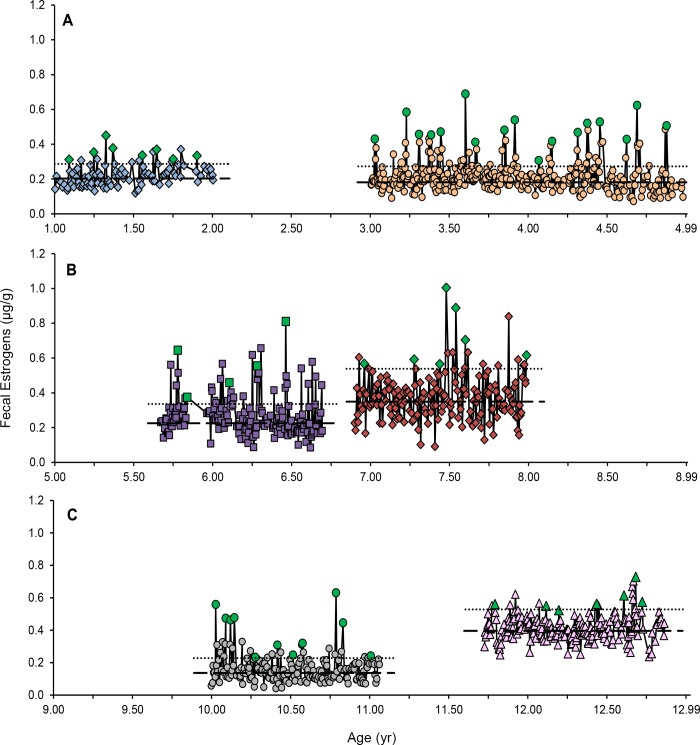
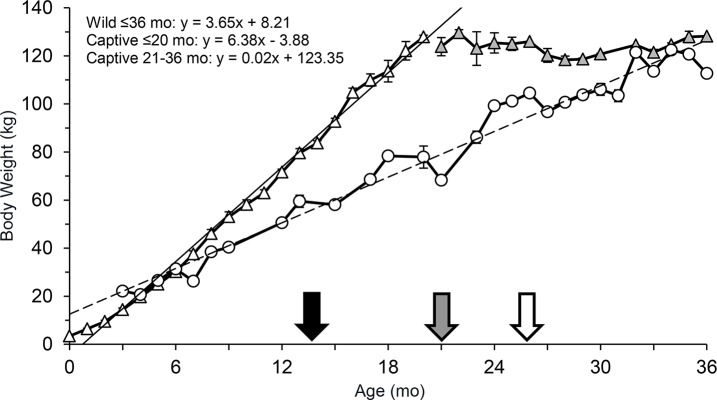
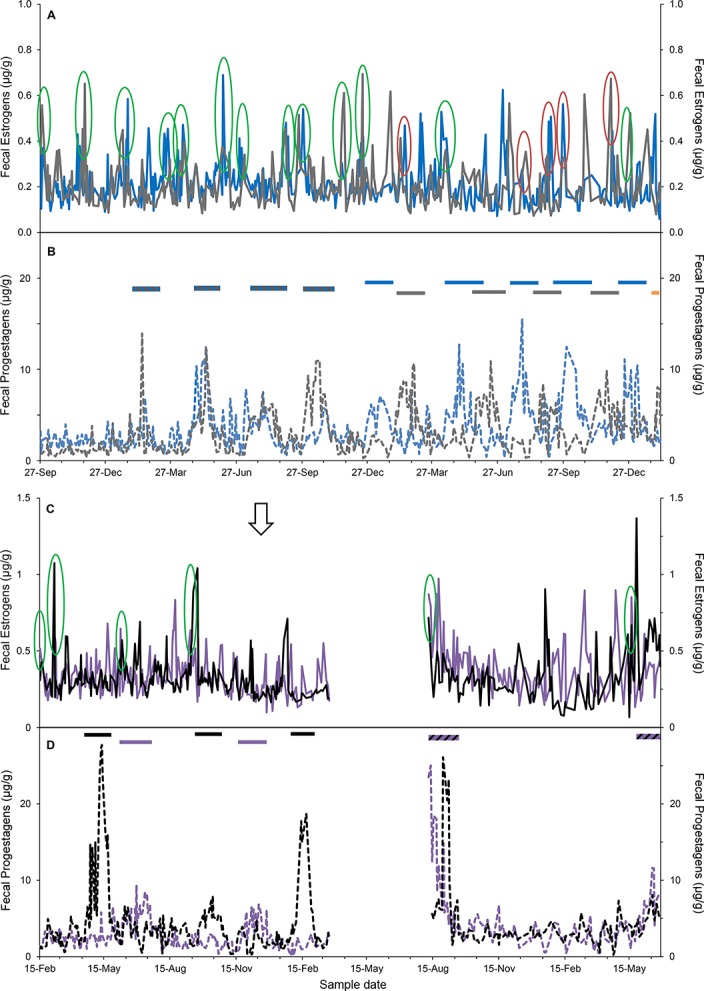
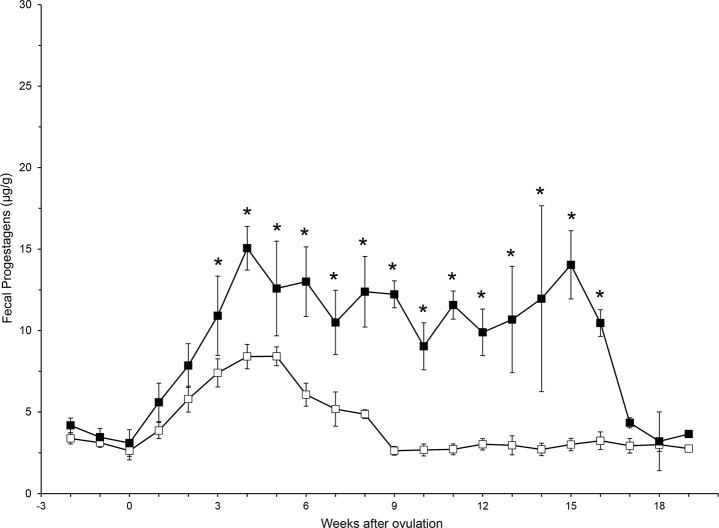
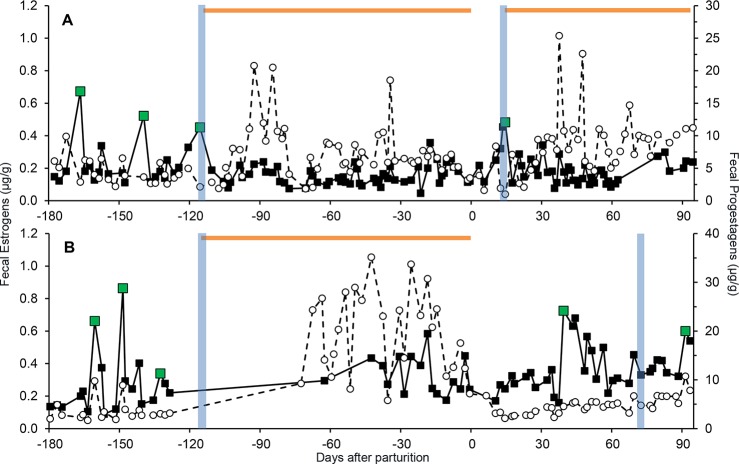
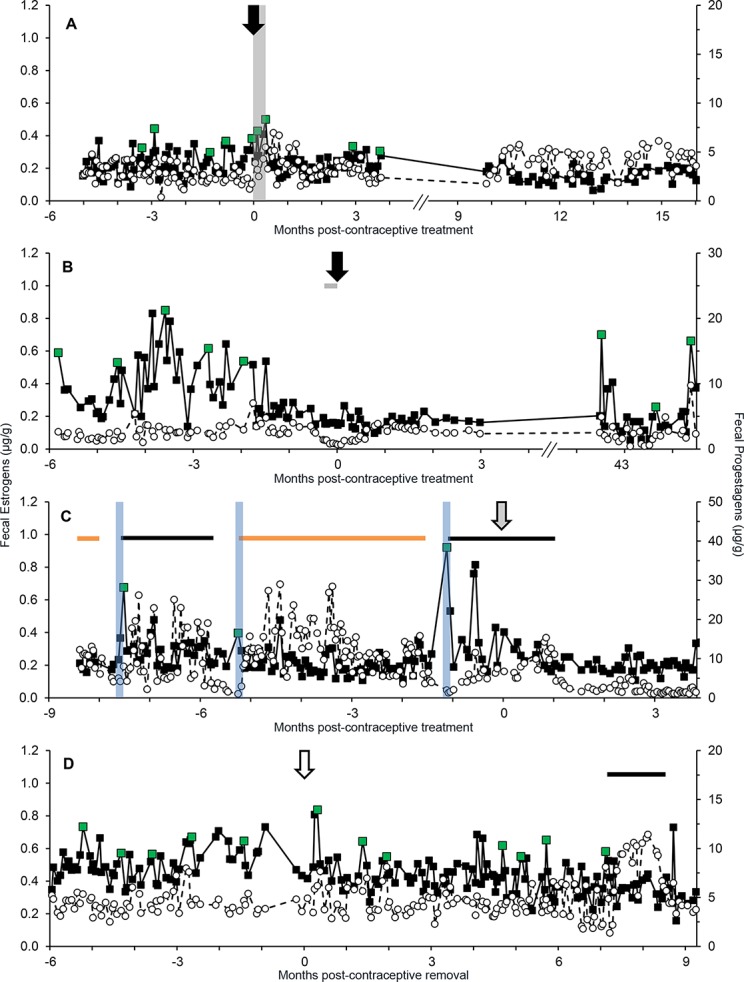
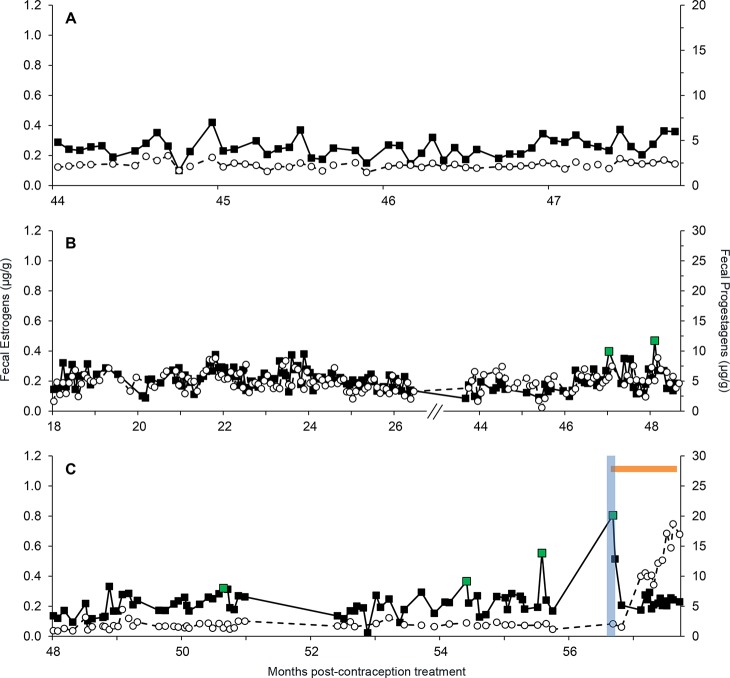
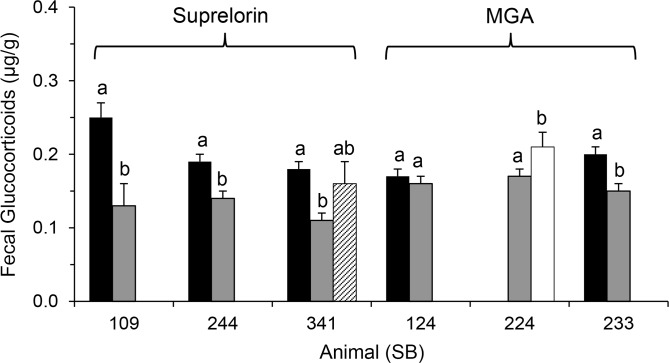
Because of poor reproduction after the lifting of an 8-year breeding moratorium, a biomedical survey of female lions in U.S. zoos was initiated in 2007. Fecal estrogen (FEM), progestagen (FPM) and glucocorticoid (FGM) metabolites were analyzed in samples collected 3-4 times per wk from 28 lions at 17 facilities (0.9-13.8 yr of age) for 4 mo-3.5 yr and body weights were obtained ~monthly from 17 animals at eight facilities (0.0-3.0 yr of age). Based on FEM, estrous cycle length averaged 17.5 ± 0.4 d in duration, with estrus lasting 4.4 ± 0.2 d. All but one female exhibited waves of estrogenic activity indicative of follicular activity; however, not all females expressed estrous behaviors (73%), suggesting silent estrus was common. Female lions experienced puberty earlier than expected; waves of estrogenic activity were observed as young as 1.1 yr of age, which may be related to a faster growth rate of captive vs. wild lions. Mean gestation length was 109.5 ± 1.0 d, whereas the non-pregnant luteal phase was less than half (46.0 ± 1.2 d). Non-mating induced increases in FPM were observed in 33% of females housed without a male, consistent with spontaneous ovulation. A number of study animals had been contracepted, and the return to cyclicity after treatment withdrawal, while variable, was ~4.0 yr and longer than the 1-yr expected efficacy, especially for those implanted with Suprelorin. For FGM, there were no differences in overall, baseline or peak mean concentrations among the age groups or across seasons, nor were there any relationships between reproductive parameters and FGM concentrations. Overall, results suggest that poor reproduction in lions after the breeding moratorium was not related to altered adrenal or ovarian steroid activity, but for some females may have been a consequence of individual institutions' management decisions.
由于8年繁殖禁令解除后繁殖情况不佳,2007年启动了一项对美国动物园雌性狮子的生物医学调查。从17个机构的28头狮子(年龄在0.9 - 13.8岁)每周采集3 - 4次样本,持续4个月至3.5年,分析粪便中的雌激素(FEM)、孕激素(FPM)和糖皮质激素(FGM)代谢物,并从8个机构的17只动物(年龄在0.0 - 3.0岁)大约每月测量一次体重。基于FEM,发情周期平均持续17.5±0.4天,发情期持续4.4±0.2天。除一只雌性外,所有雌性均表现出雌激素活性波动,表明有卵泡活动;然而,并非所有雌性都表现出发情行为(73%),这表明安静发情很常见。雌性狮子进入青春期的时间比预期早;在年仅1.1岁时就观察到雌激素活性波动,这可能与圈养狮子相对于野生狮子更快生长速度有关。平均妊娠期为109.5±1.0天,而非妊娠黄体期不到其一半(46.0±1.2天)。在33%未与雄性关在一起的雌性中观察到非交配引起的FPM升高,这与自发排卵一致。许多研究动物曾接受过避孕处理,停药后恢复周期性的时间虽然各不相同,但约为4.0年,比预期的1年药效期更长,尤其是对于那些植入了Suprelorin的动物。对于FGM,各年龄组之间或不同季节的总体、基线或峰值平均浓度均无差异,生殖参数与FGM浓度之间也没有任何关系。总体而言,结果表明繁殖禁令解除后狮子繁殖不佳与肾上腺或卵巢类固醇活性改变无关,但对一些雌性来说,可能是个别机构管理决策的结果。