Tossi Vanesa Eleonora, Regalado Jose Javier, Iannicelli Jesica, Laino Leandro Ezequiel, Burrieza Hernan Pablo, Escandón Alejandro Salvio, Pitta-Álvarez Sandra Irene
Laboratorio de Cultivo Experimental de Plantas y Microalgas, Departamento de Biodiversidad y Biología Experimental, Facultad de Ciencias Exactas y Naturales, Universidad de Buenos Aires, Buenos Aires, Argentina.
Instituto de Micología y Botánica, CONICET-Universidad de Buenos Aires, Buenos Aires, Argentina.
Front Plant Sci. 2019 Jun 18;10:780. doi: 10.3389/fpls.2019.00780. eCollection 2019.
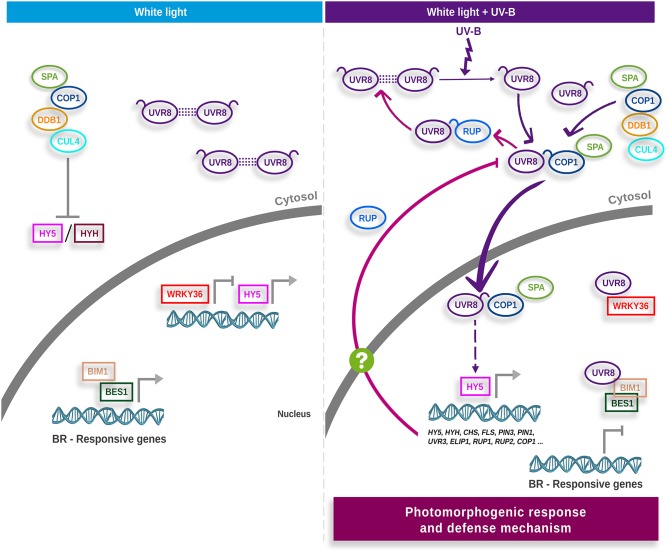
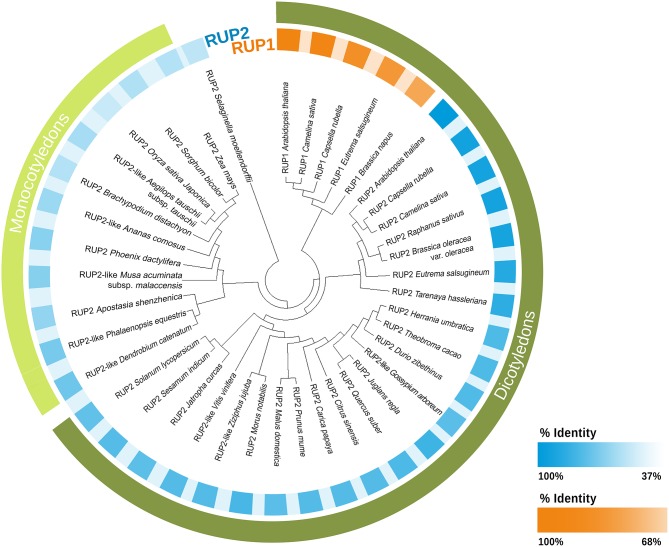
Ultraviolet-B radiation (UV-B, 280-315 nm) is an important environmental signal that regulates growth and development in plants. Two dose-dependent UV-B response pathways were described in plants: a specific one, mediated by UVR8 (the specific UV-B receptor) and an unspecific one, activated by the oxidative damage produced by radiation. The constitutively expressed receptor appears inactive as a dimer, with the two monomers dissociating upon UV-B irradiation. The monomer then interacts with COP1, an ubiquitin ligase, hindering its ability to poly-ubiquitinate transcriptional factor HY5, thus averting its degradation and activating the photomorphogenic response. HY5 induces the synthesis of proteins RUP1 and RUP2, which interact with UVR8, releasing COP1, and inducing the re-dimerization of UVR8. This mechanism has been thoroughly characterized in Arabidopsis, where studies have demonstrated that the UVR8 receptor is key in UV-B response. Although Arabidopsis importance as a model plant many mechanisms described in this specie differ in other plants. In this paper, we review the latest information regarding UV-B response mediated by UVR8 in different species, focusing on the differences reported compared to Arabidopsis. For instance, UVR8 is not only induced by UV-B but also by other agents that are expressed differentially in diverse tissues. Also, in some of the species analyzed, proteins with low homology to RUP1 and RUP2 were detected. We also discuss how UVR8 is involved in other developmental and stress processes unrelated to UV-B. We conclude that the receptor is highly versatile, showing differences among species.
紫外线B辐射(UV-B,280 - 315纳米)是一种重要的环境信号,可调节植物的生长和发育。植物中描述了两种剂量依赖性的UV-B反应途径:一种是由UVR8(特定的UV-B受体)介导的特异性途径,另一种是非特异性途径,由辐射产生的氧化损伤激活。组成型表达的受体以二聚体形式呈现无活性状态,两个单体在UV-B照射时解离。然后单体与泛素连接酶COP1相互作用,阻碍其对转录因子HY5进行多聚泛素化的能力,从而避免其降解并激活光形态建成反应。HY5诱导RUP1和RUP2蛋白的合成,这两种蛋白与UVR8相互作用,释放COP1,并诱导UVR8重新二聚化。这种机制在拟南芥中已得到充分表征,研究表明UVR8受体是UV-B反应的关键。尽管拟南芥作为模式植物很重要,但该物种中描述的许多机制在其他植物中有所不同。在本文中,我们综述了有关不同物种中UVR8介导的UV-B反应的最新信息,重点关注与拟南芥相比所报道的差异。例如,UVR8不仅由UV-B诱导,还由在不同组织中差异表达的其他因子诱导。此外,在一些分析的物种中,检测到与RUP1和RUP2同源性较低的蛋白质。我们还讨论了UVR8如何参与与UV-B无关的其他发育和应激过程。我们得出结论,该受体具有高度的通用性,在不同物种间存在差异。