Dipartimento di Chimica Industriale "Toso Montanari" University of Bologna , Viale del Risorgimento 4 , 40136 Bologna , Italy.
Dipartimento di Chimica e Chimica Industriale , University of Pisa , via G. Moruzzi 13 , 56124 Pisa , Italy.
Chem Rev. 2019 Aug 28;119(16):9361-9380. doi: 10.1021/acs.chemrev.9b00135. Epub 2019 Jul 5.
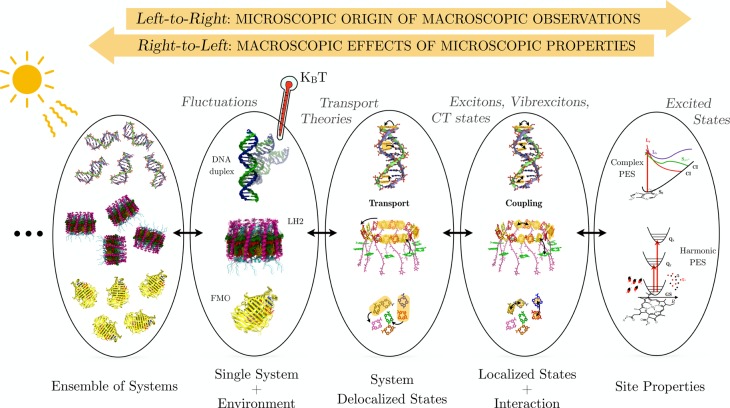
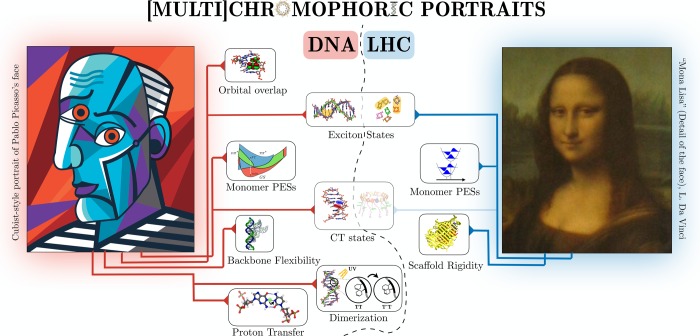
Multichromophoric biosystems represent a broad family with very diverse members, ranging from light-harvesting pigment-protein complexes to nucleic acids. The former are designed to capture, harvest, efficiently transport, and transform energy from sunlight for photosynthesis, while the latter should dissipate the absorbed radiation as quickly as possible to prevent photodamages and corruption of the carried genetic information. Because of the unique electronic and structural characteristics, the modeling of their photoinduced activity is a real challenge. Numerous approaches have been devised building on the theoretical development achieved for single chromophores and on model Hamiltonians that capture the essential features of the system. Still, a question remains: is a general strategy for the accurate modeling of multichromophoric systems possible? By using a quantum chemical point of view, here we review the advancements developed so far highlighting differences and similarities with the single chromophore treatment. Finally, we outline the important limitations and challenges that still need to be tackled to reach a complete and accurate picture of their photoinduced properties and dynamics.
多色生物体系是一个非常多样化的大家族,成员范围从光捕获色素蛋白复合物到核酸。前者旨在捕获、收集、高效传输和转化阳光能量用于光合作用,而后者则应尽快耗散吸收的辐射,以防止光损伤和所携带遗传信息的损坏。由于其独特的电子和结构特性,对其光诱导活性的建模是一个真正的挑战。已经设计了许多方法,这些方法建立在为单发色团实现的理论发展以及捕获系统基本特征的模型哈密顿量的基础上。尽管如此,仍有一个问题悬而未决:是否有可能为多色体系的精确建模制定一个通用策略?在这里,我们从量子化学的角度回顾了迄今为止的进展,突出了与单发色团处理的差异和相似之处。最后,我们概述了仍然需要解决的重要限制和挑战,以全面准确地了解其光诱导性质和动力学。